
EVEREST BASE CAMP TREK
USD 1,290 / Per Person
Everest Base Camp Trek Quick Facts
- Itinerary Duration: total of 15 days
- Everest Base Camp Trek: 5,364 m
- Highest Point of Trek (Kala Patthar): 5,550 m
- Level of Difficulty: It's medium difficult
- Start and End of Trailhead: Lukla Airport (Short flight from Kathmandu)
- Duration of Trail: Approx. 130 km | 80 miles
- Season: March to May and September to December
- Food and Lodging: Available in lodges/teahouses on the trail.
- Type of Trek: Private trekking, group trekking, solo trekking are options.
- Pass: Sagarmatha National Park Pass, Khumbu Pasang Lhamu Rural Municipality Permit
- Walking Time: Avg. 5-7 hours in a day.
- Acclimatization Days: Typically 2-3 acclimatization days are advised and they are divided in Namche, Dingboche and so on.
- Minimum Age for the Trip: There is no minimum or maximum age limits, but a certain degree of physical fitness is needed.
- Porter and Guide Services: The trek service includes a guide and a porter (one for 2 trekkers)
- Internet and Charging Facilities: Teahouses offer internet access and charging facilities with nominal fees.
- Local Currency: Nepalese Rupees. Cash is needed for the journey as ATM machines are available at very few places.
Everest Base Camp Trek Overview
Everest Base Camp Trek is the best way to get to the heart of the Khumbu. This high-altitude route in Nepal’s Sagarmatha National Park puts one right under the imposing shadow of Mount Everest. Widely referred to as the Trek To Everest Base Camp, or simply a Nepal EBC Trek, it is a favourite and popular trekking destinations with those who have an appetite for hiking/trekking and the great outdoors.
Most make their way to Lukla by a brief flight to start things off, then put in some walking via Phakding to reach Namche Bazaar, the well-known Sherpa village and commercial centre of the Everest region. From there, the trekking trail passes through Tengboche and its Dawa Choling Gompa. (Buddhist temple); it is a place of considerable Buddhist history where the Lamas can be heard intoning Buddhist mantra "Om Mani padme hum". Further on in Dingboche, the gradual pace allows trekkers to acclimatize to the altitude and the thin air, which are not to be taken lightly on an EBC hike because of altitude sickness. At day’s trek trail end, the tea houses and modest/ small lodges that line the path provide a warm bed and a good meal.
We cannot overstate the importance of having the right gear and equipment in these conditions. A well thought out packing list is a must for your safety and comfort against the cold, so be sure to include good quality jackets, trekking shoes and trekking pants. The trail will take you along the Khumbu Glacier’s edge after Gorakshep on the way to Everest Base Camp; from there some make the extra effort to put in a climb up Kala Patthar to be rewarded with a sunrise view of Everest that is hard to beat. In a way the whole route is a tribute to Hillary and Sherpa Tenzing, the first to make the summit, and their example is an inspiration on any mountain expedition. You might call it a Himalaya base camp tour or a cultural walk in the mountains, perhaps even a prelude to peak climbing, but in the end this trek is an amalgam of adventure and Sherpa tradition for an experience in the Himalayas one does not forget.
Everest Base Camp Trekking Highlights
- Face-to-face encounter with mightiest of them all – Mount Everest at Legendary Everest Base Camp located in Sagarmatha.
- Take one of the most exciting short flights around the globe that lands you directly onto Lukla’s cliff-side runways.
- Wander amidst the unique species of wildlife found within the bounds of Sagarmatha National Park and enjoy its breathtaking Himalayan landscape and glaciers.
- Rest and acclimatize yourself in the bustling Sherpa trading center of Namche Bazar.
- Marvel at the majestic beauty of Tengboche Monastery – the spiritual epicenter of this region and its stunning natural surroundings.
- Walk along the massive Khumbu Glacier and admire the mesmerizing ice formations of Khumbu Icefall.
- Walk through flowering rhododendron forests - in spring this place blossoms.
- Watch an amazing sunrise over Mount Everest on top of Nangkartshang Peak’s ridge.
- Discover and encounter with peculiar culture and customs of the Sherpas.
- Enjoy an incredible view of Everest, Ama Dablam together with Lhotse, Nuptse, Thamserku, and Cho Oyu. Your accommodation will be a traditional tea house which serves hot meals, is friendly, warm, and surrounded by the mountains.
- Ride through thrilling hanging bridges over the boisterous Dudh Koshi River.
- Just relax at Hotel Everest View while enjoying your breakfast with the magnificent Mount Everest in front.
Where is Everest Base Camp located?
The trek passes through the beautiful Khumbu Region located at the foot of the highest mountain in the World, Mt. Everest. On the south (Nepal) side we have the famous South Base Camp while the other one is known as North base camp located on the other side (Tibet). These are the main starting points for the climber’s journey towards the top of the mountain.
This particular section of the Himalayas in Everest region has other amazing mountains, some even more awesome than Everest itself. You will find many names to refer to these mountains depending on language and culture. However worldwide everyone will know them by the name of Mount Everest, which honours the British surveyor Sir George Everest.
But if you happen to be visiting Nepal then you should probably try saying Sagarmatha “forehead of the sky” and the Tibetans would say Chomolungma “Holy Mother”. There is so much expressed in each and every word that talks so much of the different cultures of the ones that so admire the giant above that.
Everest Base Camp Trek Distance
The Everest Base Camp trek covers approximately 130 km (80 miles) round trip from Lukla, about 65 km (40 miles) one way. The trek begins at Lukla (2,860m), through the Sherpa villages of Phakding, Namche Bazaar, Tengboche and Dingboche to arrive at the bottom of the world’s highest mountain – Everest Base Camp (5,364m). For a lucky few, there will be an early rise to Kala Patthar (5,550m), the area's highest point from where one has literally the best view of Everest at first light in the morning.
In normal conditions, trekkers spend 5 to 7 hours hiking a day and thus usually cover 10 to 15 km per day, but of course the walking distances will decrease a bit when the acclimatization days come. Because these days are meant to let the body adjust to high altitude, trekkers will be able to enjoy a slower pace. Including a few rest days on a trip, the total trek is going to take between 12 to 15 days.
Everest Base Camp Standard Trek Duration
Everest Base Camp Trek usually requires approximately two weeks. The place you start and end your journey is Lukla (2,860 meters). The main objective of the hike is to reach the Everest Base Camp (at 5,364 meters) - one of the highest spots you can reach via trekking in this trip. As the route goes from really high elevations, one or two acclimatization (rest) days will be included in your schedule. Besides the acclimatization days there will be acclimation hikes too, one at Namche Bazar and another at Dingboche. The program aims at maximum acclimatization to make the final destination Everest Base Camp reachable safely to you and also comfortable.
Mountain Views from Kala Patthar and Nangkartshang Peak
Kala Patthar is at 5,555 m offering some of the best viewpoints during your Everest trekking adventure. Not only will you have the chance to take beautiful photos of Pumori, Nuptse, and Lhotse but also to take a great photo of Mount Everest that is very close to you. Watching the Sunrise at Kala Patthar is definitely the highlight of each and every trip to the Everest Base Camp.
Nangkartshang Peak, which lies above Dingboche, presents another viewpoint of interest where you can view the huge Imja Valley below while getting great pictures of Ama Dablam, Lhotse, and Makalu. Also on very good weather day you may see Cho Oyu, Kwangde, and Kusum Kanguru from Nangkartshang. This is one of the favorite spots for both photographers and people going on acclimatization walk.
Why Choose Sherpa Expedition and Trekking for EBC Trek
- Combining decades of local Sherpa expertise with our passion we ensure your safety and comfort on each trek.
- All of our guides are licensed, English speaking, and raised in Khumbu providing authentic insight that cannot be matched by an outsiders' agency.
- Each guide has accumulated years of experience at high altitude. Our guides have received training in first aid, rescue coordination and altitude sickness management.
- Fixed departures with small group sizes – guaranteed, no last minute cancellations.
- Sleeping bags and down jackets can be hired and returned upon trek completion (no extra baggage to bring from home)
- 24/7 Emergency Support – we have direct access to our Kathmandu office with rescue coordination. We're here to help!
- Booking with us couldn't be simpler - we've got a super easy online booking process, transparent pricing, and always friendly customer service.
Elevation Profile
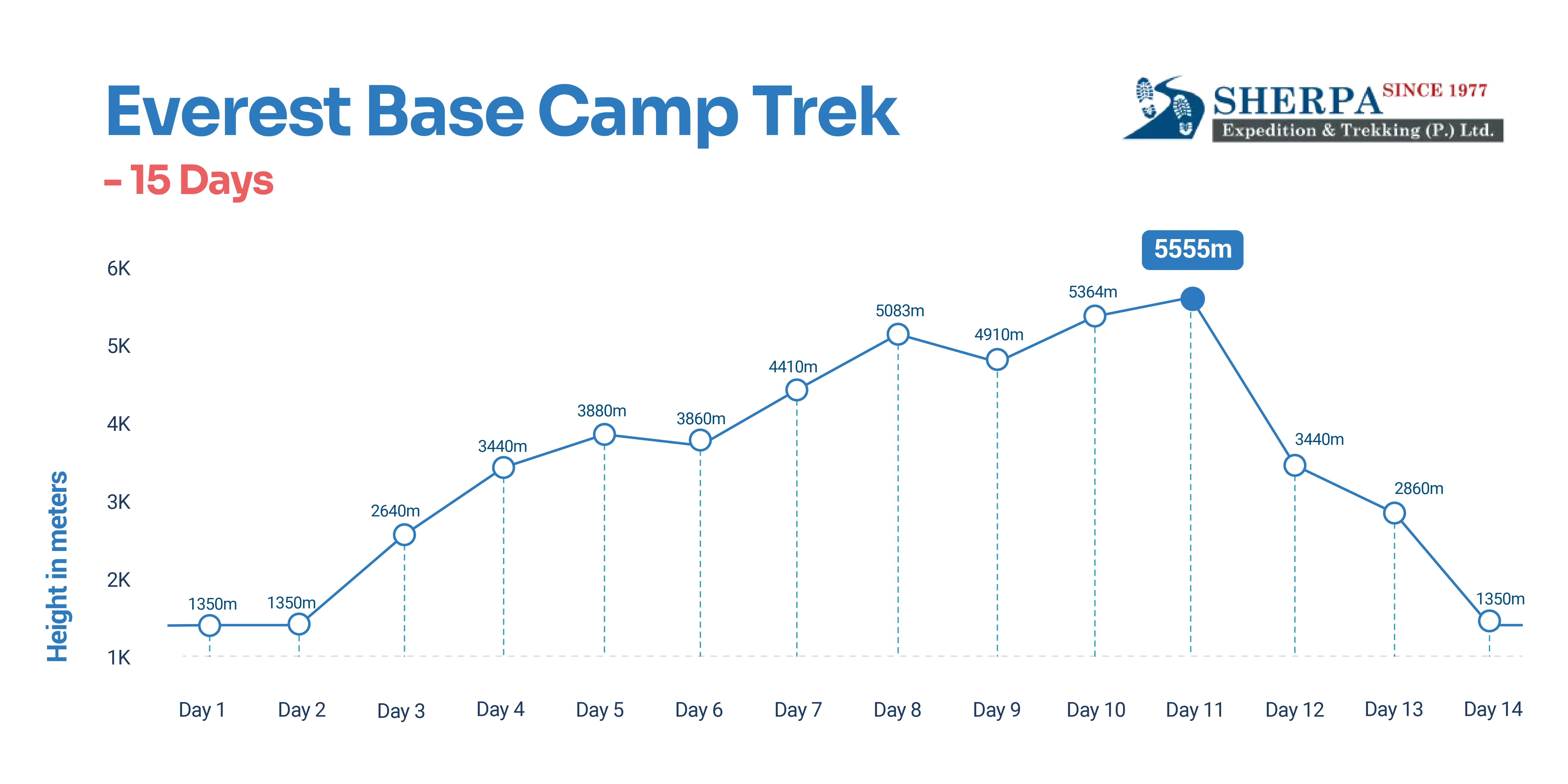
Everest Base Camp Trek Itinerary
You are going to be greeted by your Sherpa Expedition and Trekking representative on arrival at the Tribhuvan International Airport (Kathmandu). Afterward you can leave relax in your hotel of Thamel (approx 20-30 minute drive from airport). Once you’ve dropped your baggage, you may choose to relax in your room following your long flight from abroad or wander into the lively Thamel bazaar brimming with trekking equipment shops, cafes and souvenir shops.
Your lunch meal shall be at your hotel or a local restaurant. Later we'll hold a brief about your Everest Base Camp itinerary including current weather conditions, permit details, and safety measures. Our guide will provide you with a complete inventory of gear that should be carried for this Himalayan trek. Please proceed to purchase or hire further trekking gear as required before you head off on your expeditions. Finally, you can head out for dinner in Kathmandu. No trekking, ascending/descending activities today. This will give you enough time to freshen up prior to starting the actual trek tomorrow.
After the morning breakfast at the hotel, you begin a tour of Kathmandu Valley where several UNESCO cultural sites are located and other sightseeing stops before you are to trek. You begin this sightseeing tour with the Pashupatinath Temple – the most sacred Hindu temple in Nepal. After visiting this ancient place of worship, you move on towards Boudhanath Stupa which is considered as one of the biggest Buddhist stupa. Then continue to visit Kathmandu Durbar Square/Swayambhunath (Monkey Temple) whichever you prefer more, here you will get the opportunity to know about the history, architecture and custom of Nepal from our guide.
Once you complete all the sightseeing tours, have lunch at local Dhaba. As the afternoon progresses, your guide will be there to help you make the last trek (tours preparations) e.g. double-check your gear, permits and your flight tickets to Lukla. Also, you can take advantage to shop for a bit in Thamel. The city tour is basically only light-paced walking around these cultural sites. As there will not be much variation in elevation, the level of your exercise will be such that your body gets used to it.
Your day begins very early with a transfer to the domestic airport where you board a spectacular 30-35 minute flight to Lukla, known as one of earth's most stunning mountain airstrips. As soon as you are in the air you will get to admire the entire Himalayan range in front of you with the clear sight of the snow clad mountains. After this, you will get to land in the renowned Tenzing-Hillary Airport. After lunch with the porters in Lukla the walk begins. Heading north the path takes you to the Sherpa villages of Chheplung, Thado Koshi, and Ghat.
As the mountain trail closely hugs the Dudh Koshi River you will need to cross multiple suspension bridges beside which there are many places of prayer - mani stones, prayer wheels, and colorful prayer flags which you can stop to look at whenever you choose. Usually, lunch is prepared for you when you reach Ghat (approx. at 2-3 hours walking) a small hill-side village with teahouses. Then the path through forests and terraced farmland continues to take you to Phakding. Altogether during this day you will get an hour of ascending and about two hours of gradual descent.
Today, after an early breakfast in Phakding, we walk north following the Dudh Koshi River through lovely pinewoods and Sherpa villages. We go through Toktok, Benkar, Chumoa, Monjo and Jorsalle villages. Several suspension bridges with colourful prayer flags are crossed.
At Monjo, your guide will show the permit as we will enter in Sagarmatha National Park.
After lunch at Jorsalle, the last village before the steep ascent, we start the most challenging part of the day – an uphill hike to Namche Bazaar. This steep ascent which goes through dense forest will take 2-3 hours and you may have your first sighting of Mt Everest on a clear day. This day includes approx. 4 hours moderate walk and an hour of downhill, and many ups between the villages. As you arrive at the heart of Sherpa culture – the vibrant Namche Bazaar, unwind with some Sherpa tea, watching the glorious mountains.
After breakfast at your lodge in Namche Bazaar, you can start walking on an upward trail leading up towards the Everest View Hotel. You'll pass through some wonderful rhododendron forests and alpine trails en route taking approximately 2 hours.
During this time, you will get mesmerizing panoramic views of some of the greatest peaks of Himalayas, namely Mount Everest, Lhotse, Nuptse, Ama Dablam, and Thamserku etc. However, many groups continue for some more kilometres reaching out to the famed Khumjung village which houses one of the famous monasteries as well as the famous Hillary school set-up by Sir Edmund Hillary himself.
You'll have lunch in Namche Bazaar after descending down for approx. 1 and half -2 hours. In the afternoon, you may want to spend time exploring the interesting museum dedicated to the brave Sherpas of the region, walk around local cafes and bakeries or just browse around in various trekking shops selling all sorts of things relating to treks and tours. This day's walk would include about 2 hrs of hiking upwards followed by another 2 hrs for return journey allowing your body to acclimatise with the higher altitude and keeping you active prior to proceeding further in this amazing part of the Khumbu Region called the Sagarmatha Zone.
You will continue your walk on this day with great panoramic views of some of the tallest mountains in the world including Mount Everest, Lhotse, Nuptse, Ama Dablam and Thamserku. After having breakfast in Namche Bazaar, our trekking journey starts as we walk on the mountain side with amazing views. We walk gently and enjoy some scenic beauty, crossing the river first to go into the village of Kyangjuma which is famous amongst trekkers for its excellent quality tea. Most trekkers break their journey for tea at Kyangjuma then proceed to descend steeply towards the small riverside settlement called Phunki Tenga near the Dudh Koshi River. It takes us approximately 2 and half to 3 hrs to reach there for lunch.
Post-lunch, you have to cross a suspension bridge and then start climbing. We will be ascending for almost two hours to reach the famous Tengboche Monastery that houses the biggest and the most important Buddhist monastery of the area. Thus, today's walk comprises of approximately two hours' time in descending towards Phunki Tenga and three hours' in an ascent to reach Tengboche. Upon reaching, we'd be allowed to attend the monk's prayer and the rest of the night will be spent at the teahouse, with a view of the great Himalayas in front.
We'll have our early breakfast and descend down through peaceful rhododendron, pine and fir forest, towards the village of Debuche. We'll traverse through the Imja Khola on a suspension bridge and hike up to the Sherpa villages like Pangboche and Shomare.
We are rewarded along this section with some very spectacular views including that of Ama Dablam, Everest, Lhotse and Island Peak. We will have lunch here in Shomare, about half way through our day's trek, having walked for approximately 2 and half to 3 hours. From here we follow the trail into more open countryside towards Orsho which sits at an altitude of 4,190 meters and then pass across the bridge leading us into the picturesque village of Dingboche. If you'd prefer the route towards the right you reach a village in Pheriche. The trek continues through yak meadows and stone walls. At last we reach the charming village of Dingboche for spending the night in a teahouse.
Today's objective is to spend some time on our own in this area for acclimatization as we'll be going over 5,000 meters tomorrow during our trek. After an early breakfast, head out with us again for another short trek to Nangkartshang Peak.
We will walk towards this peak through a very steep track which goes directly behind the village of Dingboche. It should take us around 2-3 hrs to reach the top where we can enjoy the panorama view of Makalu, Ama Dablam, Lhotse, Island Peak, Imja Valley and many other glacial areas. We will also pass through some amazing alpine meadows along the way. After spending some quality time here enjoying the incredible landscape, you will have to make a slow return to Dingboche following the same track. So you must be prepared for that too. It might take around 1 and half to 2 hours total to get down.
Back in Dingboche you could eat lunch at your lodge and go up exploring more about the village itself if you want to know more. Our recommendation would always be to take it easy once you arrive back and do some relaxing. Today, you'll have around 3 hours of ascent and 2 hours of descent walking. Our suggested "Climb High, Sleep Low" strategy means we are acclimatizing well enough before heading onward to Lobuche.
Post breakfast, we will start our trail towards the northwest direction, heading towards Dughla (Thukla). Our initial stage will be an easy and pleasant trail passing through alpine regions offering amazing vistas of Taboche, Cholatse, and Ama Dablam.
Lunch will be served at the place itself, which takes approx. 2 and half - 3 hrs to reach. Next, we need to cross this little stream and move on upwards towards the steeper parts that climb towards Thukla Pass. This point from where we have our lunch should reach up in an hour or so. From Thukla Pass, we can see a great view of Nuptse, Pumori, and many other snowy mountains. At the summit of the pass we get to see a number of memorials for climbers/Sherpas lost on their expedition for Mt. Everest. So, post having tea, the whole team will start walking towards Lobuche Village. This will take us nearly another hour. We are going along the glacier till we get to the vicinity of Lobuche village.
Today's itinerary consists of around 5 hours' journey comprising almost no descent. Today, we stay overnight in a comfortable teahouse, making sure to rest up and be well-prepared for tomorrow's ultimate mission, i.e., the Base Camp Trek.
After having our breakfast on day ten, we set off from Lobuche to Gorak Shep by passing on the rocky lateral moraine of Khumbu Glacier and then headed towards the north.
The trek continues on higher ground, reaching the point known as the 'Italian Pyramid Research Station.' We will have beautiful views of Pumori, Nuptse, and other surrounding mountains here. During this time, there will be no difficulty in ascending to the highest peak, Gorak Shep, which can be completed within 2 to 3 hrs. Then take a rest for an hour's break for a delicious meal and drop all big-sized bags at the tea house of Gorak Shep. After that, in the afternoon, we proceed further in an eastward direction to explore Everest Base Camp, following a difficult path filled with loose rocks and glacial moraine behind the Khumbu Glacier. You may complete this stretch of trek within 2 - 3 hours only. Then celebrate this day by exploring the base camp of Everest, which has colorful tents of expeditions in the spring climbing season. Finally, backtrack your way to go back again to Gorak Shep in two hours, making this a tough day covering approx. 5-6 hours of ascent and 2 hours of descent.
Today we take on the sunrise hike towards Kala Patthar, which is located at an altitude of 5,550 meters from sea level. We'll also trek all the way down towards our destination for this day, Pangboche, which will be found at an altitude of 3,900 meters above sea level.
The entire trip should last us around 7-9 hours and consists of ascending for just around two hours, then descending back down towards the campsite again at a rate of one hour every hour that passes.
The first half of today's plan sees us start off early in the morning while having a light breakfast or hot drink while still up here at Gorak Shep. Afterward, we head out toward Kala Patthar, which provides a view into some pretty amazing mountains such as Mt. Everest itself along with other ones too, like Nuptse, Lhotse, etc. Then once there, spend enough time appreciating its beauty by sitting around chatting amongst ourselves before heading back down towards Gorak Shep for breakfast.
Lunch will be taken either at Thukla or Pheriche. From Gorak Shep we head downhill along the alpine meadows to our next destination - Pangboche. The route takes us by way of the beautiful village of Shomare where the scenery becomes more lush. During today's hike we cover an approximate of 2 hrs of ascension and 6-7hrs of descent. It may feel longer, because we are going down hills also you don't have to struggle to breathe today as we are losing elevation.
We continue our trek downwards towards Debuche as the day progresses. Crossing the Imja khola via suspension bridge and making a small hike upwards to revisit the beautiful Tengboche Monastery where we can truly appreciate the magnificent Himalayan scenery surrounding this ancient place of worship.
Afterwards we head steeply downwards through some densely packed forested areas until reaching yet another popular resting point amongst trekkers called Phunki Tenga which offers some wonderful views of the whole valley area. With an approximate walking time of around 2 and half - 3 hours most people will spend some quality time sitting down eating their lunch at the summit of this climb.
The rest of today’s hike continues on foot as we cross over the Dudh Koshi river and start ascending gradually towards Kyangjuma – a walk that will last us an estimated 1 and half to 2 hours. Here, however, things change slightly in terms of terrain. As we progress towards Namche Bazaar we’ll find ourselves walking on relatively flat ground which follows alongside the edge of the hillsides before ultimately reaching back into Namche itself. Today’s hike consists mainly from a gentle stroll amongst some stunning mountain scenery, taking approximately 2 hours of ascent followed by 3-4 hours descent.
Starting from the Namche Bazaar we start our journey towards the Hillary Suspension Bridge as we continue on our way down to the lower valley. On this descent journey we pass through areas such as Jorsalle and Monjo where we exit Sagarmatha National Park after going through some permits.
As we progress further along the way, we will have to walk through places like Benkar, Toktok and Phakding which are popular stops amongst many trekking groups who usually take their lunch here after covering approximately 3-4 hrs walking time.
Post-lunch we shall be crossing various suspension bridges across the Dudh Koshi River as well as crossing other regions like Ghat, Thado Koshi and Chheplung before finally climbing up a little bit for about an hour to Lukla which will also be our last ascent journey of this whole trek.
Overall you should expect approximately two hours' worth of ascent walks while spending four to five hour long descents. Once there at Lukla simply relax within these cozy confines of this lovely teahouse establishment where everyone comes together (guides, porters and fellow travelers) to celebrate having completed our mighty endeavor called the Everest Base Camp Trek. This particular night celebration dinner shall mark its end in true style.
You'll have breakfast in Lukla today and then walk for a short while to the Tenzing-Hillary Airport. If weather permitting, you can take an early morning flight that gives you incredible scenic views of snow-capped Himalayas, deep valleys and forested hills as we go down for 30-35 minutes to reach our starting point.
It's important to note here that during peak season (Spring/Fall), sometimes these flights make stops along the way such as in Ramechhap Airport due to high volumes of air traffic. So depending upon the seasons and airline's schedule your itinerary may change accordingly.
Upon reaching Kathmandu, our representative from Sherpa Expedition and Trekking will pick you up from the airport and drop you at your hotel. Normally, you will have lunch at one of the fine restaurants in Thamel and in the afternoon you can do shopping for souvenirs or visit those wonderful sites you didn't manage to visit before your trek. You will have no trekking/climbing/descending, so it is easier to adjust to city life again.
Once you've enjoyed breakfast back at your hotel in Kathmandu, you’ll get to spend some free time according to your international flight schedule. A representative from Sherpa Expedition and Trekking will collect you from your hotel and transport you to Tribhuvan International Airport.
We’ll generally try to pick up passengers 3 hours ahead of departure times as we want everyone to be able to go through all the necessary steps with their airlines including check-ins, immigration formalities and security procedures. As there’s no trekking or elevation gained today, it means that we can also give our group members time to walk along the interesting and vibrant streets of Kathmandu one last time while en route to the airport. So, sit back and enjoy a nice cup of tea or coffee while your driver gets you to the airport safely.
Once you fly out of Nepal you’ll definitely leave with amazing memories of your adventure into the breathtaking beauty of Khumbu region, local Sherpa culture, ancient monasteries, dramatic suspension bridges, and the incredibly unique experience of walking to the highest point of Earth (Everest Base Camp and Kala Patthar). This will certainly rank high among the top treks of the world.
EVEREST BASE CAMP TREK INCLUDES & EXCLUDES
The following services are included in your package.
- Pick up from airport and transportation via private Car/Jeep.
- Three nights of standard twin-sharing hotel accommodation in Kathmandu, including breakfast.
- Three meals per day including breakfast/lunch/dinner while on trekking only.
- Fresh fruit every evening after dinner
- Trekking Lodge (tea house) accommodation
- Permits to trek Park: Entry fee Permit for Sagarmatha National Park, Permit fee to Khumbu Pasang Lhamu Rural Municipality
- Lukla - Kathmandu - Lukla or (Ramechhap - Lukla - Ramechhap) flight + private transfer in Kathmandu + domestic airport tax park
- Entry Permit fee for Sagarmatha National Park and Khumbu Pasang Lhamu Rural Municipality.
- One well trained, experienced, friendly, honest and English speaking government licensed guide. Salary, food, drinks, accommodation, transport and insurance included
- Strong, capable and trustworthy sherpa porters with proper safety and walking gear along with salary, food, accommodations, insurance etc. One porter will be provided to look after you and other traveler.
- We also provide comprehensive medical supplies on hand with a First-Aid Kit accessible throughout the trek.
- We will arrange emergency helicopter services as per your need (Paid by your travel insurance company).
- SEAT: Please bring with you a sleeping bag, down jacket, duffle bag, walking poles (you may rent them if you don’t have any). Please return them once the tour is over.
- Sherpa Expedition and Trekking T shirt
- Government taxes and official expenses
- Guided Kathmandu Sightseeing Tour With Private Car Or Jeep
- Trip achievement certificate after successful trip completion
- Oxygen meter that checks pulse, oxygen saturation and heart rate twice daily – great way to monitor altitude sickness symptoms and ensure you are healthy on your trek.
- Assistant Guide provided if group is 8+ people.
Costs Excluded
- Meals in Kathmandu (lunch and dinner).
- Entry visa Nepal - which is easy to get a visa on arrival at the Tribhuvan International Airport, Kathmandu. USD 30 for 15-day visa / USD 50 for 30-day visa / USD 125 for 90-day visa are the fees you must pay.
- Personal travel and medical insurance.
- International airfare.
- Personal expenses.
- All alcoholic/non-alcoholic drinks, soups, tea, coffee, hot chocolate and cocoa, mineral water, and all extra food/cold/hot drinks purchased on the way while trekking (either at trekkers'/tea houses during evenings). All desserts/sweets including chocolates, cake, pie, and pudding.
- Hot showers and battery charging at tea houses.
- Tips for the guide/porter/driver – tips will be paid as expectation.
- Sightseeing monuments entrance fees (Kathmandu)—$30/person.
- Excess baggage over 15 kg for the Lukla flight.
If you return before completing the trek program because of sickness or other problems, all payments for flights, hotels, mountain rooms, and food are non-refundable. You will also have to pay all additional hotel and food expenses in Kathmandu yourself.
EVEREST BASE CAMP TREK Departures
Every departure listed below is 100% Guaranteed — once you book, your trip will run as scheduled regardless of group size.
Select a departure month
Fill out the form below and a Travel Expert will reach out to create your perfect tour.
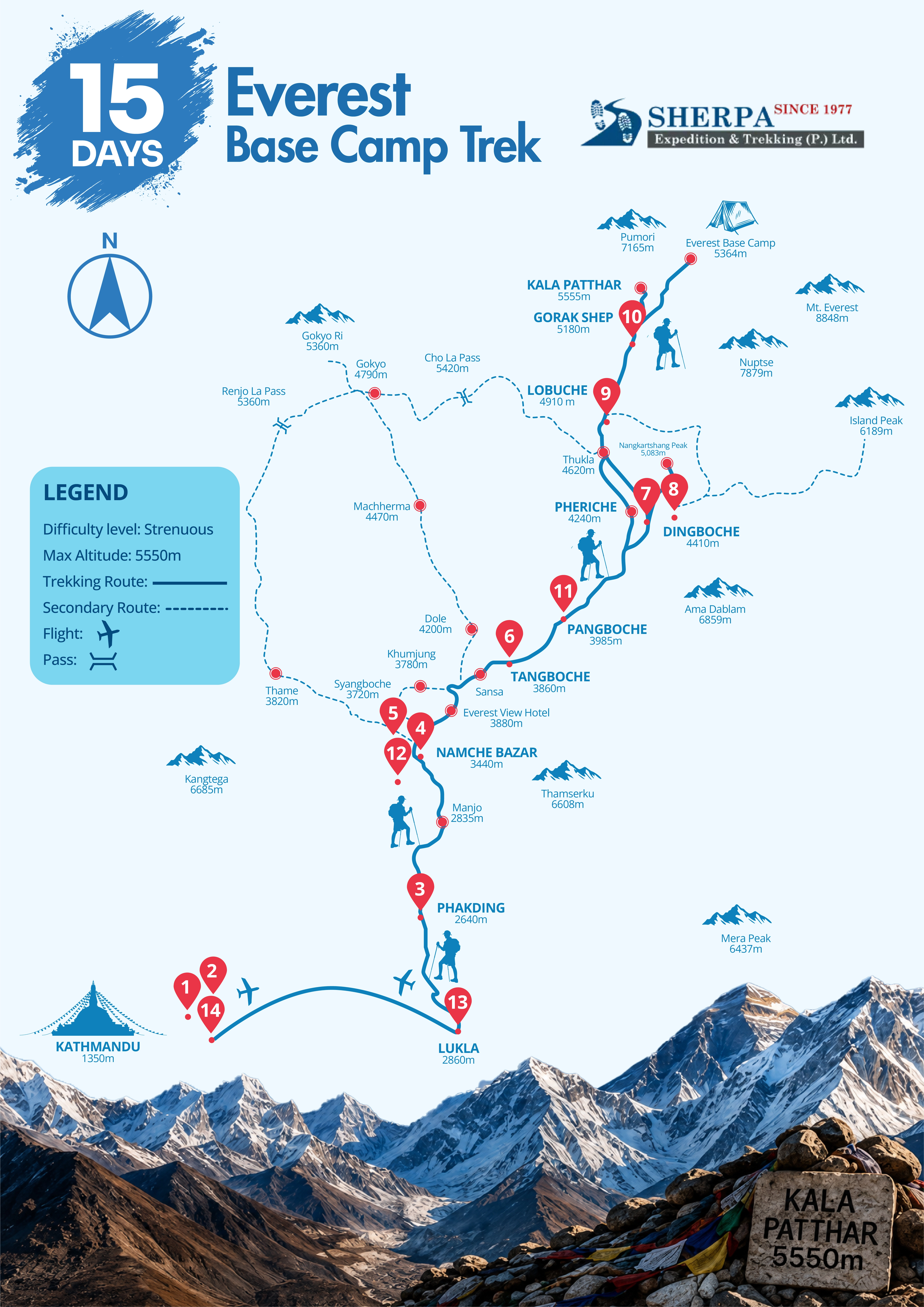
Everest Base Camp Trek Route Map
EVEREST BASE CAMP TREK PACKING LIST
The list of gear that you would be required to carry on the trek is outlined below. Make sure you carry with you essential gear as your comfort and security depends on this, yet it is equally important to shed all the equipment which you will not use in the trekking.
General
- Season Sleeping Bag and Down Jacket – We will give you if needed but has to return after your trek.
- Duffle Bag – Sherpa Expedition and Trekking will provide Duffle Bag during your Trek, however this also needs to be returned after completing your Trek.
- Wind and Water Proof Thin Layered Jacket – Must-Have item as morning and evening temperatures are below 3,000m.
- Daypack.
Head, Ears, and Eyewear
- A Warm Hat / Beanie – You’ll need a hat that covers the ears made of soft wool/fleece to protect you from the elements.
- Sunglasses – Choose sunglasses with UV protection category 3 or 4 to protect your eyes from the harsh sunlight and glare off the snow at higher altitudes.
- Neck Warmer / Buff – To keep your neck and face warm and protected from the wind, dust and cold we recommend using a buff.
- Sunscreen (SPF 35–60) – Due to the higher altitudes and intensity of sunrays during winter months it’s important to use a good suncream to block out the rays.
- A headlamp and an extra set of batteries.
- Lip balm with SPF.
Hands
- Walkers may wish to bring along a pair of half gloves for use with their walking poles.
- Warmer shell gloves and liner
Upper Body
- Long sleeved t-shirts
- Thermal tops
- Wool jacket or pullover
- Sports bras for women and girls
- Water and windproof shell jacket
Lower Body
- Thermal Underwear (especially trousers) – Insulating base-layer bottoms for retaining body heat and staying warm when out there during cold mornings, evenings or even high altitude trekking.
- Windproof and waterproof trousers - Light-weight outer-layer trekking pants for protection from winds, rains and snows keeping you dry and comfy through changing mountainous weather conditions.
- Warmer trousers
- Comfortable trekking pants
- Extra casual sports pants
Footwear
- A pair of good waterproof trekking boots
- Pair of sandals.
- 4 to 5 pairs of woolen socks
- Sock liners.
- Light shoes and sneakers
First Aid Kits and Medicines
- Assorted adhesive bandages (fabric preferred)
- Blister treatment cream or similar
- Insect and anti itch ointment
- Ibuprofen or other pain relief medication
- Diamox 125-250mg tablets – a medicine commonly used to help prevent or reduce the symptoms of Acute Mountain Sickness (AMS), but please consult with your physician before taking this pill at the suggested dosing rate.
- Wraps and splints - take some elastic bandage, lightweight splints, butterfly bandages, sterile gauze or adhesive dressing to treat sprains, cuts, blisters or any other minor injury during a trek.
- Water purifying pills
Our Company Guide carries medicines and first aid kits along with them for trekking. However, it’s always good if you take your own First Aid Kit with yourself on the Trek.
Miscellaneous, But Must Be Useful on the Trek
- 4 passport size photos with the original passport
- Water bottle and filter
- Flight details – please make a copy and leave one for us at our office in Kathmandu if you wish to change your flight date.
- Toilet paper + Plastic Bags + Hand wipes / Towel / Soap (bathroom kit)
Extra Things
- Comfortable trekking poles
- Quality energy dry foods (up to you)
- Power bank and music player
Bring a camera – It would also help to carry a good camera with enough memory cards, chargers, and spare batteries since colder temperatures cause fast draining of your battery life and there might not be much charging facility along the trails, or you will have to pay extra to charge your phones.
Documents and Money
- Passport with valid Nepal visa
- Travel and medical insurance papers
- Extra passport photos for permits
- Bring along cash as there aren’t many ATMs around to take care of your monetary needs on the trail. Make sure you bring all of it in Nepali Rupees
Toiletries and Personal Care
- Tooth brush and tooth paste: Carrying a travel size of brush and toothpaste will ensure that you maintain your daily oral hygiene throughout your trek.
- Light weight one is always convenient to pack for mountain lodges.
- Quick dry towel
- Hand sanitizer
- Wet wipes
- Nail clipper
Gallery


Everest Base Camp Trek Cost (All Hidden Cost)
- Solo trekking costs more per person than group trekking and can save the share of guides, porters and transport costs.
- There are standard charges of the flights to Lukla where these will fly via Manthali Ramechhap Airport in peak season.
- TIMS permit and National park fees are one of the additional required expenses.
- The cost of guides and porters depends upon the size of group and duration of the trek and included services.
Everest Base Camp trek all costs are deeply explained below:
Solo vs Group Cost
We have seen that solo trekkers usually pay high fees per person because they don't share costs with other people such as guides, porters, transports and permits. But group trek will be less costly to each member than solo trek when there is a group of 4+ trekkers.
Flights to Lukla Cost
During these busy times of year (spring and autumn), flights are sometimes diverted via Manthali Ramechhap Airport with additional travel times/costs for road transfers. Prices do fluctuate depending on current season/weather/demand etc – always book well ahead for best price and guaranteed seat.
TIMS Card and Charges
Everest Base Camp trekkers must carry an agency-issued TIMS card. This is because it records the trek for security and to be on the safer side. Currently, the NTB records the fee of NPR 1000 for trekking SAARC nationals and NPR 2000 for foreign nationals other than SAARC countries trekking in the regions.
Everest Base Camp Trek Permit Costs
The entry fee to the national park is collected because the path leads through a protected area, and permits are checked at the checkpoints in the path. According to the NTB, the fee of NPR 1,500 is levied to SAARC nationals, and NPR 3,000 is levied to foreign nationals other than SAARC countries, whereas the entry is free for children above 10 years of age.
You are required to possess National Park (NP) Entry Permit which will be verified at the national park checkpoint. Additionally, you will acquire Khumbu Pasang Lhamu Permit in Lukla. You should bring a valid passport with you prior to the starting of the trip. Most standard packages include this fee, but better check this first with your operator.
Nepal Visa Cost
Most foreign nationals can obtain a tourist visa for Nepal either before they travel via a Nepalese diplomatic mission or when arriving at one of several international entry point designations (including Tribhuvan International Airport).
Visa eligibility, fees, entry requirements, and payment methods can vary over time; therefore, visitors should check with Nepal’s official Department of Immigration on their official site for the most updated information to plan their trip accordingly. On this page, visitors will be able to find all up-to-date information regarding visa fees, applying for your visa online, how to get a visa-on-arrival in Nepal, what documents are needed for obtaining a visa, and other latest immigration notices from Nepal’s immigration department. Always make sure you confirm these details prior to departure.
Porter and Guide Cost
The cost of a porter and guide depends upon trip length, group size and whether you have meals / accommodation / insurance, etc. Also, please note that tips for porters and guides will be paid apart from their salary, which forms an expected earning to them from every trek they participate in.
Food and Water Cost
The cost of food and drinks increases as you reach high altitudes because everything has to be brought up there either by porters or mules. Basic foods like Dal Bhat, noodles, soup, etc., are quite affordable if you go lower down the mountains. However, as you approach the Base Camp, the price of all kinds of items rises rapidly. Also, the cost of drinking (bottled / purified) water also rises as you reach high altitudes.
Accommodation and Teahouse Costs
Everest Base Camp route provides lodge and teahouse accommodation right from Lukla till Gorak Shep. Rooms at high altitudes will be simple twin sharing rooms, whereas luxury lodges with attached bathrooms are mostly available till below Namche.
The food choice also remains good on the entire trail. Also, hot shower availability increases as you go up, but its charging and Wi-Fi costs increase too, which are charged separately from most of the teahouses.
Travel Insurance Cost
The exact cost of travel insurance is dependent upon provider and level of coverage but should specifically cover high altitude trekking and have a provision for emergency helicopter evacuation to an altitude of 6,000m as a minimum, as otherwise, medical rescue from the remote Himalayas can be incredibly costly.
Alternative Trekking Routes in the Everest Region
Everest trekking routes offer alternative difficulty and scenery profiles. We can travel from normal route base camp trek, remote adventurous trips in high mountains to lakes of turquoise colours and high passes in jagged peaks.
Gokyo Lakes
On this trek, we journey over beautiful turquoise glacial lakes, with great views of Everest, Cho Oyu and the tremendous Ngozumpa Glacier, Nepal's largest, from Gokyo Ri.
Everest Three Passes Trek
For trekkers looking to test the limits, this trek circles all the most scenic regions in Khumbu and, passing through secluded valleys and up over the passes of Kongma La, Cho La and Renjo La, explores the Everest Base Camp trek along with the Gokyo Lakes.
Cho La Pass Trek
To truly enjoy an Everest trip, on a trek which is equal to a good challenge that any trekking enthusiast is hoping to encounter on their adventure to Everest, we head through the icy 5,420 metre pass that divides the Gokyo Valley from the route to Everest Base Camp.
Nepal Everest Base Camp vs Tibet Everest Base Camp
We reach Nepal's South Base Camp (5,364m) after walking through Khumbu region's small tea houses and Sherpa villages. In contrast, climbing to the North Base Camp that is located high on the Tibetan side, can be done via vehicles on the broad Tibetan plateau, which allows for a less strenuous travel with shorter trekking duration and minimal cultural exposure.
Best Time to Trek Everest Base Camp Trail
Everest Base Camp Trek has preferred seasons spring and autumn respectively. Because during this season, there will be the best weather conditions, good visibility of mountains, and safe condition of trails. In spring you will see blooming flowers called the rhododendron flower on the trail conditions during the autumn season there will be dry and crisp air.
So we are going to give a detailed overview of every month below:
Everest Base Camp Trek in May
The month of May represents the end of Late Spring where things are beginning to get warmer, and there’s melted snow from winter, but rhododendron on the lower trails begin to bloom. Crowd levels are moderate due to the winding down period of this year.
In terms of weather, pre-monsoon weather will give you cloudy afternoons occasionally and rising humidity but morning clear skies for mountain view.
Everest Base Camp Trek in December
During this period you may experience cold weather. Some area in Nepal could have temperature below zero especially near the base camps for higher elevation. You may luckily be able to find a lot of other hiking persons on your trekking trail because of very cool climate here. Moreover, you need more preparation in December compared to other months, as you'll have to carry heavy equipment and warm layer clothing along your way. Also, keep ready yourself to deal with icy paths, and layers might notice short duration of sunlight.
Everest Base Camp Trek in September
September means early autumn now with the post monsoon rains settling and the visibility gradually clearing over the region. The trails are still a bit muddy in early September but dry up within days so the skies are clearer with excellent mountain views.
Everest Base Camp Trek Altitude and Risk
Once you arrive at the Everest Base Camp, your altitude will rise up to 5,364m and when visiting Kala Patthar, this goes up to an even higher level of 5,550m.From around 3000m altitudes onwards, trekkers are entering into a low-oxygen environment where there’s an obvious decrease in ambient (and therefore also partial) oxygen pressures with height.
At Base Camp, you only receive around half of the percentage of oxygen available at sea level, thus posing an even greater risk of altitude sickness for unacclimatized visitors.
Altitude Sickness and Acclimatization
AMS stands for Acute Mountain Sickness that refers to negative responses of your body to reduced level of oxygen at higher altitude.
AMS usually happens due to the rapid ascent of trekkers higher up, without giving enough time for their bodies to adjust. This can lead to mild to severe symptoms, which you should keep an eye on during your expedition journey and take some rest days as per your plan.
Acute Mountain Sickness Symptoms
A rapid increase of altitude might lead to acute mountain sickness with the occurrence of headache, nausea, fatigue, and dizziness, among other symptoms for those affected. These symptoms are usually experienced at altitudes higher than 3,000 m, and their presence calls for immediate suspension of further ascension activities or immediate descent down to a safer lower altitude in case of progressive worsening of signs and symptoms.
Types of Altitude Sickness
First, it’s important to understand that altitude sickness is broken down into three different categories that you may come across on your trekking tour.AMS Acute Mountain sickness this is the least severe type, however you are going to quite common on this. Then we have the two conditions that can be life-threatening:
- HACE – High Altitude Cerebral Edema refers to an increase in fluid within your brain caused by the lower pressure found at high altitudes.
- HAPE – High Altitude Pulmonary Edema – is when your lungs fill up with liquid, making you unable to breathe normally even while resting. Both of these conditions require an immediate descent.
Acclimatization Strategy
Overcome your fears about altitude sickness as our highly experienced guide helps you apply some really good methods for combating the symptoms, like climbing high and sleeping low.
Planned high-altitude days with opportunities to spend time in areas with higher elevation such as Namche Bazaar and Dingboche, along with a recommended moderate pace for walks allow you to see all of the beautiful sights without succumbing to them
Pre-existing Health Conditions
Note, High Altitude trekking may make your condition worse for any pre-existing heart/lung problems. The CDC advise that you seek personalized medical advice from a clinician you use who understands high-altitude trekking.
Sherpa Expedition and Trekking ensures that you will get the necessary guidance on how best to adjust your walking pace as well as monitoring of oxygen levels during each day's walk. We will also coordinate for the evacuation should an emergency arise.
Prevention Checklist
- Drink an amount of water over the entire day.
- Take your time with going up to avoid becoming too tired.
- Always bring along recommended meds such as Diamox upon consulting a doctor.
- Daily monitoring of oxygen level and symptoms with a pulse oximeter.
Everest Base Camp Trek Difficulty
Walking in high altitude, you would be carrying all your gear on your shoulders for long hours, thus to enjoy Everest Base Camp Trek the Everest High Camps are always needed by you, to stay safe during your trip with a healthy body you need to maintain good leg strength with cardiovascular fitness. For new trekkers, you need a plan in action a few months before you fly in to help get you physically and mentally ready for the trek.
Is Everest Base Camp Trek Suitable for Beginners?
Well, yes! You can definitely complete the trek of Everest Base Camp as a beginner if you have proper preparations. But, also remember that no technical climbing skill is required here, but good fitness level along with mental determination, and gradual acclimatization are necessary to get a safe enjoyable experience of first time high altitude trekking journey.
Fitness and Preparation for Everest Base Camp Trek
Everest Base Camp Trek needs cardiovascular and leg strength which one can gain by normal exercise like running, hiking, swimming, stair climbing and cycling, etc. Especially for the beginners training of few months should be carried out with increase in intensity of training so that one is able to walk longer duration of days at the highest altitude.
How Does Sherpa Culture Shape Life in the Everest Region?
The Everest Base Camp route will enable trekkers to experience beautiful landscapes as well as learn about Sherpa communities alongside the rich Bodhisattva culture that is found spread throughout the Khumbu area.
The Sherpa people are regarded as the original inhabitants of such a very high altitude of the Himalayas where they have been recognized worldwide for being amazing mountaineers along with their famous hospitality. Monasteries, chortens, mani walls and prayer flags make up the core center of every village. They carry profound spiritual meanings among the locals. The bold masked performers and puja style rituals form the main attraction of the Mani Rimdu Festival.
On a daily basis, the religious practices incorporate Buddhist beliefs among the people's activities. Please remember to respect walking clockwise around religious buildings, ask for permission before taking photographs inside the monasteries, stay quiet near the prayer areas. Such small gestures will definitely please the people who live within these mountainous holiest villages.
How Many Sherpa Villages Are There During EBC Trek?
The country consists of many sherpa villages namely Namche Bazaar, Tengboche, Pangboche, Dingboche, Lukla etc.
Detailed list of sherpa village in EBC trek are here:
Lukla
The gate leading to the Everest Zone is called Lukla (2,860 m). Coming all the way from Kathmandu, this would be your last 20 minutes. This tiny little village with its people of Sherpa ethnicity is actually an official start point for trekking. You'll find everything here like, luxury to budget hostels, high end to budget restaurants and even the airport (Tenzing Hillary).
Phakding
Peaceful village situated at the side of a river. Located along Dudh Koshi, Phakding is one of the trekkers’ first places of overnight stays after Lukla. Walking along with pine forests and going across some suspension bridges is quite common here. And this will give us the initial experience about the Sherpa way, as after that our journey will start heading upwards towards Namche Bazaar.
Monjo
Monjo lies right at the entry point of Sagarmatha National Park. All trekkers are required to get checked up here before starting their journey inside the national park. And also all trekkers need to show their permits. It’s a small hamlet but holds a very good view for all trekkers. The minute we set our foot into the village, we are surrounded by the dense green forest in which the rhododendrons spread like a sheet over, along with the wild chirps and cries of the Dudh Kosi River during our trek.
Jorsalle
A small village on the route before you start the steep climb towards Namche Bazaar. Often trekkers take lunch break at Jorsalle due to beautiful view of rivers.
Namche Bazaar
Biggest and the most active village in Khumbu, often known as ‘The Capital of Sherpas’. There are several bakeries, shops, and lodges situated right into the hillsides.
Khumjung
A traditional village of the Sherpa people near to Namche Bazaar, and there is one historic monastery and a well known school run with the help of Sir Edmund Hillary. It is a good place if you want peace rather than going to the busy Namche.
Khunde
Close to the village of Khumjung, and it’s famous for having set up a hospital under the Hillary Foundation. It will give a nice idea about the healthcare system in such communities. Also has some great views.
Tengboche
Home to the most famous monastery in the area, and it's a really special place where trekkers can experience many different things including monk chanting and prayer ceremonies because it’s their spiritual center. You can spend the night here too if you wish.
Deboche
This little village is right below the Tengboche Monastery. You’ll find a few more homes down here, but it still feels very much part of nature surrounded by forests and all types of wild animals roaming around freely. If you don’t feel comfortable staying overnight in Tengboche, then Deboche could be another option.
Pangboche
The oldest sherpa village in the Khumbu, Pangboche hosts an ancient monastery which houses sacred relics. The trail descends into fields, passing the distinctive walls and a feeling for the ancient buddhist culture of this region sinks in as trekkers continue down the trails.
Dingboche
The trekkers days in Dingboche are at the altitude to try to help their bodies get used to the thinner air that there are. Dingboche is very useful to trekking and acclimatization and views of the most awesome mountain ranges, also set up for its trekkers to enjoy an extra trek day before they continue to get to higher altitudes with another trek up one of the near peaks such as the Nangkartshang peak.
Chhukung
The name Chhukung means ‘village’ and this is indeed one of the smallest villages on the trekking trails to Island Peak (Everest region) or Chhukung Ri. It’s also surrounded by some really beautiful mountains like Lhotse and Ama Dablam. While the other way round we can say that there are very few places around Chhukung where you can enjoy such a unique scenery. Chhukung could be considered as the best place if you want more of an extra high altitude adventure while going via the basecamp.
Natural and Cultural Significance of the Everest Base Camp Trek
Everest Base Camp Trek traverses a UNESCO-listed mountain landscape. There you find glaciers, a network of valleys, and the diversity of the Himalayan animals within Sagarmatha National Park. The natural beauty of the place is equally captivating , but the route is also deeply rooted in the Sherpa cultural aspect as the way goes through monasteries, prayer flags, and mani walls which represent and reflect Buddhist tradition since centuries. This trip is not only about natural beauty but equally of culture making every step worthwhile and satisfying.
Things to Know Before Booking
Winter and Monsoon Conditions
Seasonal weather changes trail conditions and trek logistics. And this happens throughout the year. This can have implications for your comfort as well as safety while on the trail. While many experienced trekkers enjoy the solitude of less crowded winter trails, they also know that there are some potential trade-offs involved when it comes to snowfall, extreme cold, monsoon cloud cover, and potential disruptions to transportation. It’s important to be aware of these factors before booking a trek.
Food and Drinking Water
Teahouses provide meals and drinking water options. Meals includes variety of meal options (dal bhat, noodles, soups, etc.) and also provide drinking water. Please do advise at the time of booking if any of your dietary requirements (such as vegetarian or gluten free) cannot be met - in many cases we can make suitable adjustments. We advise taking water purification tablets or filters throughout your trek, and to drink plenty of water with your own refillable water bottle.
Licensed Trekking Guide Requirement
Everest Base Camp Trek requires a licensed guide under revised TIMS provisions. This means that solo unguided trekking won’t be allowed from now on in this region. The licensed agencies will also provide a guide to handle all the things during the trip like navigation, safety, permits etc. So make sure to check if your agency has a valid license as well as the guide’s credentials before you book out any trek.
Age and Fitness Requirement
No one has an exact age limit for doing Everest Base Camp trek. But you must have enough fitness levels. For kids, it’s best to see if they are at least 10 to 12 years old. Older trekkers must check with their doctors before taking on such a hike, just to make sure they’re up to this task of walking at high altitudes.
Lukla Flight Delays and Cancellations
Mountain weather can disrupt Lukla flight schedules. All because of heavy mist in the morning and unexpected clouds in the mountains of Lukla. However, our operators will always help you arrange your next available flight with an option of transferring from there to Kathmandu using helicopters, which might take some time but is a good alternative solution. We also have another choice called “Manthali Ramechhap Airport,” which is close to Lukla, and we use this airport route instead if the previous one is blocked due to bad weather.
Travel Insurance and Emergency Evacuation
High altitude trekking insurance should cover emergency treatment and helicopter evacuation (up to minimum of 6000 meters). In case you experience signs and symptoms of confusion, breathlessness, worsening of AMS – then, the best way for evacuation from high altitudes would be by helicopter airlift, immediate descents with supplemental oxygen/Gamow bags. So before booking a travel insurance policy make sure that your coverage includes all these things – covering max height, trekking activities, hospitalization, trip disruption etc.
Responsible Trekking and Conservation
Responsible trekker minimizes waste and environmental pressure. Make an effort to do small but impactful things while you trek. This means carry your own water bottle and water filters. No more disposable plastics and always choose locally run lodges to help local people economically. Stay on the trail. For your safety and wildlife's sake.
Porter Welfare and Ethical Trekking Standards
- Pay fair porter wages – We ensure our porters have fair and transparent salaries as we follow the ethics of trekking.
- Porter Load Limits: We make sure the weight that each porter has to carry on his back is limited up to an international standard.
- Porter Clothing and Equipment: We provide proper jackets, boots and gears as they have to face extremely cold weather at high altitudes.
- Porter Insurance and Medical Care: We ensure that all of our porters are covered under insurance providing them easy access to medical care whenever they need it.
- Porter Meal and Lodging: We take great measures to make sure that every porter receives the right amount of food at every meal as well as having adequate lodgings for their stay throughout the entirety of the trek.
Internet, Charging and Communication
Wifi and charging are generally available at most tea house but charge more when you go on higher altitudes. You could also get local sim card with some data package. Signal may be weak while approaching remote and high altitude section of the trek.
Cash and ATM Availability
ATMs work reliably only in Kathmandu and Namche Bazaar (in some places), so you need to bring sufficient amount of Nepali rupees for food, drink, charging, wifi and hot shower along your journey. Trekkers can also use ATMs on the higher section if they want but sometimes ATMs stop working. So better take lots of money with them.
Booking and Cancellation Policy
Most bookings require payment of a deposit at the time of booking to guarantee a spot on our treks. There will be a requirement to pay for the rest of the trek amount prior to their departure. Policies regarding cancellations vary based on the length of notice given.
What Happens If You Cannot Complete the Trek?
In case you get sick/injured while undertaking this trek we shall arrange a safe descent from here (in some cases emergency evacuation may also be necessary). Please note that all costs related to your flights/hotels/trek days etc. already incurred shall be deemed non-refundable hence getting proper travel insurance which includes trip cancellation coverage would be ideal before one departs for his/her trek.
RELATED PACKAGES



FAQS Related to EVEREST BASE CAMP TREK
General Information
Come on a walking trip in Nepal's mountains with us where we will get very near to the highest mountain of our world, Mount Everest! We shall walk around forest, village and high trail for approx 2weeks with cozy tea house accommodation at every single night.
The base camp for Mt. Everest is called as "Everest Base Camp" and it is in Nepal, at Khumbu region, in "Sagarmatha National park." It is very much at the base of the Mountain Everest; and it's surrounding by large mountains, glaciers, and rocky slopes that go up to the peak.
South Base Camp (in Nepal) can only be reached by walking. North Base Camp (in Tibet) can mostly only be reached by vehicle. Most trekkers go to the Nepal side as there's more on offer – nice walks, cool sherpa villages, etc.
This is simply a trek you do on marked trails using your legs and some basic gear. There's no need for ropes, ice axes or climbing skill – just lots of fitness and determination. This journey will suit anyone who wants to go safely!
Actually, they are totally different! Trekking to base camp means that you walk on trails to get close to the mountain, while climbing everest means that you use ropes and have technical skill plus oxygen to climb to the actual top of the mountain, which is much more dangerous than trekking.
It's famous for taking you right next to the world's tallest mountain. You will have chance to explore truly stunning sites like scenic sherpa settlements, historic monasteries and magnificent glaciers, which is considered one of the most exhilarating journeys you can experience.
Everest Base Camp Trekking is undoubtedly a trip in one of the world's best and the most fascinating sites on Earth with reaching altitude up to 5,364m/17,598ft which would be tough for few people. Majority of trekker usually consider visiting the Kala Patthar, the nearby view point above base camp that stands at 5,550mm/18,192ft.
Most of the trekkers climb up to 5,550m meters that's why the highest altitude one might reaches is Kala Patthar which provides the stunning view of Mount Everest, stunning sunrise, therefore this is the best location to take memorable pictures and save.
Well, no. at base camp you cannot get a clear picture of Mount Everest's peak because other mountains block your view of this mountain. So that's why people go to Kala Patthar for getting a better picture of the mountain.
Definitely worth it! You will be amazed with stunning mountain views + warmth from Sherpa hospitality and also get a huge sense of achievement. It might be a bit challenging trek for many people but once you complete this trek most trekkers say that this will be one of best memories of life.
Food and Accommodation
Trekkers stay at tea houses. These small, family-run guesthouses are found at intervals along the trail. Rooms at the lower villages are usually of a better standard and are more comfortably equipped, whereas at the higher villages rooms tend to be smaller and more basic with basic furnishing.
A himalayan tea house, also known as a village house or trekking lodge, is a small family-run establishment found on mountain trekking routes. It offers basic lodgings (a bed and blankets) and food for trekkers. Most also have a cosy dining area for visitors to congregate in.
Yes, virtually all tea houses have twin-sharing private rooms, though at very high altitude and during busy periods this facility might not be available at all lodges – it's wise to confirm this through your trekking agency in advance.
Typically not – at most tea houses, you can expect to use shared facilities down the corridor ( particularly at higher elevations ); only some tea houses in lower settlements such as Namche Bazaar offer private, en-suite accommodation at a higher cost.
Yes, definitely at lower village areas like Namche Bazaar and Phakding. The prices of these luxury lodges will reflect more cozy beds, private bathrooms and more varieties of food, as with going higher on the trek you may only find more basic facilities.
Yes, most of the tea houses on the Everest Base Camp trail do have hot showers with an additional fee. However, as you ascend higher up in the region you will only find these more expensive and less dependable due to more effort in providing heated water.
Yes, in most cases you will be able to charge your mobile and cameras in the tea houses with an additional charge. It is always a good idea to carry along your power bank as with going up the trail charging costs higher.
Yes, most tea houses have Wi-Fi access with some additional charges. The Wi-Fi connection may get a little unreliable and slower as you get higher on the Everest Base Camp trek, thus, we do not guarantee swift internet service on the whole trip.
Yes, most of the trail has mobile reception, but it's a little patchier the higher you go. Purchasing a local Nepali SIM card with data is a popular and inexpensive option for staying in touch throughout your trek.
You'll find a limited but filling range of meals available at most tea houses including dal bhat, noodles, soup, pasta and fried rice. Typical breakfast options such as eggs, porridge and pancakes can also be ordered.
Yes, vegetarian options are readily available and easy to find across most teahouses. Vegetarian and vegan dishes can also be found, but there is far less choice available at the higher elevations, so it's wise to discuss your dietary requirements with your guide in advance.
You should avoid meat at higher elevations as it has to be carried for many days without refrigeration. It is safer and best practice to eat vegetarian at these high altitudes to prevent gastrointestinal upset.
The water from tap and teahouses should never be drunk untreated. It is important to always filter water or take water purification tablets or boil water purchased from teahouses.
Yes, absolutely. Using a water filter and water purification tablets makes all water accessible on the trail drinkable and this also drastically cuts down on plastic waste which makes our trekking itinerary far more environmentally friendly.
Difficulty & Fitness
Its moderate difficulty, not too difficult. You are on foot, walking many hours a day at high elevation on rugged trails. No climbing skills required, but requires steady fitness and patience.
Yes, a beginner can do it really, with a solid background. Although experience in trekking is not mandatory, becoming physically fit before the trek and taking a guide who takes her time makes it so easy and safer for a first timer.
Not at all it requires no climbing skills. It's just a matter of taking two steps and walking on those marked trails. Top tips include the use of trekking poles and good boots, but no ropes or technical apparatus are needed here.
You must have good fitness – enough to walk for 5 to 7 hours a day for several days in a row. It takes great leg strength and stamina. Practicing walking or hiking before or for 30 minutes or engage in a cardio session, will make the path smoother.
First, they should begin with walking, repeating the steps on hills and do some cardio ( running on hills, bicycling, walking on hills, etc.) Gradually develop a leg strong enough and stout enough over many months for the longer walking times of summer.
Regular training around 2-3 months is recommended. This will help prepare your body for the strength and endurance you will need on the long days that you'll be walking at the higher altitude on the trek.
Good exercises to include are walking, cycling, jogging, swimming and climbing stairs. They strengthen heart and lungs; bettering the skiing and walking ability on the thinner air during the actual march.
Distance
This is usually a 12-14 day hike. This includes walking days, days off for acclimatization and buffer for possible flight delays when flying in and out of Lukla.
Most people can walk this in approximately 14 days. This will include getting on and off flights in Lukla, walking to and from the days and days off in Namche Bazar and Dingboche which will help you get in touch with the height.
The path to Lukla and back to the town is approximately 130 kilometers (80 miles). Trekking distance toward to Base Camp is 65kms which takes trekking days to walk.
Day trekking mileage typically remains between 10 and 15 kms on trekking days although on rest days, days where altitude is a challenge the duration is reduced to allow the body to accommodate less pressure and make this trek comfortably to you.
Altitude Sickness and Acclimatization
Altitude sickness occurs when your body fails to acclimatise to the levels of less oxygen in the air that you are breathing at altitude. You may feel tired and you might even have a headache but any traveler - no matter how fit and well they may be - are susceptible and particular susceptible at heights above 3,000m (10,000 ft).
The early symptoms are headache, being tired, feeling sick, dizziness and difficulty sleeping. These are indications of your body that it needs to adapt more. It's crucial to rest and communicate with your guide immediately.
The symptoms of altitude–induced mountain sickness (AMS) often begin at 3,000 m. The more you rise the greater the danger. Hence, the slow walk along with planned rest days has been incorporated into the trek plan.
This is fairly common in mild form, as the step is enough to ascend to very high levels. While most walkers experience symptoms of headache or fatigue, serious symptoms are rare if people walk at a gentle pace with adequate rest.
Even until the gym-hungry trekking enthusiasts can experience altitude sickness. You're not completely safe when it comes to fitness and health simply because you're fit. Slow pacing is relevant to all people because your body adapts more to it.
AMS is fairly mild disease that occurs with headache and fatigue. HACE is a condition in the brain that causes confusion and is harmful. HAPE is a condition that affects the lungs, resulting in difficulty breathing. Both HACE and HAPE are life threatening and require lowering to lower altitude.
Slowly walking, consuming sufficient water, abstaining from alcoholic drinks, and adequately resting between workouts all assist the great deal. A few trekkers also use medication such as Diamox, which is prescribed prior to the trip itself after consulting with their doctor.
Acclimatisation days allow your body to adapt to lower levels of oxygen so you are ready for higher altitudes. Without these days, the chances of suffering from altitude sickness are significantly raised, and so all safe trekking routes have them.
Two larger acclimatisation stops that will be needed for most trekking will be Namche Bazaar and Dingboche. The usual procedure here is to spend an extra night at the location and carry out short, localized treks and climbs around that elevation, before heading higher.
Route and Itinerary
Lobuche is considered one of the major night stops on the classic route, and it's the highest at this point (4940 meters). At the same time it's also the very last one at such heights, as it goes straight into base camp.
Gorak Shep (5164 m), or "just before Everest Base Camp," is the last village along the trail towards Kala Patthar (and thus to Base Camp). That makes Gorak Shep a base camp for an attempt to reach the famous summit viewpoint of the Everest region.
You can still do the trek via Pheriche if you want to acclimatize or get medical help there (instead of Dingboche), but this is not always included in all itineraries.
This pass has this amazing memorial site which pays homage to all those who have lost their lives on Everest and it's also very famous because of that. So if you want to take a break at some point while going down from Dingboche to Lobuche, Thukla pass will be your spot.
Classic Route: Classic route starts from Lukla, Phakding, Namche bazar, Tengboche, Dingboche, Lobuche, Gorak Shep and then we reach Everest Base Camp. Also after reaching to Gorka shep we can visit Kala patthar as well which is totally optional but highly recommended.
Chhukung isn't included in our normal trekking route. But this is a very popular one too. You can find lots of info about this village online. Basically, this trek takes you more closer to Island peak so it gives you good views of these mountains.
Sherpa Culture
Individuals coming from the northern terrain (steep Himalayas) of Nepal, also called the Sherpa people of Nepal are renowned in their ability to tolerate harsh and chilling mountainous conditions without seeming to be struggling. These people who are held in great reverence throughout the world have been praised for their ability to endure high altitude levels. They have become well loved by all through out the globe due to their jovial and friendly nature when dealing with tourists and others traveling.
Most sherpa communities are found in the Khumjung valley (also known as the Khumbu valley) in Nepal; these communities live near the foot of Everest in places such as Namche Bazaar, Tengboche , and Pangboche which are characterized not only by dramatic mountain scenery but also by an ancient past which has a rich, traditional past which involves Buddhist religious sites and ancient monasteries.
Sherpa villages can easily visted enjoyed during your Everest trekkings. You can visit and walk around the different villages of Lukla, Phakding, Namche Bazaar, Tengboche, Pangboche, Dingboche, etc.
The capital of ' Sherpa ', Namche Bazaar contains a large, lively market where trekking parties can shop for products and avail accommodations. The village is considered to be the trade and religious centre for the Sherpa people in the Khumbu region.
Tengboche Monastery which is very much sought after by those visiting Khumbu, is a sacred sanctuary and situated in an ethereal place between Everest and the mountain range peaks of Ama Dablam. That too and, what's even more special is that the sanctity and spiritual sounds and chants that emanates from the inner chambers of this sanctuary, has been kept untouched from time for centuries.
Mani walls are comprised of numerous stones on which phrases, symbols and prayers were etched; conversely, chortens represent a small, temple-like structure. Should you find these on any trail while you're on a religious trip or mountain trail, it is good practice to do this in a clockwise circle to keep them on your left.
The most holy of Buddha's prayer mantras; interpreted with the hope of bestowing well being and spiritual wisdom to the inhabitants of all places. The chant has become widespread as found in prayer flags, chortens and on carved stones throughout the region surrounding Everest.
Booking and Cancellation Policy
About 2-3 months in advance is best, especially during high season such as Spring and Autumn, as this will give you enough time to secure permits, flights and all necessary equipment before you even leave.
You should look for the proper licenses, experienced guides, excellent reviews and a clearly stated price, with no hidden extras included. It is also useful to clarify what is included, for example permits, meals, as well as emergency cover during your trek.
A good cancellation policy should state the timings of the refunds that can be expected, any non-refundable deposit made to book the holiday, and what will happen if you are unable to travel due to illness or bad weather. This should always be thoroughly examined prior to any payment.
Yes, if a trekker becomes unwell the guide can make the decision to shorten the itinerary, and can facilitate a safe return. Normally any previously paid money for that trek would not be refundable. Hence it is very important to have travel insurance.
If that situation should arise the guide will arrange to have the trekker evacuated to a safe, lower altitude immediately. In very serious cases a helicopter evacuation will be organized, especially if altitude sickness is worsening rapidly.
Your guide would contact the trekking agency who will organize an evacuation via helicopter where applicable, this would then be a matter of insurance covering any emergency evacuation costs. Thus it is vital to have adequate travel insurance cover in place.
This will entirely depend on your own insurance plan; so it is vital to check these details carefully prior to any booking. A sufficient insurance plan would include helicopter evacuation up to 6000 meters at a minimum, including emergency high altitude rescue.
In cases where there is a 24-48 hour delay on flights the operator will re-book you onto the first available flight and attempt to make alternative arrangements for a helicopter transfer. It is the reason for which extra buffer days are included on trekking routes.
Yes, you can, generally, amend your dates provided you inform the agency well in advance; though your ability to do so and any additional charges may depend on the season.
This would largely depend on the trekking company that you choose and this is something you would need to question before making a booking; a number of them do not reimburse the deposit when paid.
Weather problems would mean you get shorter times in some of the most amazing places you are visiting, or it could mean changing the planned route to avoid bad weather. The reason that the itinerary includes buffer days; in cases such as these.
Yes, ATMs are not really available along the route and cash is really king in trekking routes as it is in general. You are going to need all of it for emergency purchases, and other necessary payments, such as to be able to use the chargers and power for any electric appliances.
Yes, it's mandatory now to have a licensed guide for the trek to Everest Base Camp, as this helps in various things, for example, the safety of trekkers, availability of all required resources and permits, health of the trekker and local support from a trusted source, history, local culture, and mountains. The guide will take you from the start of your trip until you finish the trek. A guide makes sure that everything, including health, is under observation and everything necessary from the trek to the hotel and local support.
Weather and Season
Yes, from March month spring has finally sprung! Longer and warmer days are finally here, and of course, rhododendrons have started blooming. Weather here is good as usual, it may still get a bit cold, however, for higher altitudes march is still the preferred month to embark on the trail.
In April the weather and unobstructed views of the skies are optimal for camping, you'll experience the colourful rhododendrons forests. Due to the time of year, you'll often encounter many people and the trails and tea-houses will often get busy.
July is the monsoon season with rain, cloud and slippery trails. Acceptable, though less frequent, because there are more clouds that obscure mountain views and delays to flights during this period.
October is a favorite month for both clear skies and stable weather, along with beautiful views of the mountains following the end of monsoon season. This is the autumn season, but trails and lodges may be very busy.
November is the best month too with good mountain visibility, but temperatures begin to get cold. It remains a favourite month, although still a little cooler than October which is also popular to that degree, particularly in the early morning and evening.
Yes, majority of tea houses remain open throughout the year including during the monsoon season. Fewer trekkers visit at this time however, some of the smaller lodes at higher elevations may have limited services or be reduced in availability.
Solo and Group Trekking
No, it's no longer permissible to just trek without a guide in this region, so now it's compulsory by law to be accompanied by a licensed guide that will not only add to your safety but also assist you with anything required on your way up.
They lead you through the mountains, arranging permits for you, assessing your health conditions regularly, arranging hotels, managing your safety in case of emergency, and letting you enjoy it by telling the facts about the local culture, history, and mountains.
Yes, of course. Especially if it's your first trek, having a guide will help you in staying safe and in making sure you go at the right pace. A guide will manage everything required for the trip, such as trekking permits, accommodation, etc., ensuring you a much easier trek.
Private trek combines you and your customized group in the trip with full liberty over the schedule and pace of your trek. While in a group trek, you will be put up in a team of trekkers with a set itinerary and a fixed schedule with cost sharing as an option to save money on the trip.
Well, trekking groups have the security of people around you, but the main security will be by hiring an authorized, licensed guide and a well-equipped and self-sufficient trekker; it doesn't matter whether it's a group trek or a private trek.
Yes, you get the freedom of choosing the pace, rest days, and itinerary while trekking privately, and you have full liberty of deciding how you want to trek, when to rest, how often, etc.; it's just costlier than a group trek.
Yes, hiring a porter is very handy. Since the porter is carrying all the luggage, you'd just have to carry the smaller backpack on your back. It's an excellent opportunity to give employment to the local people of the region as well.
The normal weight a porter carries ranges from 20 kg to 25 kg (sometimes weight is split between two trekkers); however, these weights differ on the basis of the responsible travel trekking agency you'll travel with; their main motto is the welfare of the porters.
Latest Traveller’s Reviews
Travel experiences of our clients who recently returned from their trips.
100%
Based On 319 Reviews
Daiana Ulisses
Finland
September 10, 2024
Inspiring Leadership
Geri Elizabeth
Netherlands
September 1, 2024
Perfectly Organized
Emran Sadat
Hong Kong
August 27, 2024
Breathtaking Views

Write Your Review
Average Customer Ratings
How The Travellers Have Rated This Package
306
13
0
0
0


