Everest Base Camp Trek 12 Days Via Kala Patthar
USD 1,190 / Per Person
Everest Base Camp Trek Overview
Everest Base Camp Trek 12 Days and Kala Patthar Trek is an incredible teahouse trekking into the most iconic mountain wilderness area in the world's tallest mountain region. Held within the globally loved region of Khumbu in Nepal's breathtaking Himalaya Mountains, the trekking itinerary is entirely in Sagarmatha National Park - a UNESCO World Heritage Protected Site. Recognized as one of the best Himalayan adventures in the world, this Himalayan trek leads travellers through striking panoramas of the Himalayas; traversing sweeping glacier moraines and deep glacial valleys under enormous snow draped mountains.
Everest Base Camp and Kala Patthar trekkers hike past glacial moraines in the Khumbu Region, beginning high in the Dudh Koshi River valleys, crossing large suspension bridges through delightful villages of Phakding to get to the main commercial centre of Namche Bazaar. Then on through the stunning Khumbu valleys where trekkers get immersed into Sherpa culture and Tibetan Buddhist culture. Prayer flags fly everywhere, colourful Tibetan Mani Wall (stones) and chortens lead walkers to historic Buddhist monasteries along with the infamous Tengboche Monastery and on to Dingboche to reach Lobuche further along the river that winds its way from a large glacier. This path concludes at a settlement called Gorak Shep to reach base camp; this trekking trail is classic trek in Nepal using teahouse facilities and the famous welcoming Sherpa community in the mountains.
While undertaking this high-altitude trekking, the wanderers constantly get entertained with Himalayan Views of some of the world’s prominent mountain including Everest peak (8,848.86 m), Lhotse, Nuptse, Ama Dablam, Pumori, Khumbutse, Thamserku, and Kongde Ri. To get this ultimate of the high altitude trekking experience, they reach two viewing points at the end. The trekker arrives at Everest Base Camp sitting right on the edge of gigantic Khumbu Glacier and dangerous Khumbu Icefall. And finally, in an early morning trek climb up to Kala Patthar provides the stunning Kala Patthar Sunrise View for a sensational view of Everest panorama including a close-up look of the immense Everest South face. With unobstructed 360-degree views of Himalayan peaks on top of age-old Himalayan Glaciers, the world-famous trek in the Everest region is a dream come true for every trekkers worldwide.
Everest Base Camp Trek Highlight
- Come visit the Sagarmatha National Park – a UNESCO World Heritage Site, explore alpine valleys with forests and glaciers, see rare Himalayan wildlife, and admire the world's highest mountains.
- Come along to shop at the vibrant, charming Sherpa trading town Namche Bazaar. It's perfect for acclimatisation, fantastic mountain view and traditional market, café and original mountain culture.
- Before the Himalayan trekking experience an amazing Lukla Flight – one of the most scenic mountain flights in the world with wonderful views from the air before reaching this famous one of the world’s most dangerous airports.
- Visit Tengboche Monastery (3,874m) – the largest of the Sherpa region, with wonderful views of Ama Dablam, Mt Everest, Sagarmatha, etc.
- Reach Kala Patthar (5,555m) - the highest viewpoint for trekkers with direct sight of Mt Everest, particularly at sunrise.
- Explore Sherpa's distinct style of life, tradition and ancient culture and practice, get familiarized to its climbing historical sites and Buddhism faith.
- Spent night in these prominent high altitude settlements like Dingboche and Gorak Shep to acclimatize for your hike to Everest Base Camp & Kala Patthar.
- Thrilling suspension bridge – You can walk on these amazing bridges across Dudh Koshi river where there are colourful prayer flags and enjoy the spectacular view of the gorge and mountain scenery.
- During this tour you will also get an opportunity to witness the unique Buddhist practice including prayer wheels, mani walls, chortens, monasteries and many more traditional things which are still practiced even after centuries in this beautiful Khumbu region.
Flora and Wildlife on the Everest Base Camp Trek and Kala Patthar
Along with Snow-covered Peaks Everest Base Camp and Kala Patthar treks offer some great opportunities for spotting various kinds of flowers and Himalayan wildlife too.
There are lots of animal species, including the Himalayan Tahr (goat-like mammal), musk deer, and Danphe (Himalayan Monal), which is considered one of the most beautiful birds in the world and a very rare species. Also, there are many other animal species found in this area, such as snow leopards, red pandas, etc. They all come under the category of an animal that can be very difficult to spot, but they have become the central point of attraction for several wildlife experts.
Moreover, the mountains of the Everest region have become home of the Himalayan tahr, which is a sort of big wild goat mostly seen in Asia. In spring you will come across many colorful blooms of wildflowers, such as blooming blue poppies, edelweiss, primulas of various colors, etc. The valley’s floor is covered by wildflowers in such a way that it provides for a wonderful sight of natural beauty. In the background scenery of rough mountains, the view of nature shall definitely a joy to see.
On the lower parts on our path through the woods and forests you may notice beautiful smells emanating from rich and aromatic pinewoods with silver fir trees, birch, and many rhododendrons. These thick woodlands hold their own moisture within. At the same time, they act both as shelter for the local wildlife animals and as protection from the elements for the trekkers until the woods open out into an expanse of barren land called the alpine landscape.
The trees are in places where they just cannot go any higher. Everything in green is therefore gone, only peculiar and strong plant forms left, strong enough to fight extreme cold and winds. These are alpine shrubs, and mountain moss, and alpine dwarf juniper and fragrant incense-grass.
Everest Base Camp Trek and Kala Patthar Route
The trail starts at Lukla after an awe inspiring flight from Kathmandu that transports the travellers to the doorway to Everest and Khumbu. Our trek descents slowly down a few hundred meters to an edge of a stream bank, Dudh Kosi, the milky way river from where the trail rises steep to another of streams bank before reaching a high suspension Bridge followed by our Everest Base Camp trek start-rise in pine forest up to a village named Namche Bazaar a major trekking centre. From above the Namche the trail rise on a mountain pass followed by our Everest Base Camp Trek steep climb to Tengboche our holy and spiritual centre and location of one of the famous monasteries followed by our journey up the valley to Dingboche the trail rise up crossing glacial moraine to Lobuche.
We walk parallel to the imposing Khumbu glacier finally arrive at Gorak Shep, the nearest settlement to Base Camp our starting point to climb up to the Mount Everest.
After our everlasting memory to Mount Everest Base Camp our trek rises up to Kala Patthar the finest point to admire Everest summit and from there we may turn to trail to a route following back up on the major valley path for completing our adventure with wonderful memories back at Lukla.
Why Choose Sherpa Expedition for Everest Base Camp Trek and Kala Patthar
- Decades of Trekking Experience - Founded in 1977, Sherpa Expedition & Trekking has been providing its decades of Himalayan experience along with well-thought-out itineraries, transparent service with social, cultural, and eco-responsible awareness.
- Licensed Trekking Guides - Our licensed government trekking guides possess years of knowledge in all the above concerning Everest trails, altitude management, local culture and customs, weather conditions and emergency protocol. You will always be in safe, steady guiding hands of our knowledgeable and dedicated guides throughout trek.
- Departures Guaranteed & Flexible Schedule: Fixed Departures are also available with flexible booking options. We can arrange private departures, customized itineraries, date changes or a combination of all to work around your schedule wherever possible.
- Sleeping Bag & Down Jacket Rental: With us, there is always an option to rent a high-quality sleeping bag or insulated down jacket if you don't want to lug along these heavier items from home. Minimize your luggage and stay warm at high altitude.
- Round-the-clock Emergency Help: Support can be provided either at any point or at all times during your trek. Guides regularly check trekkers' oxygen levels and help coordinate a communication path to trigger evacuations if needed, and provide immediate help in an emergency.
- Effortless Reservations: Make your Everest trek reservation fast by making general trip inquiries, receiving prompt replies, having your booking completed securely, and enjoying supportive, attentive service when booking your trek before, during and after your trek.
- Local Knowledge and Responsible Trekking: Trek with people based in Nepal who promote sustainable tourism and eco-friendly trekking while working and traveling with locals - guides, porters, local teahouses, mountain communities.
Gorakshep: Final Settlement Before Everest Base Camp and Kala Patthar Trek
It is the ultimate human settlement in Sagarmatha National Park if you are on journey towards the Base Camp of Mount Everest & Kala Patthar. Situated along the margin of dried, ice-covered lake, bordering Khumbu Glacier, this settlement provides accommodation, meals and resting facilities that enable hikers to continue towards Everest Base Camp as well as to reach Kala Patthar where you would capture fantastic views of Everest at sunrise. Here at this location you are being watched by two colossal peaks - the imposing Mount Pumori and elegant Nuptse.
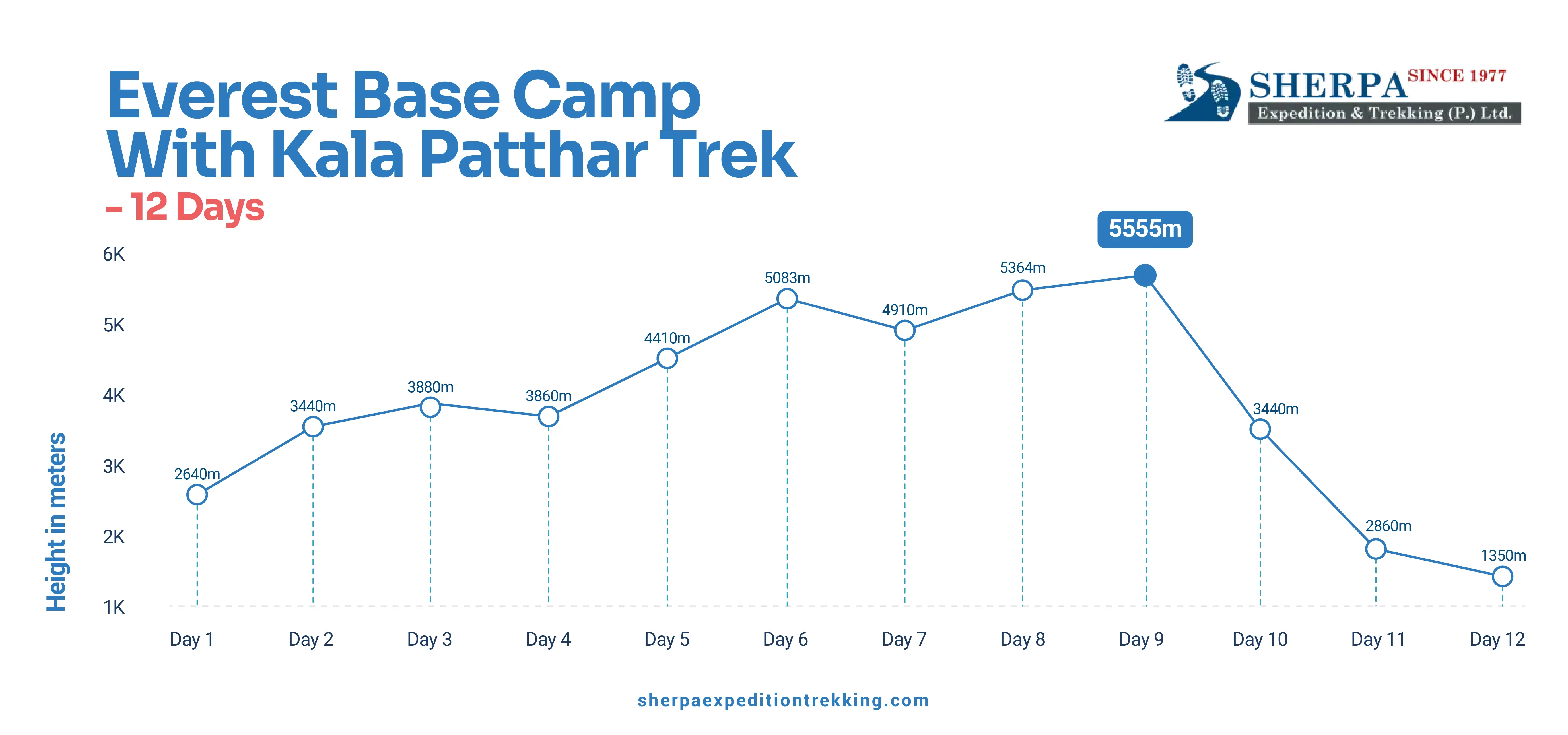
Elevation Profile
Everest Base Camp Trek via Kala Patthar Itinerary for 12 Days
Start your adventurous journey today. We will drive you to airport and there will take our wonderful 30 minutes flight flying among awesome snow capped high Himalayas range to Lukla. Once you land, our support team meets you to organise all your gear. A hearty breakfast at a local teahouse awaits you before setting off on your trekking trail which involves going down hill from Lukla by turning gently right and walking round the stone mani walls then crossing the archway gate of the town.
The trek takes us down gradually towards Phakding and we can expect to be descending for about 2-3 hrs walking down forested pathways across small tributaries past some traditional Sherpa hamlets such as Chheplung and Thado Koshi. You'll have a hot lunch at Ghat around midday, fueling up as you enjoy the amazing views of Kusum Kanguru. In the afternoons, you'll travel through a level terrain where the track has some mild ups and downs. You'll turn left to walk on the banks of the river Dudh Koshi and then climb high into Phakding in a short but easy ascent. In the evening when you're set right back at the lodge, just relax yourself and then dinner will be served to all in the common area about 7:00PM.
Our day begins at 7am after a substantial breakfast, and we head off along the Dudh Koshi River. As we leave Phakding, the trail soon begins a journey through beautiful pine and rhododendron forest, taking us across more of the famous suspension bridges (of course the famous high Hillary Suspension Bridge) and after around 3 hours on a gentle, up-and-down riverside path we reach Toktok and Monjo. We are now entering the Sagarmatha National Park.
Shortly after the national park entrance check post in Jorsalle we will stop for an early afternoon lunch break to prepare ourselves for a steep day to come.
As soon as we set off again after lunch the trail is forced sharp right across the river and we face a sustained two or three hours climb via a steep winding, zigzagging path through the dense forest – gaining in altitude with every step. About half-way up this section the trees provide their first framed glimpse of Everest. We continued climbing, finally coming to a more level walking before turning into Namche Bazaar; from here you checked into your lodge for dinner and the night.
Today you'll enjoy breakfast on the day of acclimatisation at 8:00 AM, followed by an active morning of "climbing high, sleeping low" to allow your body to prepare. Starting out from the lodges, head out of the horseshoe village to the left and tackle an upward hike that's challenging at times for about two hours until you reach Syangboche Airstrip. Continue with a gradual incline to the world renowned Everest View Hotel at 3,880m, enjoy a steaming tea at the terraces with the 'most fantastic view of Everest, Ama Dablam and Lhotse' on offer.
Hike back down for just about an hour in time for a leisurely lunch in a village bakery or your teahouse.
For the remainder of the day it is left to your leisure: wonder through the chaotic back streets of Namche Bazaar, take time out at the Sherpa Culture Museum, rummage in the colorful stalls of the market place and relax at an outdoor table in one of the bustling cafes, meeting up for your well-earned supper of an evening.
After an early 7 o'clock start and a good, solid breakfast, you depart from Namche to proceed along a fairly smooth level trail as it zigzags high above the Imja Khola valley with endless mountain vistas for approximately two hours. It then cuts to the right and makes a rather swift and very abrupt descent through pine forested, dusty tracks for nearly 1.5 hours, until you reach the river bank at Phunki Tenga. Your early lunch will then be enjoyed by the river next to the water powered prayer wheels as you anticipate the arduous afternoon climb.
Post lunch, you cross a simple bridge and the trail straight up goes for 2 to 3 solid hours of relentless ascent all the way through dappled light pine forest, and in shady rhododendron and fir woods, along tight trails winding ever upward testing even the strongest of legs until it breaks out onto an open grassy ridge.
At the summit lies the awe-inspiring Tengboche Monastery below Ama Dablam with the monastery perching proudly. You will be checked into the teahouse and explore the monastery premises before dinner with the temperature falling rapidly.
Start the day with an impressive sunrise view of Ama Dablam, have breakfast around 7.30 AM. After breakfast, leave Tengboche – a descent of about 30 mins through woods of birch and rhododendron to Deboche. Crossing a hanging bridge over a turbulent river Imja Khola, the trail turns to the left and starts a gradual but sustained ascent into alpine zone where the trees grow sparse, then to low scrub and tundra.
For a duration of approximately 2 hours and 30 minutes through old chortens and mani walls you ascend to Somare village with the view of Everest and Nuptse (around 12 noon take your lunch).
After a little rest, the trail is an uphill slog on the wide river valley, then at fork turn right – road split for Pheriche. Take the right path, you'll reach the safe haven, wind protected fields of Dingboche after an hour and a half/2 hours along the crossing of Lobuche River, to lodge for a hot cup of tea, relax and have a warm dinner in Dingboche.
You have your second acclimatization day today, and it starts with breakfast around 8 AM. To aid you in dealing with the altitudes to come, you'll experience a challenging, steep upward walk to Nagarjun Hill (5,050 meters or 16,568 feet, directly to the north of Dingboche). You leave Dingboche, turn to the left and it will be uphill all the way for 2 and half - 3 hours of rocky trails and switch backs.
Challenging although the view from the top is spectacular with Makalu, Lhotse, Cholatse and Ama Dablam's impressive south face.
After the views and photos have been taken, you will turn around and make a steep, 1 – 1 and half hour descent back into Dingboche in time for lunch. The rest of the afternoon is yours to sleep, rehydrate, play cards or just rest in the warmth of the teahouse dining room before a fairly early dinner.
We'll have an early breakfast and then start to climb out of Dingboche, branching off the main trail to the left onto a high trail above the valley floor near Pheriche. We'll traverse this a wide, exposed high alpine ridge for around 2-3 hours with a gentle climb, crossing scrubby ground with terrain views of Taboche and Cholatse, to reach the cluster of buildings called Thukla (Dughla) where we'll have an early lunch around 11.30am. Just after lunch the day becomes significantly harder, with a steep 1-1.5 hour climb up a rocky, boulder-strewn Thukla Pass.
At the top, we'll traverse past the touching array of memorial stones put up to climbers whose lives were claimed by Everest.
Then the trail bears right and continues as a steady, flat-ish rise along lateral glacial moraine for the final 1.5 hours to the remote high altitude village of Lobuche where we'll dine and rest for the night.
This significant day starts at 6am. Departing Lobuche your trail begins following rocky moraines and loose rubble alongside the huge Khumbu Glacier you will traverse in mostly undulations rock and minor ascents and descents for around 3 hours to the dry lake bed settlement of Gorak Shep, where you will check in and grab a light early lunch. Following your lunch collect a day pack with all of your warm layers and water then take a turn off to the right from Gorak Shep onto the glacier moraine ridgeline towards Everest Base Camp (5364m). Expect 2-3 hrs ups and downs on your traverse over unstable ice and rock along moraine ridges. Your reward for reaching Everest Base Camp will be the imposing Khumbu Icefall and will have plenty of time to take those photos. Afterwards expect around 2 hours downhill over the moraine trail as you hike back towards your tea lodge in Gorak Shep where a lovely warm dinner will greet you on arrival.
After an early wake up call, it's time for the demanding, though stunning, ascent. With the cold of the predawn air at around 4:30 a.m., your team will set off the cold trail upwards toward Kala Patthar. Setting out from Gorak Shep left, the climb is directly up steep, unending slopes without any stop at all – you have to go from 2 - 2.5 hours to this highest point covered with rocks and prayer flags before the sun starts kissing the peaks of Mount Everest, Nuptse, Changtse with its gold hues.
You will click your souvenir photographs and climb steeply back to Gorak Shep (1 hour) and on to a hot breakfast; now it is time to pack your bags and walk back down the valley. Walk further for another two hours downhill back to Lobuche, then further down along Thukla Pass. You will have a late lunch in Thukla or Pheriche then after half an hour further turn right to the valley floor to be in Pheriche by late afternoon for your dinners.
A 7:30AM breakfast gets your day started off on a good foot with lots of long walks downhill. The trail takes us down from Pheriche, alongside the river valley, past Somare, across the Imja Khola, then up another short but pretty nice hike of about 20 minutes until we reach the top again at Tengboche.
Once here, take a quick rest at the monastery, and head back right (to start heading down). Here we enter into some really nice, dense rhododendron forest as the trail drops pretty steeply down for anywhere between an hour-and-a-half, sometimes even two-hours. We'll end up coming into Phunki Tenga where we highly recommend getting yourself that hot lunch next to the river.
That's when the fun begins. After that little bit of much needed 'me time' we're now going to do one of my favorite things while trekking. It's the big uphill stretch. Although only lasting for about 1.5 hours total, this will definitely be one of the hardest part of trek. As you get closer towards Namche Bazaar, the trail flattens out onto this super-wide trail which hugs the mountain wall, giving amazing views all around.
On this day, which is your final day, you will have breakfast early in the morning in Namche Bazaar. Today's trek begins at the beginning of the sharp 1.5- 2 hour descent down the renowned Namche hill. You should be very careful while walking on the switch backs and loose stone roads down till the river level using the suspension bridges again.
You will proceed ahead through Jorsalle and Monjo along the Dudh Koshi River and then leaving behind the boundaries of Sagarmatha National Park you will take a rest for lunch at Phakding on the midday.
After lunch you will walk on a trail to the left and start walking further along the gentle ups and downs between two Sherpa settlements (Ghat and Chheplung). In the end, to have a last 1- 2 hour effort uphill will bring you back to Lukla and the archway gate of Lukla will show you that you completed the base camp trek. In the evening you can enjoy the final feast together with a guide and porter.
You will rise early on your last day in order to hop on one of the early morning flights to Lukla airport (provided the weather allows it). Enjoy a swift cup of morning tea or breakfast at your lodge, then a brief stroll back to the airport to take the little twin-otter to Kathmandu. The short 30 minute flight will have you sweeping back over the green hills and alpine crests towards the warm and green dustiness of Kathmandu Valley. Back in Kathmandu, you will meet up with your private transfer to whisk you back to your hotel – time to dive into that hot shower and spend the rest of your day exploring and shopping until your dinner.
EBC Trek with Kala Patthar Package and Inclusions
Costs included in your package.
- Private car/jeep from/to hotel (domestic airport pickup/transfer).
- 3 main meals: breakfast, lunch and dinner a day on trekking.
- Fresh seasonal fruits every day after dinner.
- Comfortable teahouse & trekking lodge accommodation.
- All necessary fees including national park permits & municipality permits: Sagarmatha National Park Fee, Khumbu Pasang Lhamu Rural Municipality Fee
- Domestic (Ktm-Lukla-Ktm or Ramechhap-Lukla-Ramechhap) in the schedule, inclusive of all private airport transportation and airport charges.
- Nepal Govt Licensed trek leader (Sagarmatha Expeditions) :- trekking guide, good knowledge of English, reasonable cost, lodging, meals, transportation and insurance all inclusive
- Well stocked first-aid box and emergency medical equipment for all emergency.
- Arrangement for emergency helicopter rescue. (All payment borne by the client and travel insurance).
- SEAT necessary gears: Use our sleeping bag (rental), down jacket (rental), duffel bag (rental) & trekking poles (rental) if need. This rented item has to be returned after trek.
- Sherpa Expedition & Trekking official T-shirt.
- All local Govt. taxes and official service charge.
- Trip Achievement Certificate.
- Pulse oximeter (to measure your heart rate and blood saturation two times in a day to check the symptom of altitude-related illness).
- Assistant guide on trek if group size 8 or more pax.
Costs Exclude
- Food in Kathmandu i.e. breakfast, lunch & dinner.
- Teahouse accommodation in Kathmandu except specified.
- International flights.
- Personal accident, medical and high altitude trek with helicopter evacuation and emergency return cost.
- Passport with Nepal visa fee (U$ 30 for 15 days, U$ 50 for 30 days, U$ 125 for 90 days) and work permit fee if required.
- Alcoholic beverage and all type of drinking including drinks, water, soup, hot chocolate, tea, coffee, soft drinks etc.
- Extra food taken besides the meal menu.
- Extras and desserts which can include, like chocolates, cakes, pies, desserts and others.
- Hot showers and battery recharging fee charged by local teahouse.
- Tips (guides, porter etc.).
- Cost for extra luggage fee on transit Lukla airport where on Lukla the flight allowance is 10 kg.
- Note: Any cost incurred due to change in itinerary or early arrival in Kathmandu or early departure from the trek in order of sickness, personal issues or any other cases to re-establish the further logistic and accommodation/meals at Kathmandu.
Everest Base Camp Trek 12 Days Via Kala Patthar Departures
Every departure listed below is 100% Guaranteed — once you book, your trip will run as scheduled regardless of group size.
Select a departure month
Fill out the form below and a Travel Expert will reach out to create your perfect tour.
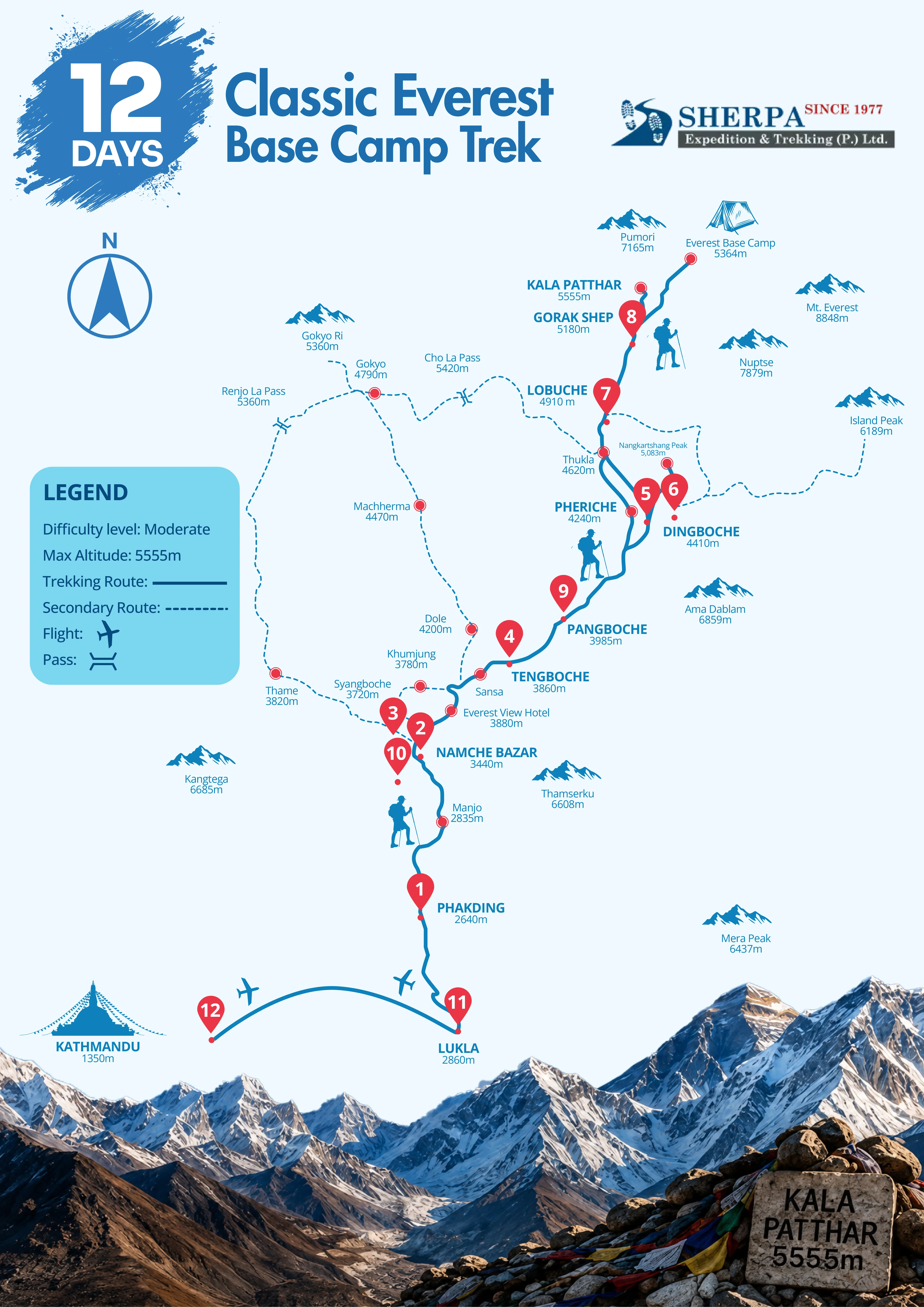
Everest Base Camp Trek 12 Days Route Map
Gear and Packing List
This information should offer you a realistic perspective on things that would need to be packed for trekking. Don't skip these essentials otherwise you'll be less comfortable in high altitude, but you also can't put on weight to a baggage that will follow on your trek; as a guideline, this is a listing of representative equipment needed for clothing, sleeping items, equipment and essential items. It is also a comprehensive packing list.
General
- All season down jackets rated for temperature -15C/-20C and four season sleeping bag (Sherpa Expedition & Trekking provide sleeping bags but you have to return it).
- Water-resistant duffle bag 70L-90L for porters (Sherpa Expedition & Trekking provides a duffle bag during the trekking tour but you have to return this back when trek finished).
- Daypack with 30L-40L and it should be water-proof bag cover.
Upper body - Head/Ears and Eyewear
- Sunhat/Baseball cap or other type of covering for sun.
- Warm woolen/fleece hat (for the ear).
- Polarized sunglasses for eye cover, this sort be cat 3 or cat 4.
- A neck gaiter or buff: a multi-purpose accessory which protects the neck against wind, dust, and sunshine, and also can be used as an elastic hairband or as a face-mask.
- SPF 50+ sun cream: with this high-intensity, ultra long-lasting sun protection screen (against long waves of UV radiation, etc.).
- Chapstick/Lipbalm for protection for lips.
- 3-4 pieces batteries, head lamp with some extra recharge cable with that.
Hands
- Light weight outer gloves/ liner gloves.
- Windproof/impermeable heavy outer gloves or lined mittens.
Upper Body
- 1 Short and long sleeve - wick away T-shirts or tank tops.
- 1 Thermo shirt.
- 1 Polar fleece pullover or jacket.
- 1 Sports Bra.
- 1 Waterproof and windproof outer layer top or jacket that is breathable and lets you vent from your arm to hip-level.
- You can take a few more non-cotton shirts/sweaters in a bag if you wish.
Lower Body
- Thermal insulation clothing - A pair of insulated thermal underwear for your lower part (you can go with either a fleece or merino wool).
- Lightweight quick-dry trousers - You'll want to have a pair of insulated or fleece lined ones.
- Breathable rain or waterproof trousers.
Footwear
- When trekking wear waterproof, well-worn and sturdy trek boots giving good ankle support. They will also help keep your feet warm on long treks.
- You would need lightweight shoes for changing into whenever you go out of trekking around the teahouse place – sneakers, sandals, light slipper boots, or even simple walk shoes / trek shoes that do not come with inner soles.
- You can take along 4-5 pairs of warm trekking socks as well if you want them. These can be wool or synthetic.
- 2 to 3 pairs of light liner socks – To prevent blistered feet!
First Aid Kit and Medicines
- Assorted adhesive fabric bandages & sterile wound pads.
- Blister kit with moleskin, blister dressings & anti-itch creams.
- Pain relief medications – Ibuprofen, Paracetamol, etc.
- Medications to address altitude sickness (Diamox, Acetazolamide).
- Medications for diarrhea, ORS salts (rehydration salts).
- Water purification tablets / portable water purifiers.
- Note: Trekking leader/Guide on trip will carry a team first aid kit. We advise you to carry a personal first aid kit and all prescribed medications.
Personal Items & Documents
- Original passport & valid visa.
- Four passport photographs.
- Medical Insurance with high altitude clause cover & evacuation services.
- Flight tickets / e-tickets & the itinerary copy.
Personal Toiletry and Bathroom Bag
- Quick dry microfibre towel.
- Biodegradable soap, hand sanitizer and wet wipes.
- TP – Toilet Paper (stored in a sealed plastic bag!).
- Toothbrush, toothpaste, mouth wash etc. and the toiletries you commonly need.
Miscellaneous Kit and Electronics
- Lightweight adjustable Carbon fiber poles for support
- Power bank to recharge gadgets during your trek, also a Universal Travel Adapter / extension cord
- High energy snacks, dried nuts and sports drinks
- Digital camera & accessories / spare batteries (to be kept warm during the trek)
Gallery


Everest Base Camp and Kala Patthar Trek Acclimatization Stops
The proper acclimatization is required for a successful trip at higher elevations. We have incorporated 2 strategic rests on our itinerary – one at Namche Bazaar (3,440m) after which you will do a short hike all the way up to the famous Everest View Hotel (a perfect place to get used to lower O2 level), another at Dingboche (4,360m). On that day, you can enjoy a fun and exciting walk up the Nagarjun Hill (5,050m) in the early hours of the morning followed by some great views. This will help you get well adapted towards your ultimate destinations such as Gorak Shep / Everest Base Camp & Kala Patthar.
Everest Base Camp and Kala Patthar Trek Distance
Everest Base Camp and Kala Patthar Trek is a total of 130 kilometers (80 miles) trek length with the rounded journey up and down. This total distance for trekking all the way from and to Lukla is covered over around 12 days. By walking at a sustainable consistent pace helps your body to acclimatise slowly and safely to the higher altitude as much as needed. On average walking duration is 5 – 7 hours per day.
Although there might be a couple of really long days. Smallest walking time days are early in the itinerary where your pace will slow down; for example, reaching Dingboche for over 4 - 5 hours of walk. On the most rigorous days your trek will go up to the Everest Base Camp, a 6 – 8 hours trek from Gorak Shep where you are hiking over unstable and tricky moraines while also making a push to the top Kala Patthar (5644m) on your 9th day requiring an early hike of 5-6 hours.
Everest Base Camp and Kala Patthar Trek Difficulty
Everest Base Camp and Kala Patthar Trek This trail is of moderate nature. We trek from 2,860 m at Lukla up to 5,644 m above the sea level up to visit Kala Patthar via Everest Base Camp. However, one issue we need to overcome while on the treks here is high altitude sickness and accordingly, make sure that we properly acclimatize with moderate speed.
Is Everest Base Camp and Kala Patthar Trek Suitable for Beginners?
The Everest Base Camp and Kala Patthar Trek can indeed be appropriate for the first timer as long as he/she has solid determination of mind, proper physical health, strength and fitness. An actual trekking experience to higher altitude trekking is not so compulsory, but one needs cardio endurance, strength and stamina in the legs and cardio fitness to cover daily 5 to 7 hours trek in the Himalayas.
Preparation and Safety Measures for Everest Base Camp and Kala Patthar Trek
Physical Fitness
At least 2 to 3 months of cardiovascular workouts and strength training should be done while still at home before you start training and it has to be supplemented with a regular regimen of running, biking or swimming and climb stairs while carrying your daypack full of water and some weights (similar weight your intended backpacking on your Himalayas trip ). Focus on leg strengths, high endurance level and developing a super strong core so that your body will not rebel at the thought of an upward climb day after day.
Diet and Hydration
Pack a high carbohydrate, balanced meal when on the trail to ensure your energy levels are kept up in the high altitude. Fresh vegetarian food, such as Dal Bhat, should be sought from local teahouses in order not to ingest spoiled food and get an upset stomach. Drink three to four liters of purified water per day which will assist you with acclimatizing to the altitudes. Purify your drinking water using water tablets or a SteriPEN every time you refill your water bottle or bidon.
First Aid Kit and Altitude Medicine
Personal medical kit with blister treatment, ibuprofen, rehydration salts, bandaids and broad spectrum antibiotics. Also include Diamox (Acetazolamide), if you consult with your physician on how to use this drug to prevent or mitigate symptoms of high altitude sickness. Have a pulse oximeter handy every day while doing your acclimatization checks as well. You can monitor blood O2 level and heart rate with that device.
Essential Gear
Take a reliable warm pair of gloves and sunglasses with you. Also, pack properly with a four-season sleeping bag, as well as durable waterproof and windproof shell jacket and trousers and all moisture-wicking layers, as well as a good down jacket for maximum warmth insulation. Ensuring a well broken-in set of trekking shoes, and a reliable set of walking poles are very essential in order to avoid the pain and impact in your joints from all the descent trekking down a day.
Things to Know Before Joining Everest Base Camp and Kala Patthar Trek
Insurance and Visa
Purchasing travel insurance of up to 6000 meters with emergency helicopter evacuation will secure yourself. You may then take Nepal Tourist Visa through on-arrival at the International Airport of Nepal (Tribhuvan International Airport). Otherwise, the Nepal Visa forms the country's website can also be acquired just prior, by filling Nepal Online Visa application form. The costs for this include 30USD for 15 days, 50USD for 30 days and 125USD for 90 days.
Permits
- Sagarmatha National Park Permit: Permit required for entry inside the Sagarmatha National Park. It's a protected region as well as a UNESCO World Heritage Site and there is Mount Everest. Cost of permit is NPR 3,000 (approx. USD 23) per person and you can issue this at the Nepal Tourism Board head office in Kathmandu and also at the entry at Monjo.
- Khumbu Pasang Lhamu Rural Municipality permit: It's the trek permit issued by local bodies. This one is the Khumbu Region trekking permit which is available for NPR 2,000 to 3,000 (approx USD 23) for foreign trekkers. You can buy this at the Lukla airport, at the checkpoints at Monjo on the day of arrival.
Transportation
Transfer arrangements are made via private car, jeep, or tourist van to/from Kathmandu Airport on your arrival and departure day. Private transfers from/to your hotel to domestic airport or Ramechhap Airport are also arranged dependent on Lukla flight situation for a punctual and comfortable beginning of the trip and the trip's close with Everest Base Camp and Kala Patthar Trek.
Lukla Flight
It takes around 30-35 mins flight to reach Lukla from Kathmandu while it may only take around 15 to 20 min flight to Lukla from Ramechhap airport. Weather in mountain is not stable and frequently lead flight canceling and delay; adding extra buffering days to Everest Base Camp and Kala Patthar Trek is very important. Due to heavy flight, in the peak season the flights from Kathmandu to Lukla are always diverted to Ramechhap Airport. You would be transferred by private vehicle about a 4-5 hour drive from Kathmandu to Ramechhap Airport in the early morning.
Duration
A typical Everest Base Camp trek takes 12 to 14 days to cover a span about 130km coming from Lukla. Acclimatizations are part of the trek to enable your body to slowly acclimatize with altitude on the process to the trek destination EBC and Kala Patthar.
Guide and Porter
We urge you to hire a knowledgeable tour leader/trekking guide who costs up to 25 to 30USD per day, and he is always prepared to manage you efficiently during your trekking adventure. A porter will help you carry up to 20KG of your personal effects for approximately 20-25 USD per day.
Accommodation
We use a pleasant lodge for trekkers on our treks. The lodgings provide basic comfort and are also hospitable, along with delicious food as well. Your accommodation includes a double-sharing bed, and sharing toilets with either squatting or western styles. A very minimal expense will be needed for heated water showers; or even one may go to the top-rated quality hotels at lower altitude (which sometimes even offers heated rooms or attached washrooms, etc.).
Food and Water
We can take carbohydrate-rich dishes as we visit teahouses during trips too. Dal Bhat, noodle soup and many items are very readily accessible in the Khumbu local area at a reasonably priced charge. Avoid eating meat items past Namche; particularly when experiencing wellness issues. You ought to consume at least 3-4 liters of drinking water every day and keep bottled water clean using purifying medicines such as a SteriPen
Weather Condition
Summer months (from June to August) plus the coldest part of winter months (Dec to Feb) can be the times of maximum extremes on the path to EBC and other elevated trails. In the wet season between June to August, heavy showers frequently cause the trails to turn muddy and soggy while greatly reducing the visibility leading to more flight postponements. The chilly winter months of December to February are marked by extremely low temperatures (-20 degrees C), fiercer katabatic winds, and significant amounts of snowfall especially at higher elevations.
Personal Expenses
Remember to carry 15 USD to 25 USD daily for your individual expenses on tour like for a shower, internet, mobile recharge, hot drinks and also meals over and above the included package, plus tips etc. for guide and porter once finishing your trips.
Everest Base Camp and Kala Patthar Trek Map
Everest Base Camp with Kala Patthar trek is 130kms trek in which we will start walking form Lukla (2850m). And from here you will proceed toward the river (Dudh Koshi). As this route is walked through the river side itself which gives an easy passage for us to get around some huge villages such as Namche Bazaar, Tengboche, Dingboche, and finally reaching Lobuche right before Gorak Shep. Here we can see Everest as well and after that, we continue moving further in direction of Everest Base Camp (5,364m). On the other hand, there's another path that leads upward climbing over a steep rocky slope to reach the top of a famous landmark known as 'ridge of Kala Patthar' i.e., 5,555m.
Lukla: The Starting Point and Main Gateway to the Everest Base Camp and Kala Patthar Trek
Lukla is the major access for undertaking the famous Everest Base Camp & Kala Patthar treks and nearly every Everest region treks even our own trip commences with a thrilling mountain flight to this charming village which is the first introduction point into the heart of Everest. You can witness the famous Tenzing-Hillary Airport here and onwards you will trek along the banks of the Dudh Koshi River, through charming Sherpa villages towards Namche Bazaar, EBC, as well as, Kala Patthar. This location also works as a central transit & storage center for the supplies needed to sustain the entire Everest trekking and mountaineering Zone.
Selecting a traveling date for the Everest Base Camp and Kala Patthar trek ensures ideal weather condition, terrific view along with terrific hiking throughout your trip.
Spring (March – May)
In March, April, and May, the sky is usually totally clear, bringing excellent visibility along with moderate temperatures. Rhododendron plants blossom along the trekking routes and make the environment very amazing, along with the surrounding viewpoint. Mt. Everest expeditions in April and May provide benefits to climbers too.
Autumn (September – November)
Autumn season (Sept – Nov) is arguably the most favored trekking season. The environment is pleasant to walk during daytime and the trail is in dry and clear condition. High in the Himalayas, days are bright, and in autumn days generally see clear skies from mountain vistas after the rains of the monsoon have gone away. The days are good for trekking till Kala Patthar for views.
Winter (December - February)
Winter can bring extremely cold, freezing temperatures and a big dump of snow up high, but sunny, clear and bright days. Trails and teahouses will be slow and quiet, but for overnight freezing conditions a good cold weather sleeping bag will be essential.
Monsoon (June - August)
In the monsoon excessive rain and cloud obscures Mt views with muddy tracks and constantly leeches at lower elevations. Visibility often becomes so bad that views of the high mountains are impossible, while weather delays have disrupted flights to Kathmandu from Lukla and on tour.
RELATED PACKAGES



Frequently Asked Questions
General Information
Everest Base Camp (5,364m) - A busy camp situated on the Khumbu glacier, it is the main stop and base for climbers trekking to Everest. Kala Patthar (5,555m) - The nearby black ridge with "the complete view" . Kala Patthar actually is the best vantage point.
Kala Patthar is often referred to as the premier viewpoint. Since Nuptse, the secondary mountain peak behind the “face of Everest, ” is located at EBC, this dark ridge provides you with the best and closest look of the King of Mountains (Everest) and her partners in crime, Everest and Lhotse, that almost trekkers receive.
Most trekking people climb the EBC, spending the night at the famous Gorak Shep, then climb for the peak at sunrise the next morning . The climb to Kala Patthar - Non-technical! This requires going upwards, on the top of the rock, at approximately 2-3 hours of walk.
While no specific high altitude experience is required for this trek, you must be physically fit to face its challenges. Beginners are welcome as long as they prepare themselves consistently for cardio and have a determined attitude along with an acclimatizing pace.
Preparation and Fitness
Cardiovascular training such as running, cycling, and stair climbing about 2-3 months before the trek should be taken care of to prepare yourself. Strength work for legs and core is needed so you are ready for steep rises and long daily hikes!
Yes, you should definitely train wearing a 5 kgs to 8 kgs weighted backpack to develop your neck, shoulder, and back strength, and strength in leg muscles, which makes them readily responsive and helps you cope with your continuous day pack worn in a rough mountain terrain.
High altitude trek planning should be done 8-12 weeks prior trekking, as it would provide sufficient time to build cardiovascular endurance, stamina and muscular fitness.
It is not absolutely mandatory to be a previous high-altitude trekker but you must be physically well prepared for it. Beginner trekkers with consistent cardio conditioning, motivation and slow acclimatisation can easily complete their trek.
Health and Safety
Acute Mountain Sickness – The following can occur as earlier signs of acute mountain sickness: headache, loss of appetite (anorexia), light-headedness (dizzy feeling), fatigue (feeling weary), bad sleep, and/or nausea (throwing-up sensation). If early symptoms such as these stop ascent to avoid potentially serious high-altitude problems.
HACE will result in extreme confusion and loss of coordination and hallucinations. HAPE will result in extreme breathlessness at rest, persistent cough with pink spittle and intense chest pain. Both forms are life-threatening emergencies.
Speak to your doctor before taking Diamox before ascending as lots of trekkers take this as a way of speeding up natural acclimatisation, however, it is not a cure only a preventative measure. Be well hydrated.
Tell your guide immediately and have a rest and get plenty of fluids-take mild painkillers. Do not ascend further if symptoms persist or are worse in the morning-descend.
Permits
No permit for Kala Patthar: The two official permits, Sagarmatha National Park Entry Permit and Khumbu Pasang Lhamu Rural Municipality Permit, allow you to go all over the trek route including of course Gorak Shep and Everest Base Camp.
It’s a local governance fee and this permit contributes to developing infrastructure of the region. Foreigners doing trekking in Everest Region must carry this Permit; show at Lukla entry/exit, or Monjo entry/exit.
Normally, two permits are just required to trek the normal route: 1. Sagarmatha National Park Entry Permit 2. Khumbu Pasang Lhamu Rural Municipality Entry Permit.
No TIMS card is required. Entry fee usually for the Khumbu Pasang Lhamu Rural Municipality Entry Permit. 3000 NRS ( 23 USD ) which will be paid on the checkpoints in cash local Rupees.
Insurance and Visa
You can pay for the Visa on Arrival in cash (USD, EUR, GBP – primary foreign currencies) on entry at Tribhuvan International Airport in Kathmandu. The credit/debit card payment machines there are often hit-or-miss.
Yes, there is an online tourist visa application form available on the Department of Immigration official web portal that you can fill within 15 days from your entry date. This can fasten up the processing for you.
The 15- 30 or 90 day tourist visas allow you to hike at your heart's delight and even give you breathing room on your journey for the trek for Everest Base Camp and Kala Patthar. You require a 30 Days Tourist Visa only.
Yes, all children need to have a visa for their travel. Tourist visa (Gratis visa) free for children below the age of 10.
Guides and Support
You are required to have a licensed guide for security and trekking assistance according to the government laws. Carrying heavy luggage can be done by hiring a porter and you can walk comfortably only with a day bag.
Approximate prices; Guide will cost about USD 25 to USD 30 and porter will cost about USD 20 to USD 25 for a day, it includes food, lodge and insurance.
It is a tradition to tip in Nepal. Usually, you may want to tip around 10 to 15% of the entire package cost (around USD 10 to 15 per day for guides and around USD 8 to 10 per day for porter).
Generally, two trekkers share one porter to carry 20kg to 25kg in total weight (per porter; duffel bag about 10 kg to 12 kg for each trekker) so that each of the trekkers have easy carrying.
Accommodation
Accommodation is in basic family owned teahouses. Unheated rooms consist of a bed with a good quality mattress and pillow, mostly bunk beds. There are common rooms with central stoves for warmth in the evenings.
Menus offer diverse range including rice or noodles (Dal Bhat), fried rice, noodles, pasta, soup and eggs. The vegetarian meals, being freshly prepared, are safer choice as elevation rises.
Yes, but services have to be paid for in higher villages. Electricity to charge your devices will cost you $2-5 per charge and Everest Link Wifi will only cost around $5 per data package.
Yes, a 4-seasonal sleeping bag rated from -15°C to -20°C is compulsory. It will get really cold in the teahouses bedrooms in the evenings/nights especially in places such as Gorak Shep.
Latest Traveller’s Reviews
Travel experiences of our clients who recently returned from their trips.
100% of travellers recommend this trip
Based On 269 Reviews
Beautiful adventure
Caring and Professional
Amazing Journey with Inspiring Scenery

Write Your Review
Average Customer Ratings
How The Travellers Have Rated This Package
257
11
1
0
0