
15 DAYS ANNAPURNA CIRCUIT TREK
USD 1,190 / Per Person
Annapurna Circuit Trek Highlights
- A most typical Himalayan traverse journey in Nepal from Dharapani, that forms a circuit around magnificent Annapurna in a landscape ranging from green terraces to quaint villages to high alpine terrain.
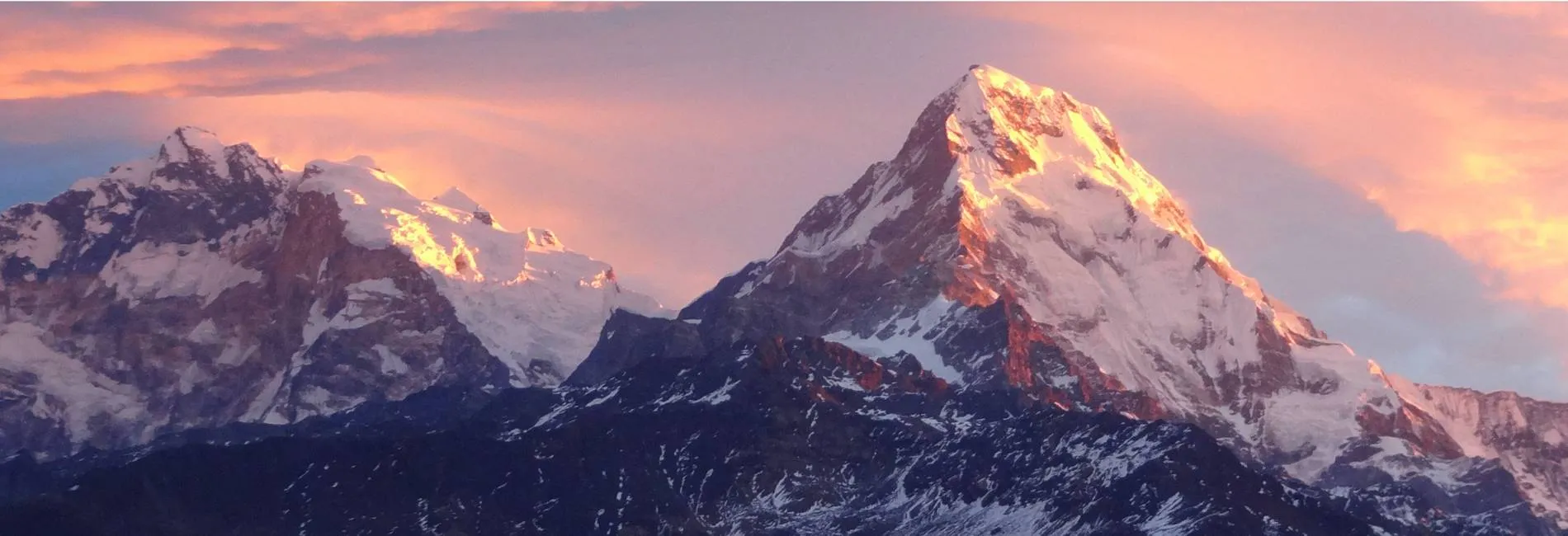
- Savour a complete 360 degrees panorama view of the gigantic Himalayan giants like Annapurna I, II, III and IV with scintillating views of Manaslu, Machhapuchhre, and Gangapurna along different legs of trek.
- Traverse across the highest trekking pass of the world, Thorong La, an impressive 5,416 m altitude, where the drama of the Himalaya continues with superb scenery of the Himalayas.
- Visit the highly holy pilgrimage spot Muktinath - a Hindu and Buddhist holy place with an ancient temple, everlasting flame and holy water.
- Travel along the Kali Gandaki river through Mustang's dry landscapes and discover Jomsom - an adventurist's haven.
- Wander around the beautiful apple village of Marpha which is also recognized for its quaint white-washed houses, fruit gardens, apple goods as well as tranquil environment with lofty mountains as background.
- Relish hot springs of Tatopani as you get close to the trail's end.
- Wander through scenic Tukuche village nestled amidst towering mountains and steeped in the rich traditions of the Thakalis in the Kali Gandaki valley.
- Relax at the naturally hot springs of Tatopani – natural hot tub to be more appropriate- where you have to enjoy the mineral waters after struggling through the remote mountains.
- Unforgettable sunrise view from Poon Hill across the towering peaks of the Annapurna and Dhaulagiri ranges which is truly one of the most spectacular mountain views in Nepal.
Annapurna Circuit Trekking Overview
The Annapurna Circuit Trek - also commonly known as the Annapurna Round Trek or Thorong La Trek is one of the world's finest mountain treks through Nepal Annapurna region which completes full Annapurna Massif or Annapurna in the form of Ring Annapurna Conservation area. The trek is renowned due to: spectacular scenery, great climate change and rich cultural encounters. You'll journey via the classical Annapurna Trail, deep and impressive Marshyangdi Valley that will guide you the way down along the Marsyangdi River.
The journey traditionally starts at a short distance north of the town of Besisahar. You'll venture into ancient Himalayan villages /settlements like Bhraka village, Kagbeni, Manang etc., going further up through the beautiful, pastoral Manang valley, passing high altitude trekking spots such as Yak Kharka, Thorong Phedi and then finally taking on the daunting crossing of the 5,416m high Thorong La Pass.
Amazing panoramas of all 360 degrees could be taken in the renowned tea house trek. View various types of spectacular landscapes and mountains that includes Annapurna I, II, III, IV, Gangapurna, Tilicho Peak, Machhapuchhre (Fishtail Mountain), Mount Dhaulagiri, Manaslu, Nilgiri Mountain, Hiunchuli, Lamjung Himal, Tukuche Peak and Pisang Peak, etc. Additional hiking option travelers could add on this high pass trekking are trekking over Ice Lake of 4,600 meters (Kicho Tal) and onward on top to on the Kang La Pass and the hidden valley towards Nar and Phu and so on.
You'll discover spectacular and immersive experiences beyond just the giants. Find real cultural immersion; experience genuine Buddhism via Buddhist Culture and authentic Tibetan Buddhism and Tibetan community in Buddhist monastery like Braga Monastery and Tashi Lhakhang Monastery, and also while visiting the local Hindu pilgrimage sites. Share true generosity; reside in authentic homes sharing lifestyles with the Gurung people, Thakali group, and Tibetan people. Again descend to the dry Mustang Valley and you will cross over the Kali Gandaki river in the Kali Gandaki gorge, enclosed on either side by the Dhaulagiri ranges.
Embark from fascinating Kathmandu and end in the lovely city of Pokhara with the Sherpa Expedition and Trekking team. With us you are guaranteed an outstanding trekking adventure with a reliable team of experienced professional Sherpa's who lead in providing a wide assortment of mountain guiding skills, safety precautions, excellent planning services, transportation and reliable assistance for trekking and climb expeditions to all Nepal regions. We have years of experience in leading from a safety perspective with permits, visas arrangement and highest altitude pass logistics handled with efficiency.
Why the Annapurna Circuit Is the World's Best Long-Distance Trek
With the Annapurna Circuit Trek, you get a full package in just one trip: dramatic altitude change and unmatched variety while climbing alongside the surging Marsyangdi River. Walking from Chame, Upper Pisang to Ngawal will blow you away as the way passes from the tremendous view of surrounding Himalayan mountains, lakes of river which flow down from a glacier, views of Gangapurna Mountain with awesome wrap around Manang village.
The diversity of climates is unlike anything you'll encounter elsewhere - the trek leads you from thriving subtropical lush-green forests at ~600m through to frigid, arctic high-mountain conditions at 5,416m, all on the one single journey. Cultural diversity abounds here too. The trip takes in a spectrum of cultures including Hindu villages on the verdant foothills and in the middle-mountain elevations where Buddhist communities reside at Manang village, leading into the secluded Thakali cultural enclave that is the Kingdom of Mustang.
An anti-clockwise trek provides slow, safe and effective altitude acclimatization. The gradual incline of the trail in an anti-clockwise direction provides ideal conditions for building a good elevation gradient that has you acclimatized by the time you need to cross the notorious Thorong La high pass.
The route, a stretch between 160-230km, exceeds the Everest Base Camp trail and is dramatically more diverse. Finally the trail unfurls at the relaxing and tranquil Taatopaani hot springs before an awesome Poon Hill sunrise rounds the itinerary off. The 15 day itinerary strikes a fine balance between keeping to a good pace while allowing enough time to acclimatise and remains the most common choice.
Thorong La Pass Crossing and Tilicho Lake
Ascend the highest mountain pass at 5,416m / 17,769ft - Thorong la Pass and cross over the ethereal waters of the Tilicho Lake. This is a route which has one of the best high altitude mountain passes and side trips options.
Thorong La Pass Crossing (5,416 m)
It is the highest pass/ highest point on the trek. High altitude acclimatization is vital in order to take on the crossing difficulty posed by Thorong La. The pass becomes even more physically demanding due to unpredictable weather conditions as well as the intense chill in the air in the early hours of the morning and the journey itself rewarded by arriving at the prayer flags on the top.
Tilicho Lake Side Trip
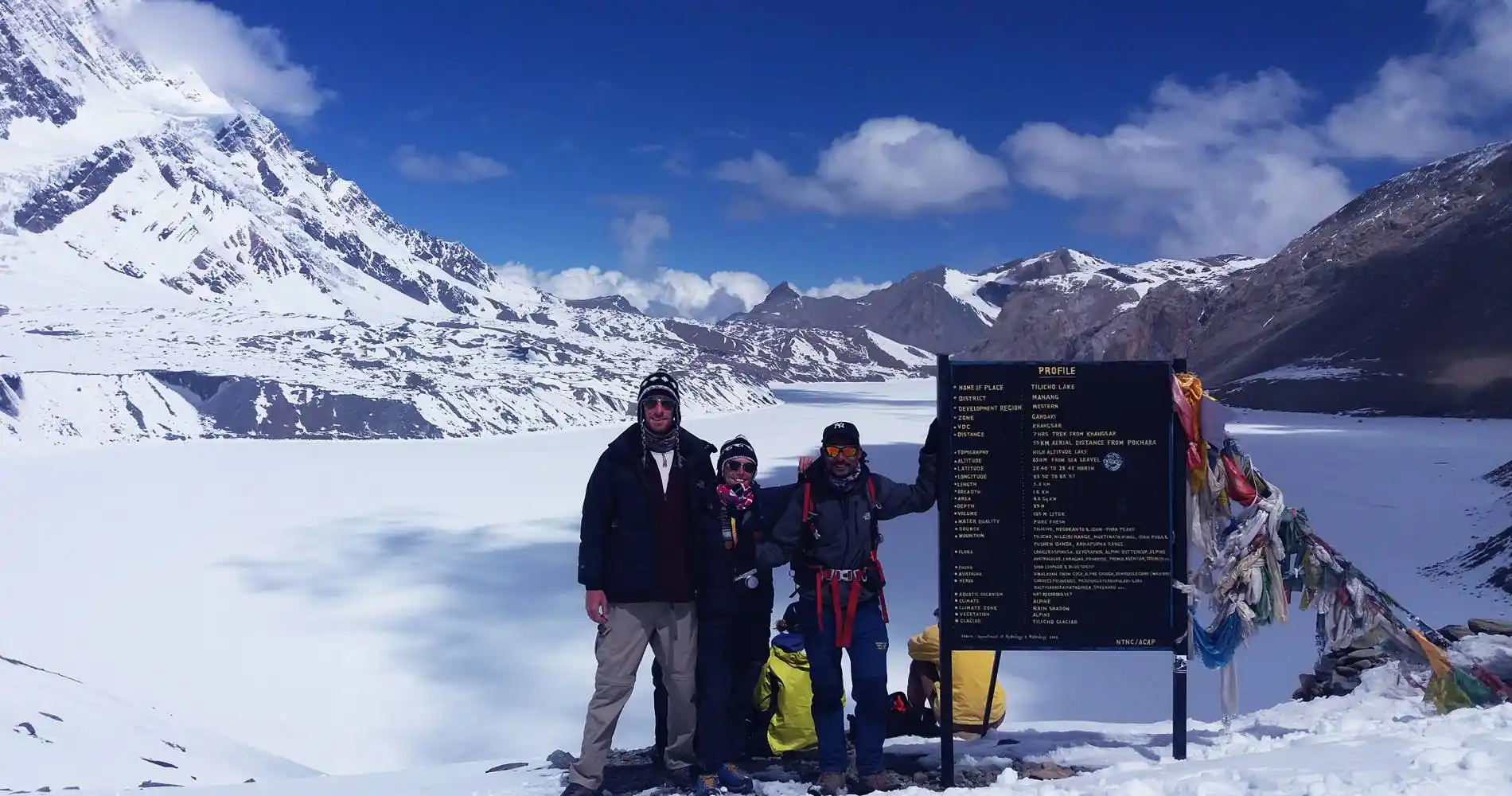
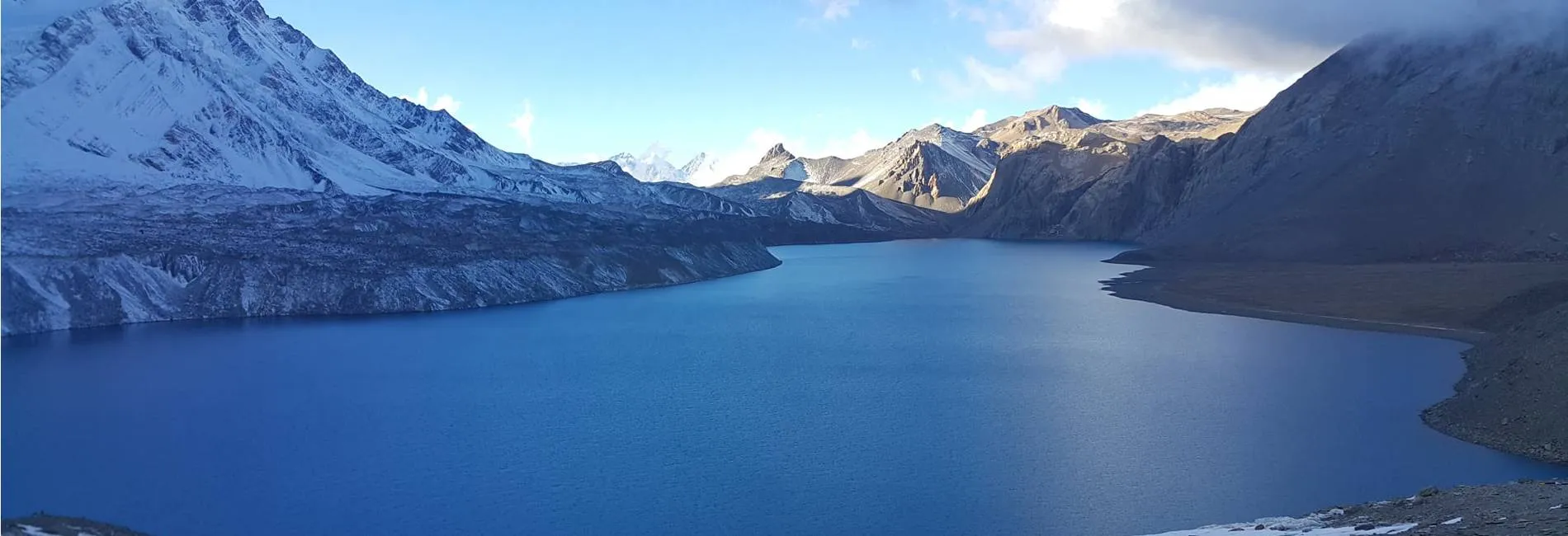
Starting from Khangsar, this rugged side-trek route takes trekkers securely to Tilicho Base Camp. Reached over 4,919m below dramatic icy faces, the pure green of the lake mirrors tremendous views of Tilicho peak.
Book Sherpa Expedition for Annapurna Circuit Trek
- Why Us: Our company is run by native Sherpas with decades of Himalayan high-altitude expertise - giving us advanced safety procedures, unparalleled local knowledge, and authentic cultural insights you just won't get from overseas trekking companies.
- Our local difference: We are small, sustainable operators with low guest-to-guide ratios, ensuring quality of trek. We pay fair wages and provide full insurance and gear to our whole crew and let you tailor your Annapurna Circuit to your preferences and at your own pace.
- Experienced Sherpa guides: Led by highly experienced, government-licensed Sherpa guides - also certified as wilderness first responders - each has crossed Thorong La countless times. Your guide will expertly manage the acclimatization process and immerse you in the local culture.
- Guaranteed Departures: If your booking is confirmed, it surely runs. We never cancel or postpone confirmed departures no matter the number of travelers in your group, so you have ultimate confidence booking your own international flights.
- Included complimentary High-End trek Gear: Save weight and save money with free rentals of your 4-season down jacket and high-quality deep-freeze sleeping bag.
- 24-Hour Emergency Support: We provide 24-hour on-mountain safety monitoring, 24-hour tracking of real-time weather in the Annapurnas, and 24/7 coordination of swift medical attention and helicopter evacuations via satellite technology.
- Easy Online Booking System: We make it easy for you to book your dream trip from our efficient online portal with clear and transparent pricing, flexible payment options and instant confirmation.
Elevation Profile
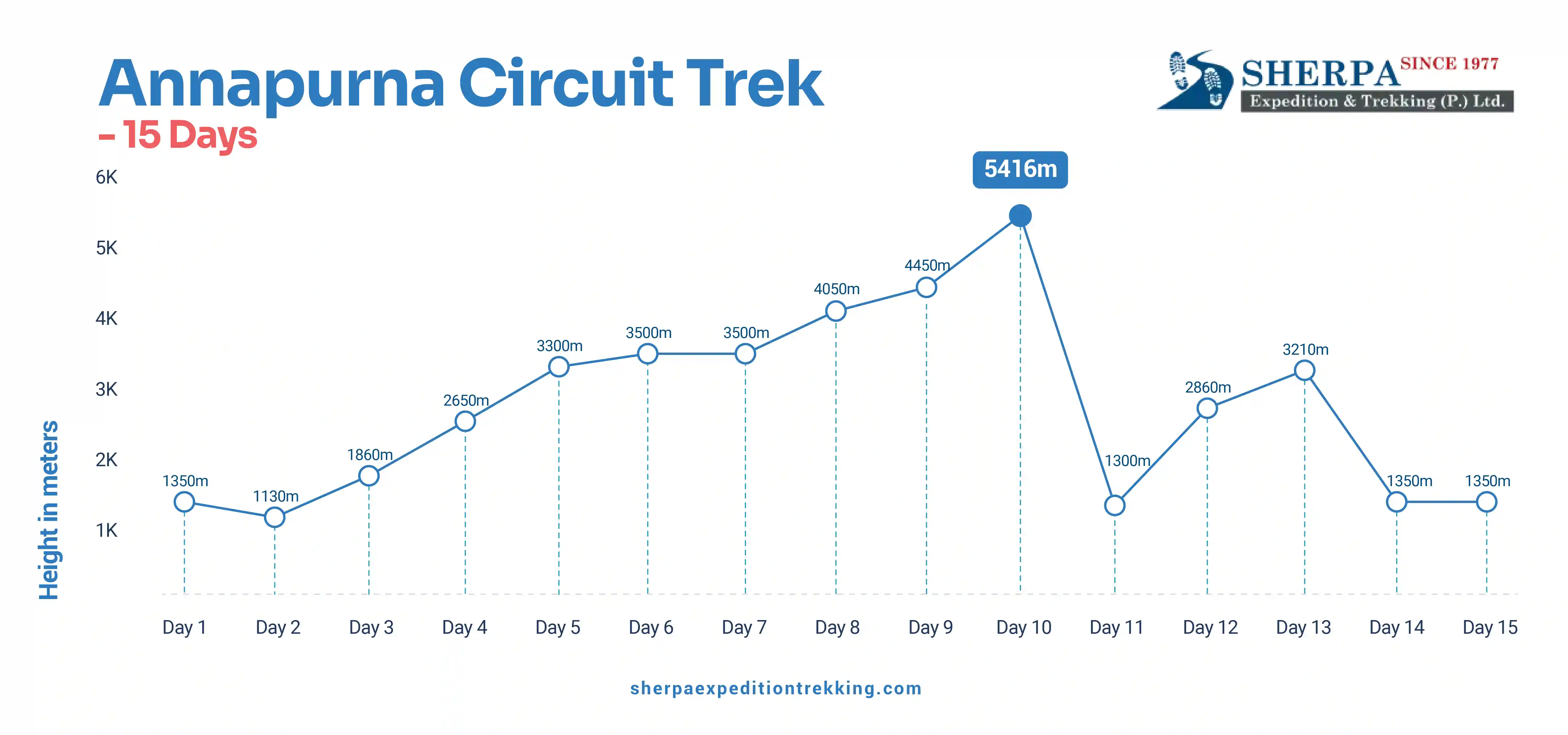
Annapurna Circuit Trek Itinerary
Upon landing at Tribhuvan International Airport (KTM), our local representative will welcome you at the terminal's exit point and transfer you towards the west part of the city towards the vibrant city center. As you travel along colorful streets of Kathmandu you reach your hotel located in Thamel for check in. You can take time for lunch at the local cafe nearby.
The balance of the day is yours to explore and get familiarized with your trekking gear and buy anything you want at the last minute and also meet your trek leader who will brief all about the trip.
You will be staying at an altitude of 1,400 meters, which should cause no discomfort. At night you can join your guide for a small briefing before you head for dinner followed by a night rest at Kathmandu.
Start your morning off well with a hearty breakfast, then climb aboard our public bus as we drive west on the Prithvi Highway towards Syange. Along the way, we’ll be accompanied by the rushing waters of the Trishuli River, stopping mid-way for a lovely riverside lunch.
Further up the track, we’ll cross over to the Marsyangdi River Valley’s bumpy dirt road through the village of Besishahar – the trekking hub town where all our permits will have been registered prior to departure. Thereafter, we’ll continue driving north past small villages and terraced rice fields until eventually reaching Syange. The lower 1,130 meter altitude makes for a lovely and easy walking place with impressive views across the valleys. We make ourselves comfortable and head to our little tea house for a cozy dinner. A wonderful time to reflect on everything that has gone on during these initial days.
Have breakfast in the teahouse, lace on your boots, and head up from the east bank of Marsyangdi river. The trek up will gradually wind and climb through deep bamboo forests and gorges past Jagat, and Chamje before traversing the swinging bridge on your right. The trek will climb sharply through staircases to the horseshoe plateau of Tal for lunch near spectacular falls. Head along the cut-cliff side road and through the entrance gate of chorten which lead Dharapani to north. You would feel ok to hike up 1,500 meters. Dinner will be served along the cozy fire and you will spend overnight in the Dharapani teahouse.
After your breakfast in Dharapani hike towards west through pines and firs woodlands. On passing the village of Bagarchhap and Timang, be rewarded with a magnificent view of Manaslu. You'll reach Thanchowk around midday, have a hearty lunch at the local lodge there after resuming your walk. We walk on this way through apple orchards that are centuries old and we walk over to the right bank of the river across a high bridge. Eventually, you end up on a long valley with steep cliff rocks on both the banks. You pass across a decorated portal called Kani and will eventually enter Chame. Chame is the administrative center of the Manang district. Enjoy dinner at teahouse and have an overnight stay in Chame.
After enjoying your breakfast we head out on our morning's adventure with a trail through dense alpine forest. We will cross a river bridge into the left bank and follow the winding path down the valley of the Marsyangdi River. As we walk along the banks of this beautiful mountain river, we'll be surrounded by amazing views as we walk past the magnificent curves of the spectacular Paungda Danda.
We have this gigantic rock-face of pure, slick shale to our left, extending more than 1,500m upwards!. Afterwards we enjoy lunch with excellent views of AnnapurnaII and IV across the serene waters of Dhukur Pokhari.
Following your delicious lunch, we will take a right and head towards Upper Pisang for the wonderful chance to appreciate the traditional stone Tibetan architecture that the region boasts, while enjoying yet more sweeping views of endless mountains that go far in the distance! . During the higher parts of the trek (above 3,000 metres), when climbing, you will have to notice that it'll require a more strenuous respiration which you should take into account, and we will accordingly go at a more relaxed, and gradual pace.
Tonight we dine in the teahouse dining hall before heading off back for another night's sleep in Pisang.
After enjoying the morning walk towards Ghyaru and Ngawal you will reach Ngawal where your trekking will resume on the other side of Ghyaru hill.
You will then have the privilege of witnessing some of the best views of the entire Annapurna Range that this route has to offer and after taking in all there is to see, your guide will take you down the same path through the historical village of 'Braga' – home to the one of world's oldest monastery dating back over 500 years. Eventually reaching your destination of Manang situated at 3,500 mts above sea level as opposed to lower altitudes, people may experience mild symptoms such as light-headed headaches or brief moments of shortness of breath when adjusting to the higher elevations during your trekking journey.
In order to ensure restful nights throughout the duration of our adventures together we provide dinner earlier than usual today allowing extra time dedicated solely towards relaxation within Manang before sleeping soundly tonight.
Today's plan involves spending the entire day exploring around Manang and taking advantage of the opportunity for some much needed acclimatization time. Your guide will take you on a walk which follows what locals call the 'climb high, sleep low' rule. It means that we either head south towards Gangapurna lake and the Chongkor viewpoint or alternatively go north to visit the historically interesting Praken Gompa for blessings from a local lama.
In the early afternoon, you head back towards Manang village, where you can grab some lunch at the tea house. From there you are free to chill in the sun and absorb the health-giving powers of drinking Buckthorn tea, or perhaps, for something educational, a local Himalayan Rescue Association altitude lecture. They provide interesting presentations on how the rescue teams save people affected by altitude sickness. Staying at 3,500 metres ensures that your red blood cells have time to adapt without overexerting yourself – always important with altitude gain. After dinner at your teahouse, you can enjoy another restful night in Manang.
This Day 8 is dedicated entirely to trekking between Manang and Yak Kharka – our destination this evening. So make sure to eat well during breakfast today because you are going to need those energy reserves.
After breakfast we depart from Manang and move to the north-west. We turn right from the center of the town and then go upward through the path that cuts through the old village of Tenki. A thrilling trek from a lush valley into harsh terrain and sparse vegetation in alpine desert, we begin to leave trees behind.
We hike into a green field and graze yaks as we pass the Jarsang Khola stream, and we reach the lodge on the road in the placid village of Gunsang.
Have your lunch with Annapurna Range behind us as. As we trek higher the air gets very thin from 4000mtr and then we have to take a very steady and rhythmic walk. Reaching the Yak Kharka early in the afternoon we will dine a warm dinner and then relax to stay in Yak Kharka overnight.
With an early breakfast we head out northwards on these high mountain slopes towards the foot of this pass. Crossing over a beautiful wooden suspension bridge we reach the right side of the river. We continue our trek along a narrow path cutting up from within the landslides.
Caution is required on this part of the trail as there have been instances of people being struck by rocks falling down on them. We eventually reach 'Thorong Phedi', meaning "Foot of the Pass" by midday. It will be nice to take advantage of some well deserved relaxation after our long walk and we will treat ourselves with a hearty carbohydrate rich lunch later
Altitude affects everyone differently but symptoms like decreased appetite and/or sleeping difficulty may occur due to its altitude of 4,500m. Our local guide keeps an eye on your oxygen level as we rest throughout this afternoon and then enjoy a very early dinner before our overnight stay in Thorong Phedi.
You will get up early morning (around 3:30 AM) after a quick breakfast and start heading towards the steep and icy trails. As we continue hiking we reach high camp, cross through various false ridges amidst freezing wind blowing.
With an altitude of 5,416 meters you need to give your brain maximum mental endurance. Once on top of the hill which has prayer flags you can celebrate and relax while heading back down the steep slopes of Thorong La Pass. At the end of the 1,600 meter journey we descend from the pass of Thorong La Pass and into the Mustang region, where we stop off at a place called 'Charabu' for our lunch before continuing on to the sacred pilgrimage town of 'Muktinath'. We are all very tired as we finish a long 9 hour day but after enjoying our celebratory dinner you can sleep well knowing that this time tomorrow night you will be staying at a low altitude below Muktinath.
Post-breakfast we proceed towards the Sacred 108 Water Spouts of Muktinath Temple and then board our local vehicle and head southwards. We will be going down the arid, wind-swept landscapes of the lower Mustang through Jharkot, Kagbeni, Jomsom, etc., the bed of the beautiful Kali Gandaki River.
We have an opportunity to taste traditional Thakali lunch in the most picturesque stone village called "Marpha," which has become famous because of its apple orchards. From there, we continue driving through one of the deepest gorges in the world known as 'Kali Gandaki Gorge' between the Annapurna and Dhaulagiri mountains, with spectacular Ghasa and Dana Waterfalls, descending into 1,300 meters altitude from where we had suffered high-altitude headaches. This will vanish completely once the oxygen level rises. We enjoy dinner and a relaxing dip in natural hot springs here before an overnight stay in Tatopani.
After having breakfast in the morning, we will walk towards the west, crossing the Kali Gandaki River from the long suspension bridge. After that, we can see some beautiful scenic views while going towards the south. We are going to pass through Ghara and Sikha. There also we have the opportunity to see many types of cultivated terraces field and traditional Magar farmhouses.
We take lunch at a nice lodge in Chitre after spending a few hours climbing on stone staircases. Then our trekking route goes into ancient densely thick forests of rhododendrons, oaks and magnolias. While hiking further we go high again up to 2,870 metres and by evening time we reach the ridge top village called 'Ghorepani' there we take our dinner as well as spend our overnight stay in Ghorepani.
We meet you at your lodge at an early hour of morning around 4:30 AM and take you on a walk up this 45-minute stone staircase to reach the peak of Poon Hill which stands at 3,210 m. At the top there will be a golden sunrise over Dhaulagiri, Annapurna South and Machhapuchhre.
Then we make our way down all that you have climbed earlier with some time to rest in between, and then we go back down thousands of stone steps towards Ulleri from Ghorepani as we head to Tikhedhunga to have lunch on the side of the rivers. As we move forward you can see the ACAP (Area Conservation and Protection) checkpoint and once passed, we go across the last bridge to enter Nayapul village, where our trek ends officially here. At this point, we drop you off at the vehicle that takes you down a 2-hour drive by highway to Pokhara where you'll get dropped off at your Lakeside Hotel and enjoy dinner lakeside and overnight stay in Pokhara.
The trip starts with a nice breakfast as we overlook Phewa Lake. We then head out on our tourist coach towards the east on the Prithvi Highway heading to the capital.
The drive is through some beautiful rural townships and terraced farmlands and also passes several highway markets. The views during this part of the tour simply cannot be beat. There will be lots of opportunity for photo and tasty, view-accompanied lunches all the way along. This usually takes place somewhere near Kurintar.
The roads leading to the Kathmandu valley go through some wonderful mountain vistas and high ridges which make this area very scenic. We arrive back at our hotel in the Thamel district by late afternoon. Elevation will be a mere 1400m here so that's also good news. Buy some final souvenirs, feast on a traditional Nepali party meal and snuggle down in bed ready for your final night's sleep in Kathmandu.
After you have had breakfast, some more souvenir browsing / packing / caffeine rush in the Thamel or take a final photo, get yourself an ' achievement certificate ' from our team. We will be waiting exactly three hours before your international flight to take you via private car through city traffic to Tribhuvan International Airport. Also, don't forget to capture all the memorable scenic photos with yourself and your loved ones. This is an incredible 15 day Annapurna Circuit tour that you will never forget.
Annapurna Circuit Trek 15 Days Packages and Inclusions
Package Included
- Airport pick-up and drop-off from and to the airport in a private vehicle.
- 2 nights of standard accommodation in Kathmandu with bed and breakfast.
- 1 night of standard accommodation in Pokhara with bed and breakfast.
- Teahouse accommodations for the entire duration of the trek as per the itinerary.
- Proper three meals per day (Breakfast, Lunch and Dinner) while on trek.
- All the transfers (local jeep transfer or any jeep transfer, etc.) included as per itinerary :
- Public bus – Kathmandu to Besisahar.
- Sharing jeep – Besisahar to Syange/Jagat.
- Public vehicle to Tatopani.
- Tourist Bus – Kathmandu to Pokhara to Kathmandu
- ACAP/TIMS registration permits for each client.
- One experienced, and the government-certified, English-speaking and Nepal’s Ministry of Tourism trained trekking guide and leader (Including guide’s meals, accommodation, wages, and insurance)
- English-speaking assistant guide for groups of 8+ trekkers, with a trek leader-to-trekker ratio of 1:5 or lower.
- Sherpa porters (one porter for every 2 trekkers to carry bags of up to 15 kg for each trekker, including porters’ meals, accommodation, salary, and insurance).
- SEAT: Down jacket, sleeping bag and duffel bag rental (returned after trip conclusion) and trekking poles on a complimentary basis.
- First Aid medical kit carried by your guide (comprehensive kit used).
- All necessary trekking permits.
- American Medical Association-approved oximeter/oxygen meter to check heart pulse, oxygen level, and blood pressure twice daily to help prevent altitude sickness (AMS).
- Travel and rescue arrangements. (Rescue service is guaranteed in case of any problem during trekking. However, all costs must be covered by your travel insurance policy, as rescue costs can be very high. Our company provides these services at reasonable costs if and when they are required.)
- Official Sherpa Expedition T-Shirt, and accomplishment certificate.
Package Excluded
- City Meals – Morning to night meals during your stay in Kathmandu and Pokhara, including lunch and dinner.
- Nepal Visa Fees – Nepal entry visa fees are paid upon arrival at Tribhuvan International Airport (KTM):
- $30 USD for 15 days
- $50 USD for 30 days
- $125 USD for 90 days
- Travel and Medical Insurance – Personal travel, medical, and high-altitude emergency evacuation insurance.
- International Flight Ticket – International flight tickets to and from Kathmandu.
- Personal Expenses – Personal items such as toiletries, laundry expenses, telephone call bills, shopping, etc.
- Beverages and Extra Snacks – Alcoholic and non-alcoholic drinks (soju, beer, tea, coffee, hot chocolate, cocoa, mineral water, cold drinks), and extra food items such as special meals and hot drinks at teahouses during the trek.
- Desserts and Food Sweets – Additional food items such as cakes, pies, puddings, and other sweets. Hot water for showers at teahouses and electronic device charging costs.
- Tipping – Tips for trekking guides, porters, and drivers, which are customary and appreciated according to each country’s travel culture.
If you return early from your trip due to sickness, any kind of problem, or personal emergencies, the amount paid for your international flights, domestic air tickets, hotels, mountain room rentals, food, and other facilities will be non-refundable. Additional costs such as hotels, food, and domestic flights within the valley must be covered by yourself.
15 DAYS ANNAPURNA CIRCUIT TREK Departures
Every departure listed below is 100% Guaranteed — once you book, your trip will run as scheduled regardless of group size.
Select a departure month
Fill out the form below and a Travel Expert will reach out to create your perfect tour.
Annapurna Circuit Trek Packing List
Here is an idea of what you need to bring for the trek. It is crucial for your comfort and safety to bring the necessities especially when crossing Thorong La Pass (5,416m). Making sure you don't bring too much is essential both so that you don't impose too much on yourself or your porter.
General Trekking Gear
- All season sleeping bag rated to a minimum of -10° to -15° (free rental can be arranged with Sherpa Expedition and Trekking on request but must be returned).
- Down jacket: heavy duty thermal down jacket able to handle below freezing sub-zero temps (free rental but must be returned).
- Duffel Bag: heavy duty, water-resistant, durable duffel bag for the porter to carry all of your main luggage (with Sherpa Expedition and Trekking but must be returned).
- Daypack (30-35L) Carry yourself for day items (water, an extra layer of clothes, camera, sunblock, rain shell and small valuables.
- Outer layer shell. Thin layered, durable windproof and waterproof breathable layer that should be worn every morning and evening over 3,000 meters.
Upper Body - Head, Face and Eyewear
- Sun Hat / Cap: Wide brim is needed for light at this altitude. Ultraviolet (UV). May be weakened.
- Warm Fleece / Wool Beanie: Thermal covering your whole ears for cold mornings and high camps.
- UV Sunglasses: Dark Category 3 or 4 lenses with side shields for protection against glare and snow blindness from the intense high altitude sun.
- Neck Warmer / Buff: Multifunction fleece or microfiber buff for protection against the freezing wind and dry dust that gives "Khumbu cough".
- Headlamp - Plentiful lumens of light for your headlamp, plus a spare set of batteries. At Thorong La Pass at 3:30 am without a headlamp is miserable.
- Sunblock (SPF 35- 60), sunblock lip balm.
Upper Body Clothing
- Layer 1 – 2-3 sets of Long Sleeve Non-Factor Thermals (Merino or Synthetic).
- Trekking shirt – 3-4 Light weight Trekking Shirts (Short sleeves or Long Sleeves Quick Drying)
- Mid Layer Fleece: Pack 1-2 mid-weight fleece jackets, or a wool jumper or a lightly insulated jacket.
- Sports Bra: 2-3 sports bras for girls and ladies.
- Waterproof/Windproof Jacket: A weather-proof/wind-proof jacket that also has a hood for those times when the weather turns with snow or rain.
Lower Body Clothing
- Thermal Leggings: Take along 1-2 pair of Thermal leggings or Thermal Trousers which could be in either Merino Wool or Synthetics.
- Trekking Pants: Have on hand 2 Pair of Trekking pants that are sturdy and Flexible and Quick Dry.
- Waterproof/Windproof Pants: It’s crucial that you also own a set of Hard Shell pants for wearing over Base Layers in cases where there might be Rain or Wind.
- Pants for Leisure – Bring two pair of cozy track pants or fleece pants where you could sit and enjoy a nice meal at one of our many eating facilities after a long hike.
- Undergarments – Remember to bring along four or five light-weight anti odor woollen or synthetic garments.
Hands
- Half-finger gloves / padded glove for trekking pole comfort and afternoon walk warmth
- Thermal liner glove - padded liner gloves - touch-sensitive to operate your phone or camera
- Heavyweight outer gloves/mittens - waterproof and windproof insulated gloves for our pass day
Footwear
- Trekking Boots - Sturdy, high-rise, ankle-support trekking boots (waterproof - leather/synthetics). Broken in well before you depart.
- Camp Shoes - Lightweight trainer/trail runners/comfortable sandals – to wear when not walking inside teahouses.
- Woolen Trekking Socks - 4-5 pairs of medium thick socks. Warm merino wool or thermal material works.
- Sock Liners - 2-3 pairs of thin 'liner' socks. Helps reduce friction and blisters.
- Gaiters - Optional: Lightweight gaiters to stop stones/mud/high pass snow getting into your boots' tops.
First Aid Kits and Personal Medications
- We have a comprehensive medical kit and an oximeter available during our trek. But it's highly recommendable that you bring your own medical supplies. Here are some items you can consider for prevention/cure of altitude sickness/blisters on trekking:
- Leukotape - Compeed Blister Pads/Fabric Adhesive Bandages Diamox / Acetazolamide Tablets (125mg-250mg) – Helps in Acclimatizing at higher altitudes.
- Pain and Anti-inflammatories medicines: Pack pain killers and anti-inflammatory medicines that such as ibuprofen, paracetamol, aspirin as needed to relieve headaches, muscle pain, knee or ankle pains and injuries occurred during trek.
- Anti-diarrhoea medication, Rehydration tablets and/or ORS to prevent diarrhoea. Antacids for heartburn, and indigestion caused due to certain foods.
- Wound and skin care – antiseptic cream to treat minor cuts; insect / anti-itch ointment for insect bites; butterfly bandages or sterile gauze to dress wounds.
- Water Purification - water purifier tablets (e.g., Aquatabs / Iodine), UV Sterilizer Pen.
Toiletries and Personal Hygiene
- Toilet paper: Pack in 2-3 rolls to save space and store them in bags of Zip locks.
- Travel Size Towel: For washing up and quick use for quick drying of travel clothes, it's perfect to pack a microfiber travel towel; it saves space and air-dries quickly.
- Travel-size biodegradable soap and shampoo, toothbrush, toothpaste and deodorant for all the basic needs for grooming purposes.
- Personal sanitary wipes and ziplock bag for trash disposal/use/other (for feminine hygiene issues/care)
Essential Documents and Cash
- Original Passport: You'll also need your passport (that is valid for at least 6 months beyond the date of travel) and 4 photographs to the size required for a passport.
- Nepalese Rupees (NPR): Cash of between 30,000 NPR and 40,000 NPR in Nepalese Rupees which will be needed for private use, drinks, hot showers and tips as there are no ATM machines anywhere along the path between Besisahar and Jomsom.
- Insurance and Flight Copies: Physical Copies of travel insurance policy specifying high altitude medical evacuation coverage (5,500m) and international flight itinerary.
Miscellaneous and Tech Gear
- Trekking Poles
- Water Bottles and Water Filter
- Power Banks and Charger
- Camera and Electronics
- Food and Trail Snacks
Route Map
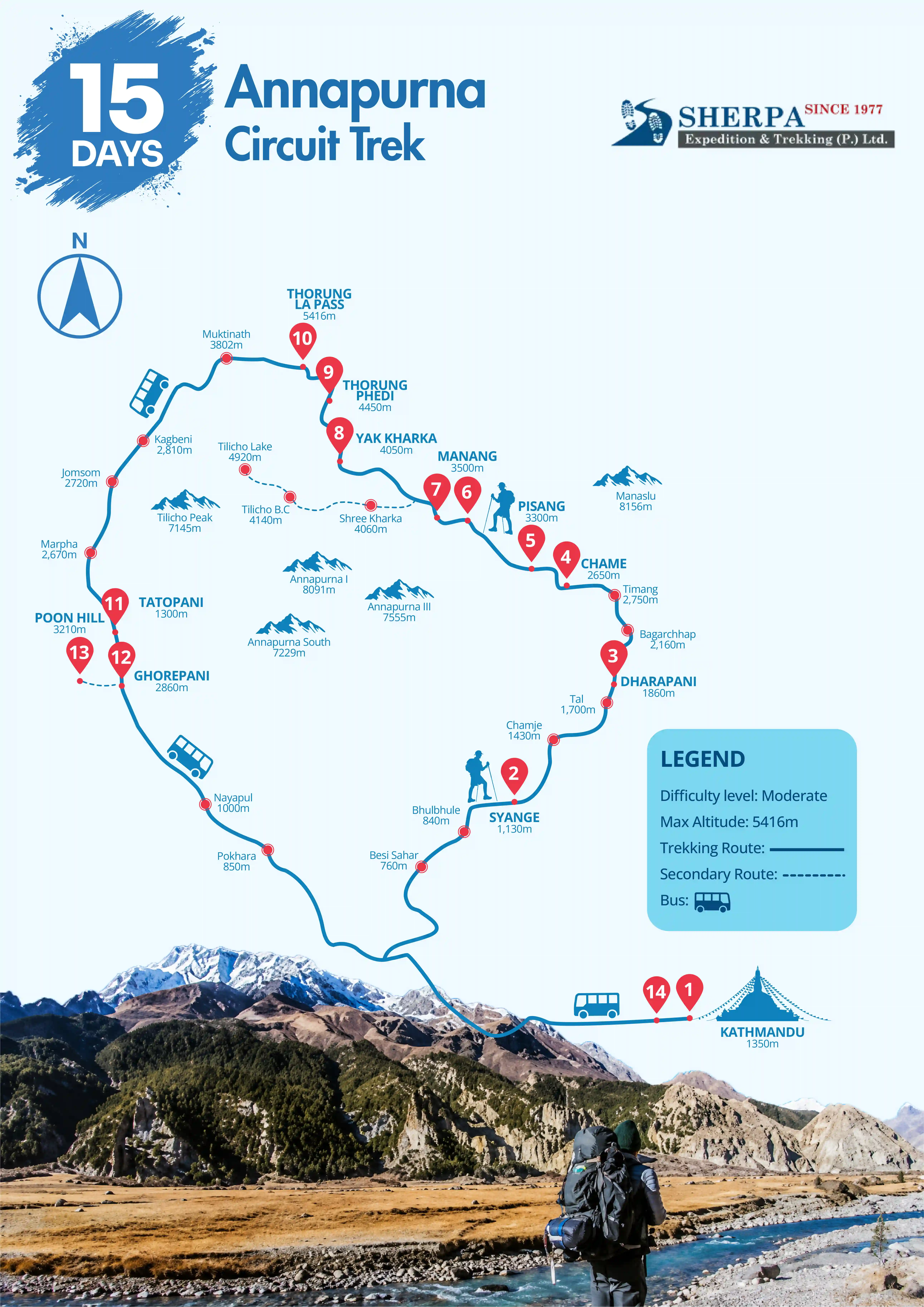
Alternative Annapurna Routes
The Poon Hill Ghorepani Trek
One of the historical short treks offering unforgettable magnificent views of the Himalayas to time starved travelers who want to view these things and don't want to experience high altitudes. You will pass the thick forests of rhododendron and indigenous Magar villages and finally arrive at Poon Hill (3,210 m ), the world's magnificent scenery of sunrise over the Dhaulagiri and Annapurna range. So this trek is also known as a preview of Nepal's dramatic mountain landscape.
Annapurna Sanctuary Trek (Annapurna Base Camp Trek)
You will be stepping on a trip that will journey you into the heart of a natural open space arena located at the high peaks of the Himalayas, surrounded by towering Himalayan mountains. From the start of your trek, the path will introduce you to the bamboo forests and the Gurung villages as you walk up toward our adventure’s heart, Annapurna Base Camp, which lies at 4130m. When you reach ABC, as we will commonly refer to base camp for short, you are blessed with a great view of Annapurna 1, Machhapuchhre, and South Annapurna surrounding you, so get yourself prepared for incredible scenery from in front, from the sides and from behind the mountains; we call it a phenomenal experience for the eyes.
Read Before You Choose Annapurna Circuit Trek
Best Time for Annapurna Circuit Trek
Spring Season – (March to May)
During this time, the rhododendrons and other wild alpine flowers bloom with colors all over the mountainsides. This is also a good period for trekking since the temperature gets more pleasant due to warmer weather.
Monsoon Season – (June to September)
The summers bring heavy rains that cause trails to be muddy. The humidity levels increase, leading to leeches coming out on trails along with the rivers in the lower elevations. There could be landslips, especially during August and September when the rains are heavier, and there may even be cloudy days where you cannot get an unobstructed view of the mountains. Therefore, it's best avoided unless you're experienced. However, the area of Manang and Mustang remains relatively dry under the rain shadow area.
Autumn Season – (September to November)
This is probably the best period to visit if you want to do the circuit as the weather is quite stable. Because of no or little rainfall in autumn, there are clearer skies this time of year compared to the monsoon. Autumn makes the nights very cold at altitudes above 4,000 m, and the air becomes cold in high mountains due to a fall in temperature. So try to book your accommodation ahead.
Winter Season (December – February)
This season can bring freezing temperatures, heavy snowfalls and biting winds to high elevations.
Thorong La Pass will be either snowed-in or icy during winters, which makes this trek very dangerous and highly technical for most trekkers. We do not recommend departure of our treks on winter season unless you have extensive experiences with cold weather trekking.
Explore Kathmandu: A City of Nepali Culture
Instead of immediately jumping out onto the trail, lose yourself for a few days with exploring the cultural heritage sites around Nepal’s capital Kathmandu. Gaze at the ancient stupas of Swayambhunath and Boudhanath, admire all types of construction designs in Kathmandu’s Durbar Squares, or have the opportunity to immerse yourself in culture by walking around the Kathmandu city markets.
Get Your Tourist Visa After Arrival at Airport
The visa can also be obtained efficiently at Tribhuvan International Airport upon arrival in Kathmandu – simply use the electronic kiosk to apply and then take it along to the officials along with your passport and cash payment ($30US/15-days, $50US/30-days, $125US/90-days – cash only).
Accommodation and Teahouses on Annapurna Circuit Trek
Rooms
The Annapurna Circuit teahouse rooms are modest, clean and twin shared consisting of two single beds and a basic foam mattress. Be sure to carry your own sleeping bag for additional warmth as there is no heating in higher altitude rooms, apart from the centrally heated dining room at times.
Toilets and Showers
While western style toilets will be attached or shared lower down the circuit, only squat toilets are available at higher camps. Solar and gas geysers are used for hot showers which may be scarce above 4,000 meters high. You will be charged from 2 USD to 5 USD for a shower.
Meals
There's a good selection of high-energy fresh, cooked-to-order meals available at most teahouses. The basic staple of Dal Bhat - lentils, rice and vegetables is available at most establishments and the second helpings are free, and don't be shy of having more of everything. International variations on basic principles include western-style food such as pasta dishes, Indian curries, Tibetan noodle soups and momo dumplings, as well as porridge and sweet dishes, so one never has to miss out too much.
Wi-Fi
Wireless internet is available for $2-$4 a day in most of the teahouses along the lower and mid sections of the trail. Quality diminishes drastically above Manang, especially with poor weather.
Food and Drink
Eat Well and Trek Well
In order to continue climbing, stay charged on long walking days with good nutrition. When it comes to eating at high altitudes, opt for freshly cooked vegetarian meals in high altitudes avoid tummy issues and stick to calorie and nutrient-rich food such as Dal Bhat, oatmeal, and potatoes to get sufficient mountain-ready energy to make it all the way to the top.
Drink Water and Hydrate Your Body
To help prevent altitude mountain sickness it is vital to have a healthy amount of water. It is best to make sure you take enough on the trail – anywhere from 3 to 4 litres per person per day for your trek. Take reusable water bottles and filter water, purify water with tabs or be more mindful of the plastic.
Annapurna Circuit Trek Permits
Annapurna Conservation Area Permit (ACAP)
This permit and entryway passageway goes toward the conservation of the nature around the area and pays for path upkeep and improvement of networks inside it. An individual must have a substantial ACAP entry pass with them always in the trekking territory as it's required at different trail entrances.
Types of Permit
Trekking Permits for Nepalese Citizens
Nepalese natives are not necessitated for the ACAP permit or TIMS card for the Annapurna Circuit trek. In spite of that, they would be asked to verify standard identification on the off chance that it's important to make any stops along the trail.
Trekking Permits for Foreigners
Foreign citizens require two types of trekking permits - ACAP and the Trekkers Information Management System (TIMS) Card. The permit price is lower for the SAARC nations.
Annapurna Circuit Trek Cost (Total Cost)
Guide and Porter Tipping
In Nepalese trekking circles, tipping is one of the social traditions with a motive of expressing appreciation for your trekking guide and porter group's unending efforts. A safe estimate would be $10 – $15 for a guide and $8 – $12 per day for a porter.
Extra Cost on the Trail
During the trek, the extras include drinking water, hot showers, device charging, Wi-Fi availability, washing your garments, desserts and liquor. Since not all the cash changers offer credit/charge processing in far off areas of Nepal, it's shrewd to have local currency close by.
Transportation Cost
The transportation arrangements incorporate costs incurred by traveling by means of normal neighborhood buses, tourist coaches and even a four-wheeled-drive Jeep – for example in going among Kathmandu, Besisahar, Syange, Muktinath, Tatopani and Pokhara.
Hot Shower Cost
At teahouses, an additional charge is applied for hot water showers with expenses ranging from NPR 300 to NPR 600 ($2 to $5) relying on altitude of the region. At extremely high camps like the one at Thorong Phedi, finding and utilizing steam warmed via gas or utilizing thermal energy can be difficult.
Wi-Fi Cost
With prices for Wi-Fi ranging from NPR 200-NPR 400 for day passes and Wi-Fi codes for local teahouse Wi-Fi hotspots, they might not be cost-effective for long-term needs. Taking into consideration Wi-Fi expenses, a Ncell or Nepal Telecom SIM card for cellular coverage up to Manang might also be efficient.
How Much Extra Money Should You Have During the Trek?
It is prescribed to bring the spending plan of approximately NPR 25,000 to NPR 35,000 ($200-$300) for additional money needs per person for paying for consumables, refreshments, hot showers, portable chargers, Wi-Fi accesses, clothing wash, desserts and alcoholic drinks. Tipping of your guide, porter and others, as per custom in trekking, would additionally be the best usage for some other cash in light of different expenses.
Ethnic Cultures and Wildlife of the Annapurna Conservation Area
Unique Culture of Gurung, Magar, Manangi and Thakali
Gurung
The main area where they reside is on the lower southern slopes, such as at Ghorepani and Ghandruk. They are well known among others due to their rich cultural heritage and traditional honey hunting practices, along with animistic traditions and their historic legacies as brave Gurkha soldiers of the world's militaries.
Magar
Magars live in the medium height valleys, on the shores of Kali Gandaki River. They are followers of both religions, Hindu and Buddhism. Magar people also have a rich history and culture with traditional farming, stone houses and rich folk music. It's good that they welcome outsiders with hospitable gestures.
Manangi
The habitat of the high altitude rain shadow region of Upper Manang, Manangi has strong cultural relations with Tibetan Buddhists. They are famous for their ancient monastery, stone hamlet, prayer flags and history of the trans-Himalayan trading network.
Thakali
From the origins of Kali Gandaki Valley, Thak Khola and Marpha the Thakali community is renowned all over Nepal with their wonderful hospitality, well-maintained stone lodge and best ever delicious authentic Dal Bhat cuisine.
Wildlife in the Annapurna Circuit Region
Occupying 7,629 sq km of protected habitats ranging from subtropical forest to cold desert in the high alpine areas, ACAP is home to the region's fascinating and numerous rare and endangered Himalayan animals. The region contains habitats varying dramatically from low altitude sub-tropical forests up to the frigid and barren cold desert of the high alpine region of Upper Manang and Mustang. These habitats include:
- Snow Leopard (Panthera uncia): the "ghost of the mountains" prowling in the high alpine region around the Annapurnas in Upper Manang and Mustang
- Himalayan Blue Sheep (Bharal), easily spotted in herds grazing the mountain sides above Manang and on the cliff edge north of Thorong Phedi
- Himalayan Musk Deer: hiding in the forests; Himalayan Tahr, Black Bears (roaming the forested sides between Chame and Pisang
- With many species of birds and at least 470 species of birdlife that include; and the national bird of Nepal.
- The brightly coloured Danphe (Lophophorus/Impeyan Pheasant) and spectacular soaring Himalayan Griffons.
Transportation Service
Access of the Starting Point
We'll start the trekking part with a drive from Kathmandu to Besisahar via highway and then from Besisahar there is a dirt road and continue it to the Marsyangdi River till Syange and from Syange this will officially begin the trekking.
Off-Road Jeep Service
Rugged 4-wheel drives used for the off-road tracks which connect Besisahar with all the upper villages like Syange and Chame on the trek to Thorong La Pass and from Muktinath all the way down to Tatopani along Kali Gandaki Valley.
Why Consider Hiring a Porter?
Because you want to hike with a light pack we transport most of your luggage for you. It gives you an easy hike as you're free from all heavy baggage to experience nature. It will significantly reduce physical tiredness, save your joints while trekking steeply upwards and help you not lose energy at high altitudes. Moreover, you are creating a direct job for the Nepalese trekking community, the mountaineer family.
Share the Porter with Another Trekker
Sharing a porter is a cost-effective idea. One porter can carry the weight of 15 kg which is 7.5 kg per trekker, you would just be carrying a small rucksack for your daily needs.
How Much to Tip
To Guide
We strongly recommend tipping your trekking guide somewhere around 10 to $15 in dollars each day per whole team, for their leadership, trekking knowledge and safety management.
To Porter
We recommend tipping your trekking porter somewhere around 8 to $12 in dollars each day per whole team, for carrying your heaviest belongings throughout the mountain.
Altitude Sickness and Difficulties on the Annapurna Circuit Trek
Altitude Sickness
Types of Altitude Sickness
- Acute Mountain Sickness - Mild and most likely altitude illness type which causes headaches, nausea, dizziness, sleepiness and loss of appetite.
- High Altitude Cerebral Edema (HACE) - More dangerous form of AMS when fluid enters in your brain and makes you disoriented, weak and unable to coordinate.
- High Altitude Pulmonary Edema (HAPE) – HAPE is considered a critical medical emergency with accumulation of fluid inside the lungs leading to acute breathlessness and severe cough along with bluish skin.
- HRA Clinic – Manang 3,500m: Doctors here give public lectures every day about altitude safety, do health checkups and will tend to your emergency medical requirements while you acclimatise to thin air. Medical support HRA (Himalayan Rescue Association) provides basic healthcare at their clinics situated in various remote areas of Nepal.
Who is at Risk?
People trekking at altitudes of 2,500m (8,200ft) and above may get AMS - it's independent of gender, age, physical condition or the traveler's experience level.
When You Need Emergency Evacuation?
Helicopter emergency evacuation is immediately required if a trekker experiences symptoms like HACE and HAPE - such as can't walk straight, extreme lethargy, confusion and cannot sleep due to shortness of breathing, constant rattle sound on chest. Descending into lower altitudes, as well as oxygen treatment, are mandatory in such cases while a rescue chopper is on the way.
Difficulties and Challenges
Weather Factors
Due to sub-zero temperatures during winter on higher passes combined with harsh wind at Thorong La Pass and heavy rainfall during monsoon at lower altitudes, a varied and challenging environment is created. Accurate planning of a technical layer system can save trekking trips.
Trekking Duration
You should trek five to nine hours a day for nearly fifteen days. For this, you need a lot of diligence, stamina and adequate caution towards your legs for extreme ups and downs over there.
Remoteness
After trekking from Manang of the Himalayas, you have limited options for any basic medical facilities, mobile connectivity or even regular teahouse accommodation. Helicopter evacuation will be made on an emergency basis if needed.
Acclimatization Strategy for the Annapurna Trek
We follow a well-established “climb high, sleep low” model that will encourage your body to safely acclimatise to the higher altitudes. We follow a programme of ever-increasing day time altitude, with an obligatory full rest and acclimatisation day at the village of Manang (3,500m) which will involve short day hikes with high day time altitude gains. The day leading up to Thorong Phedi is kept shorter in order to allow us to rest before attempting to tackle Thorong La (5,416m).
Is the Annapurna Circuit Trek Suitable for Beginners?
Yes, first-timers can complete this trek if they really have guts, some cardio, and the right preparation. No technically complex climbing skill is needed; it's all about cardio training before the trek; moving slowly, hydrating, and listening to altitude acclimatization tips given by your guide or trek lead at certain stations.
Age Requirements
Trekkers' age to join trips typically range between age 12-70yrs for boys/girls respectively. Kids less than 18 years should come with parents or their respective guardians, to avoid problems while processing their documents at the airport. Elderly people (Above 60 years) need to possess a good level of physique and need prior medical advice from a physician for joining the trips.
What if I Cannot Complete the Trek?
If for some medical reason, over fatigue, or you don't want to continue with the trek, your guide will take you to the nearest station and arrange ground and vehicle transportation from one point to another. They will take down the nearest accessible trail, such as Jomsom, Muktinath, and Manang, where you can reach Pokhara or Kathmandu.
Booking Cancellation Policy
All cancellations must be made in writing; the non-refundable deposit will not be refunded. 30 days before trip date: retaining 50% of total amount. 25 days before trip date: retaining 70% of total trip cost. 15 days before the trip date: retaining 90% of total trip cost. Within 7 days of departure: No refund is issued (100% retention).
For postponements: If you wish to postpone your trip then the new departure date may be booked without much additional cost except the difference of cost and fee of $150 USD by providing a minimum 30 days' written prior notice.
Gallery of 15 DAYS ANNAPURNA CIRCUIT TREK

FAQS Related to 15 DAYS ANNAPURNA CIRCUIT TREK
General Information
The Annapurna Circuit is an internationally famed mountain trail that goes past a colossal natural wonder, the Annapurna Mountain range. The journey reveals a spectacular array of natural vistas from subtropical river valleys to arid high-altitude deserts, and also shows pine forests.
Depending upon which ones are the starting point and the endpoint of the route, the total trail will measure somewhere between 160 and 230 kilometers (100 to 145 miles), and most people walk it in a period of around 12 to 15 days.
This is a walk that goes from one of the very far corners of North-central Nepal which is in the Annapurna Conservation Area (ACAP) and the route snakes from district to village as it passes through the Gandaki Province areas of Lamjung Manang, Mustang, and Myagdi.
There is the famous Thorong La high crossing which is the point to reach on the highest altitude of the circuit that is at 5,416 m.
If you look back on all the memorable moments, then you'd include climbing Thorong La (5,416m), experiencing village life in Manang and Thakali, going to one of the most revered temples, "Muktinath", getting a glimpse of the holy Gangapurna Lake, and witnessing sunrise from one of the very popular viewpoints, "Poon Hill".
Permits & Documentation
Annapurna Conservation Area Permit (ACAP) and the trekkers' information management system (TIMS) Card is necessary for trekkers. Both ACAP and TIMS are issued at government-established trail gatehouses.
In short, the ACAP permit is the one and only official requirement for people from any other country wishing to enter the area. A part of the funds collected from these permits is used towards safeguarding the natural environment and building local infrastructure.
Of course, one should have a complete and effective travel insurance policy which covers high-altitude mountain treks up to an elevation of six thousand as well as an emergency helicopter evacuation, the latter being one of the most dangerous aspects of hiking which needs an insurance cover.
Food and Accommodation
Accommodation: Mountain tea house accommodations are usually run by families and consist of twin-sharing rooms that include basic wooden beds and foam mattresses, shared baths and a centrally heated, pleasant and very cozy dining room.
The tea house menu includes fresh carbo foods such as, Dal Bhat (lentils and rice dish), fried rice noodles, momo, pasta and oat meal, Soups and hot breads.
Vegetarian dishes are always abundant and at high altitudes may be advisable to stay away from many ills. Many of the mountain tea houses can make vegan, gluten free or low fat meals upon request.
At the higher altitudes, the mountain tea house provides clean and comfortable lodging with a common, central warmed eating room where travellers also find opportunity to chill out and intermingle. Several of the Mountain tea houses have even offered clean heated showers and cell telephone and gadget charging facilities and internet access in exchange for a small excess cost of any you utilize.
Route and Itinerary
If done at a moderate pace, it's a safe trip, which usually takes 15 days round-trip from Kathmandu for the standard trek. This schedule is designed in such a way that it is possible to get good rest before climbing the pass by having some acclimatization days as well.
The normal trail passes Besisahar/Syange and the Marsyangdi Valley to Manang Thorong La, then Muktinath, and ends coming down the valley of Kali Gandaki to Tatopani to come back.
You may shorten or extend it using the jeep road in lower sections, and you may lengthen it as per your wish by extending it to see Tilicho Lake with a short hike.
You can leave the main route at Manang to explore Tilicho Lake (4919 meters), one of the world's highest lakes, which calls for you to spend approximately 3 extra days on the standard trekking route.
Trek Difficulty and Preparation
This adventure is considered moderately tough for difficulty. Although you won't need to be a technically equipped climber to join, you will be facing trekking hours that are long, gaining altitude on the steep sections, changing weather conditions, and, as soon as you reach 4,000 m above sea level, starting to breathe very thin air.
Absolutely, people who are not seasoned but very physically fit and motivated and, above all, the ones who will get themselves ready will definitely be able to complete it. Before going there, it is a must to do some cardio workouts to be in good shape, and while on the trek, it might seem like going slow and steady can really get you to the top!
The toughest day of hiking will be crossing the Thorong La pass. It means doing a cold winter morning climb on a steep hill while being in the freezing and almost sub-zero temperatures, with very little oxygen and high winds, followed by the descent of 1,600 meters.
You will require a strong cardiovascular system as well as good leg work to cover 5 to 8 hours of walking every day in the very harsh conditions on the rough mountain trails while carrying a day bag.
You could be at an advantage if you have been to the mountain area before, but that is not absolutely essential for joining the trek. The combination of good fitness, psychological preparation, and compliance with the safe acclimatization procedures will definitely help most healthy people to make their journey without any problem.
Best Time and Weather
The best time for the best views of the mountain and no-wind and no-cloud skies is autumn (September to November), the high season of October, while in spring (March to May), rhododendron flowers blossom, and the climate of this trek is mild-medium.
The wintertime trek (December to February) will get too freezing cold, have heavy snowy weather, and have the high possibility that it is entirely frozen at Thorong La Pass and you cannot trek Thorong La Pass at all. Without experience of trekking in cold weather, you cannot make trekking unless you use some shortcuts like a helicopter lift for your higher sections.
At the trekking beginning regions, we have temperatures as warm as 15 to 25 degrees Celsius in nature. In most of these high-altitude trekking regions, temperatures can go far below freezing down to Thorong Phedi to negative temperatures, and it could even get up to negative 10 to negative 15 degrees at the Thorong La Pass.
Cost and Booking
Fully guided 15-day packages usually cost US$900 to US$1500 based on how many people are in the tour, how many services we include, Jeep transfer, and hotel grade.
The package includes the permit and the transfer in the Kathmandu Valley, teahouse accommodation during the trekking, a guide, a porter, and food while trekking. The package excludes the Nepali visa cost, international airfare, trip insurance policy, hot drinks, meals not included, and tips. Charging gadgets like cell phones/cameras/power packs (the price of charging varies from place to place), Hot showers, WiFi, extra meals you plan to order. Bottled water or beverages you would like to buy to drink (i.e., soft drinks, beer, etc.) are excluded too.
Personal money: Each person should carry between NRS 25,000 and 35,000 ($200–300 USD) on hand for daily personal expenses such as tips to Sherpa, porters, and guides.
Guide, Porter and Safety
In order for safety, to observe altitude sickness from any altitude from the trekking itinerary and to immerse yourself in the local life, I'd recommend hiring a government regulated certified guide (very helpful).
To hire a porter would contribute to a more comfortable trek - it will support the duffel bag weighing up to 15 kg total in his possession and thus you will carry only a light daypack.
Yes really if you've an experienced guide and follow proper acclimatisation; keep yourself hydrated and follow the weather from 4000 meter level.
Take the trekking slow, try stopping at Manang (3500) as an altitude stop, drink 3 to 4 liters of water every day (preferably warm water), do not drink any alcoholic drink, enjoy a carbohydrate enriched food, and if I can afford taking drugs like Diamox, we would suggest to take diamox pills after consulting only to help with altitude sickness and acclimatization.
If HACE/HAPE has taken hold, our lead guide will arrange a rapid descent to a lower elevation and report a new client status to your insurer so a med-vac heli can be deployed.
Packing and Equipment
Essentials will be a good sleeping bag (-10c is ideal), big heavy down jacket and some waterproof and breathable outer layers, good comfy broken-in trekking boots, thermals, woolly hat and gloves, UV glasses, headlamp and a 35-litre daypack.
For the pass day you will need good insulated windproof outer gloves, liner gloves, beanie and a neck gaiter and the same as last for light and dark sunglasses with UV rating.
Some great value down jackets, heavy sleeping bags, duffel bags and trekking poles can be hired for reasonable hire rates, and can also be bought in either Thamel (Kathmandu) and Pokhara.
RELATED PACKAGES


Latest Traveller’s Reviews
Travel experiences of our clients who recently returned from their trips.
100%
Based On 162 Reviews
Brian Clites
Australia
October 14, 2024
A Truly Epic Adventure
Facundo Alvarez
United States
October 2, 2024
Adventure with Heart
Gilles Preynat
France
September 26, 2024
Comfortable and Enjoyable Trek

Write Your Review
Average Customer Ratings
How The Travellers Have Rated This Package
158
4
0
0
0


