
11 Days Everest Base Camp Trek With Namche Bazar
USD 1,150 / Per Person
EBC Trek with Namche Bazaar Overview
The Namche Bazaar Trek is considered to be among the finest Himalayan trekking adventure which can take place within the Everest Region. This beautiful region lies in the Khumbu Region of Solukhumbu District located on the UNESCO World Heritage Site (Sagarmatha National Park) under control of Khumbu Pasang Lhamu Rural Municipality. The name depicts its importance regarding this trekking adventure, it's one of the largest trading towns where all the trekkers who are going for famous Everest Base Camp Trek, Gokyo Valley trek and different other treks meet.
On your way to Namche Bazaar, we go through the beautiful Khumbu valley with rivers, dense forest, and traditional Sherpa village. Along with the beautiful river crossings, there are some amazing suspension bridges crossing over the Dudh Koshi River. We can also visit the different valleys from the hill top surrounding areas of the town, such as Syangbuche, giving a fantastic view of the entire Himalayan Ranges. There are numerous majestic mountains encircling the town, from the top of the world- Mt. Everest (8848.86 m) to similarly stunning peaks like Ama Dablam Mountain, Mt. Lhotse (8516 m.), Mt. Nuptse (7855 m.), Kongde, Thamserku, Khangtega Peaks and many others. This is why many call this place the "Heart of the Himalayas within Himalayas of Nepal."
Namche Bazaar as a melting pot of regional cultures will let you experience the Sherpa culture and Sherpa lifestyle. Visiting Sherpa museum, Namche Monastery, in Namche can even leave you amazed at the sheer opulence of the sherpa traditions. In addition to that, the old age mani (prayer) stones on the trail side would leave a deep impact on the traveler's mind. Locals have their unique way of celebrating many festivals year-round which reflect their Tibetan Buddhist culture. Out of which some famous include ‘Dumji festival’ and ‘Mani Rimdu festival’. Another one is ‘Saga Dawa’ on which birth, enlightenment and death of Buddha are celebrated. Lastly, ‘Losar festival’ which means Sherpa New Year, is also celebrated enthusiastically each year. You cannot miss visiting the lovely Bhote Koshi River and Imja Khola flowing near the town and providing water supply to the whole valleys. These two rivers create a beautiful sight in front of the town, showing the natural beauty of the Himalaya Range of Nepal.
EBC Trek With Namche Bazaar Highlights
- Visit the Sagarmatha National Park Visitor Centre first which provides an excellent insight into local wildlife, geography, Sherpa history and mountain conservation efforts before you explore some of the higher areas of the Everest region.
- Explore the fascinating collection displayed here at the Sherpa Culture Museum where you can find an introduction to their traditional homes, mountaineering history and local customs.
- Explore the tranquil surroundings of the peaceful Namche Monastery with its colorful prayers flags, spinning prayer wheels and many other things that bring out your inner Buddhist soul.
- Wander through the busy streets on Saturday to see the popular market place Haat Bazaar. Villagers and traders come from all over to offer their goods including fresh foods, clothes, Trekking equipment, local product etc.
- Acclimation hike to Everest Hotel View to enjoy the incredible view of Mount Everest and other beautiful mountain peaks such as Lhotse, Ama Dablam, Thamserku, Kongde Ri etc.
- Take a walk over the famous “Tenzing Hillary” Suspension Bridge which hangs way up high above the river offering amazing views of Himalayas including the highest peak of Earth i.e., “Mount Everest 8,848m”.
- Thame Village Hike takes you through scenic traditional Sherpa settlements, ancient monasteries, and peace loving landscape which is quite different than busy trekking trails.
- This trip will help to explore local culture and tradition of Namche Bazaar where you can meet with Sherpa family and taste their regional food along with daily activities on mountains.
EBC Trekking With Namche Bazaar Route Overview
Take an adventurous mountain flight to Everest's jumping-off point, Lukla airstrip and Begin your Everest sojourn. You will then start your hike through gentle rolling landscapes toward the riverside village of Phakding.
Further down the Dudh Koshi River valley, the trail continues past several traditional Sherpa settlements until you arrive at the town of Monjo – an official entry/exit point and check-in point for Sagarmatha National Park. After that comes another section through Jorsalle - the last settlement where most people attempt the big mountain climb.
Past Jorsalle, you’ll cross the famous Hillary Suspension Bridge, then ascend through a forested landscape dominated by pines and rhododendrons all the way up to the amphitheater-shaped Sherpa capital called Namche Bazaar.
To make your trip back home, we’ll travel exactly the same way but in the opposite direction. Leaving Namche Bazaar, our route involves a steep and winding descent back down to the Dudh Koshi River – passing through numerous high suspension bridges. We'll wind our way back through the lovely town of Phakding, take a brief flat stretch alongside the river, and finally head uphill again through Monjo's National Park Check Post to reach Lukla once more. Finally, we’ll fly back to Kathmandu in one day’s time.
Why Book EBC Trek with Sherpa Expedition and Trekking
- Distinctive Local Heritage and Tradition: As a true pioneer of Trekking (Started in 1977) and run by Sherpa's we promise to give you authentic culture experience with warmth and mountain hospitality with our safety measures which no trekking Agency can provide.
- Our Certified Sherpas Are Expert Guide With Decades Of Experience In High Altitude Trekking and Provide You Knowledge On Local Routes And Cultures.
- Guaranteed Departures: As soon you’re booked for a trek, your departure becomes completely guaranteed. Our company does not cancel trips based on the number of participants.
- Free Rental of Down Jackets and Sleeping Bags: We save you from the inconvenience of carrying down jackets and sleeping bags by offering hotel-style down jackets with warm sleeping bags for rent after cleaning every item.
- Support and Coordination 24 Hours/7 Days a Week: The operations team available for you around the clock keeps track of your progress on its way, weather changes and provides you access to emergency medical assistance in a very quick way.
- The booking is easy and fast: You can book your trek through our automatic booking system.
Why Namche Bazaar is a Gateway of Everest Region?
Situated in the curved configuration of a mountainous amphitheater at 3440 meters in height is this town. It is one of the most advantageous place for trekkers to begin their expeditions in the Khumbu region.
The main reason that most travelers come here is because they’ve reached the point where thinner air starts to play tricks with their bodies. For most people who aren’t experienced with climbing, spending a couple of nights in the town will allow them time for mandatory acclimatization hikes into some of the region’s more elevated viewpoints (like Syangboche and Khumjung) before pressing onward into the depths of the valley.
But while altitude isn't the only thing that keeps Namche bustling, there is another main reason behind why people go there. As the primary commercial nexus of the area, it offers access to things that you won’t be able to find farther up the mountains, like ATMs, cosy bakeries, gear shops, good Wi-Fi, and even medical facilities.
And if that wasn't enough, this little town also forms the physical nexus of every single important trail within the region. You might be headed toward Everest Base Camp one day, planning a detour into the magical world of the Gokyo Lakes another, or attempting the infamous Three Passes Trek yet another. No matter what direction your feet are pointed, you’re going to have to pass through the heart of this thriving Sherpa capital and make use of whatever amenities it has along the way.
Elevation Profile
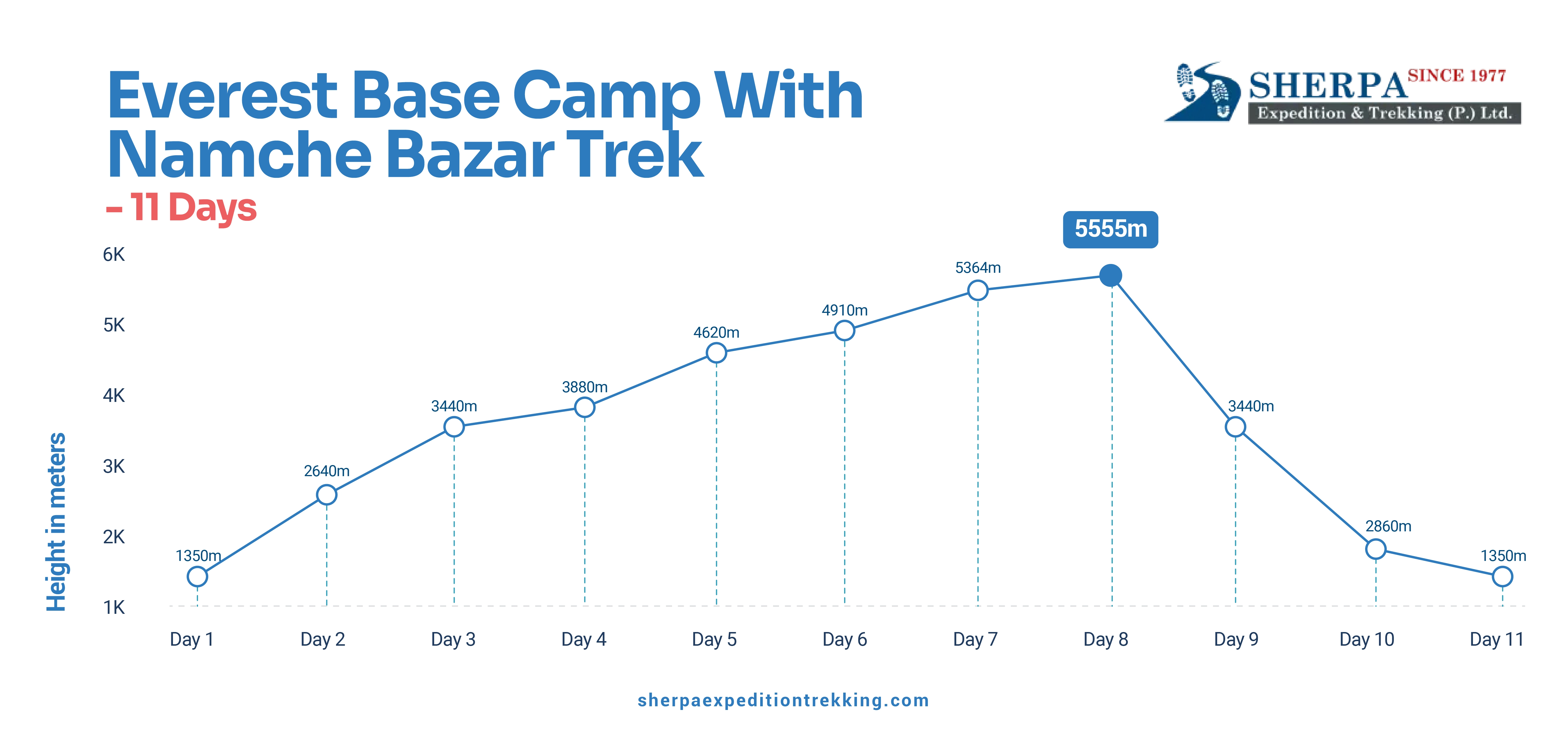
Everest Base Camp Trek 11 Days
After arriving at Tribhuvan International Airport, we'll give you a warm reception by someone from Sherpa Expedition and Trekking to get you transferred to your Hotel where you'll be spending nights during your stay here in the Thamel area, the heart of one of the most famous tourist areas in Kathmandu.
This whole drive takes approx. 20-30 minutes. During this time you can see the colorful streets and temples of the Country as well as the daily lives of its people. Upon check-in into the hotel, you will get sufficient time to either rest up or take out some exploration around the old Thamel area which is full of shops selling all kinds of handicraft and climbing gears along with various cafes and bakeries that are very popular among trekkers. It must be mentioned that meals are not given on arrival day due to the different time zones of international arrivals but still you could eat whatever you want.
At last in the Evening, you'll meet your trekking guide who will brief you regarding the entire trek as well as other important things related with your trek such as details of your trekking route, altitudes' safety issue, luggage arrangement, weather forecasting, etc. So keep yourself ready for this interesting and thrilling encounter.
On this exciting day we’ll have a special flight experience, as our first day will see us flying over some incredible mountain scenery to reach our base camp trek starting point. Also get ready to meet your porters and trek leader, who will help you greatly to reach your destination.. After all the packing and breakfast, head to the domestic airport, where you can begin a very exciting 30-35 minute flight down to the spectacular but incredibly thrilling (some say terrifying) mountain airfield – Lukla.
After a wonderful time soaking up all of the awe-inspiring sights while soaring high above the mountains, we land on the world-famous ‘Tenzing-Hillary’ airfield. From there it’s just a short walk towards the main hub of Lukla. Later we begin heading out along the famous trek path that takes us into the heart of the Khumbu region and into its many Sherpa villages such as Chheplung, Thado Koshi, and Ghat.
The journey is a magical one! You are blessed by views of the amazing Dudh Koshi River, which runs through these villages alongside a few very colorful suspension bridges hung with lovely colored prayer flags. As we move further along, we’ll also pass several mani stones as well as the lovely chorten monuments used by many people practicing their faith throughout the region.
We shall trek today from Phakding towards Namche Bazaar, located in the heart of Sagarmatha National Park at an altitude of around 3,440 meters.
Our Day 3 trek begins with breakfast at our teahouse in Phakding, followed by trekking north across the riverside of the Dudhkoshi River via several suspension bridges through various settlements, namely Toktok, Benkar, Chumao, Monjo and Jorsalle. Your guide will accomplish all necessary formalities regarding the permit here when we officially enter Sagarmath National Park. Our trekking route would continue along the Dudhkosi River till Jorsalle, where we can have lunch after traversing for nearly 3 hours.
Post-lunch we shall cross the famed Hillary Suspension Bridge and start climbing for this entire day’s highest point, which comprises mostly an uphill path passing through pine and rhododendron forests that takes around 2 - 3 hours. You may catch your very first gander view of the majestic Mt. Everest if the sky is clear during this journey as well from the viewpoint en route.
You could expect roughly approx. 4-5 hrs of ascent with approx. 1 hr of descent while covering a vast landscape throughout the day amidst tremendous Himalayan views. Upon arriving at the final destination, Namche Bazaar, one of the most important and colourful business centers for Sherpa's people, you will stay in a tea-house lodge that has beautiful views of the Himalayas.
This morning we will have our Breakfast and after that, we can spend some more time here acclimatizing ourselves as we get used to this increased altitude.
Following this important principle of “Climb High, Sleep Low” we suggest walking up on an easy trail for about two hours to get to the famous Everest View Hotel (3,880m). A lavish hotel such as the one mentioned above provides its guests unsurpassable views of every possible mountain from Mount Everest, Lhotse, Nuptse, Ama Dablam to Thamserku and many more. Most trekkers incline towards visiting the nearby sherpa villages including Khumjung and Khunde, apart from visiting the schools and monasteries around such as Hillary School and Khumjung Monastery. You can return to Namche afterwards if desired.
Lunch is typically eaten back in Namche Bazaar and there are plenty of opportunities for relaxation here with great options available in terms of visiting the local market, enjoying fresh pastries from the Bakeries, or drinking coffee/tea from the local Cafes. If you’re interested in learning more about the culture of the local Sherpa people then we recommend heading over to the Sherpa Culture Museum.
Today’s walk consisted of approx. 2hrs ascent and 2hrs descent which is perfectly fine when getting used to these altitudes but don’t plan on climbing any higher than this until your body has had the chance to adjust properly.
Start your morning with some coffee/tea and breakfasts and get ready for the hike that will be our first one today. From now on we will be heading northeast towards the scenic trail offering wonderful viewpoints of the mighty Everest, Lhotse, Nuptse, Ama Dablam, Khangtega, and Thamserku.
A fairly easy walk along the trails leading you through meadows en route Kyagjuma and eventually descend into a forested area where there are plenty of pine and rhododendron trees. Following a short easy walk, our trek reached Phunki Tenga, which is a small riverside settlement near the Dudh Koshi River. Usually we have lunch here after a 2-hour climb around from Phunki Tenga.
Next we’ll go for a visit to the famous monastery, the “Tengboche Monastery” or “Dawa Choling Gompa," which serves as the spiritual center of the entire Khumbu region. Once you have visited the Monastery then continue towards Debuche crossing the Imja Khola via suspension bridge.
From here on your journey will pass through the Sagarmatha National Park office before ending at Pangboche. Pangboche village has its own ancient and oldest monastery in the Everest Region. Today’s hike consists of approximately 3 hours of ascent and 2-3 hours of descent. We shall spend the night tonight in a traditional teahouse.
The initial segment of your journey occurs now in Pangboche to Pheriche, which starts with a substantial breakfast in Pangboche and leads up to the upward trek through gorgeous alpine pastures.
You will walk up along the trail that skirts through the villages of Shomare and Orsho and continues towards Pheriche at an elevation of 4,240m. As you approach these areas, you’ll notice the valley widens and vegetation thins out as altitude increases. There’s also a point on this trek where there are two paths one leading left to Pheriche, and one leading right to Dingboche.
Pheriche is the popular ‘acclimatization’ village used by trekkers because of its relatively low-altitude setting and proximity to Everest Base Camp. It’s also home to the famed Himalayan Rescue Association during trekking seasons. This morning’s hike will take about three hours until you get to the point where you’re going to eat lunch – usually back in Pheriche itself.
Afterwards, the trail climbs steadily uphill along the upper reaches of the Khumbu Valley and heads up towards Thukla (Dughla) which is flanked by some of the tallest mountains in the world such as Cholatse, Taboche and Ama Dablam amongst others. While today’s trek comprises mostly four-five hours of hiking with just brief periods of descending, it should give everyone more than enough experience of higher elevations ahead along their journey to the famous Everest Base Camp!
Following breakfast at Thukla/Dughla we start our gradual climb towards Thukla Pass Memorial which has several stone monuments that commemorate the climbers and Sherpas who have lost their life while exploring Everest.
We walk along the rugged lateral moraine of Khumbu Glacier through rocky areas with magnificent view of mountains like Nuptse, Pumori, Lingtren etc. After approx. 2-3 hours we will reach to another settlement named "Gorak Shep" and after lunch here, we would reserve our overnight room here.
In the afternoon we will move further east direction to explore the legendary "Everest Base Camp." While going there from Gorak Shep we are going to trek all the way alongside the Khumbu Glacier by traversing on the glacial moraine as well as rocky path. After approximately walking for 2-2 and half hours, we will finally reach the Everest Base Camp (5,364m) during spring climbing season, you can see colorful expedition tents spread out along the entire length of this glacier.
You can capture some nice photographs and also witness spectacular views. Then we will retrace back our footsteps for approx. 2 hours to return to our accommodation place 'Gorak Shep.' So total today's hiking/travelling would be approx. 5 hours ascending and 2 hours descending.
We will be utilizing this prime morning light to start our day early to wake up before sunrise, relax with your hot favourite beverage, and then ascend to Kala Patthar (5,550 m), the finest viewpoint to catch a panorama of Mount Everest, etc.. The steep and stony route to the summit will require roughly two to two and a half hours, but will more than be worth the struggle. From the top, you can feast your eyes upon the glorious panorama of the sunrise including, views of Mount Everest, Lhotse, Nuptse, Pumori and the Khumbu Glacier.
You can spend some quality time there once you get to the summit and then you can easily come down back to location at Gorak Shep after approximately one-and-a-half hours.
Breakfast will be served here and we will begin the trekking process again towards the lower places. We are going to retrace our steps back from Lobuche and while descending, we'll pass by the Everest Memorials located at Thukla Pass and proceed further to Thukla for a meal. Afternoon trekking process will carry us down the wide valley called "Khumbu" amidst alpine meadows and we'll arrive in Pheriche eventually, which is an amazing picture-worthy village and houses the famous Himalayan Rescue Association aid post.
After breakfast pack your backpack at Pheriche Guest House for now as we head back down through the alpine valley. You’ll be heading all the way down towards our next overnight stay, called Shomare. Along the path you will find some traditional Sherpa villages along with yaks grazing, and if you’re lucky enough you can spot an ancient ‘mani’ wall which are stone carvings made by the local people, depicting Buddha’s life. We pass Debuche village then make a small climb up to the world-famous Tengboche Monastery which is regarded as one of the most significant Buddhist monasteries in the whole of the Khumbu region.
Then enjoy exploring this spiritual place before starting on your long descent again through the beautiful rhododendron and pine forested area to our next stop Phunki Tenga where we get our midday meal (usually provided after a 3hr walk). Once here cross over the Dudh Koshi River on a beautiful suspension bridge then take on the last little bit of the hike back uphill to Kyangjuma which takes approx 1 and half -2hrs.
From here the trail will become flat walking along the hillsides before finally getting into the busy and vibrant town of Namche Bazaar. So today we have approx 2 hrs of ascent and 4-5 hrs of descent. We will be blessed with the most magnificent mountain views that Nepal has got to offer.
Wake up early for breakfast at your teahouse for a descent down the steps leading to the well-known Hillary Suspension bridge while moving along the banks of the Dudh Koshi River. You will pass through Jorsalle where you exit Sagarmatha National Park and then move on past Monjo, Benkar and Toktok.
After crossing multiple suspension bridges, you’ll eventually reach the village of Phakding where lunch is normally provided after approximately 3-4 hours of trekking. From here, you’ll traverse through the various Sherpa Villages including Ghat, Thado Koshi and Chheplung while having some great opportunities for taking pictures before heading uphill back to Lukla. This final part only takes approx. 1 hour and you'll enjoy seeing the last view of prayer wheels, mani stones and traditional mountain houses before ending the trek.
The whole trek today would consist of approx. 2 hours of ascent and 4-5 hours of descent. On reaching Lukla we'll have our last celebration of completing the Everest Base Camp journey with our guide, porters and fellow trekkers on a farewell evening.
After having breakfast in Lukla we will have a stroll towards Tenzing-Hillary Airport to get on our scenic morning flight back to Kathmandu.
We need to do an early departure as far as possible since the mountains' weather tends to be much calmer during mornings which increases the chance of on-time flights. You can also appreciate great view of Everest, Khumbu, Rolwaling and Himalayan range from here that only few people can see. Then after completing flight safely we drop you at your hotel located in Thamel area by our representative.
Once we reach in the hotel we can relax and visit the local market, shopping for souvenirs, having a nice meal with your group members at their favorite restaurant in Thamel, and other activities are all available.
Also, some of them choose to take dinner together to bid farewell to each other due to successful completion of trekking tour program. No trekking/ascent/descent today.
EBC WITH With NAMCHE BAZAAR TREK INCLUDES & EXCLUDES
Inclusions
- Pickup and transport at the airport by private car or jeep as per arrival time at Kathmandu.
- In Kathmandu, one night at a twin-sharing hotel with breakfast
- Three meals of your choice (breakfast, lunch, and dinner) throughout your trekking period.
- Evening treats – We offer fresh seasonal fruits for you to enjoy every day post your dinners.
- Comfortable trek teahouse and trek lodge accommodation during the entire duration of trekking.
- Necessary fees and permits to obtain: entry permit to Sagarmatha National Park and Khumbu Pasang Lhamu Rural Municipality Fee to be paid.
- Flight route: KTM – LUK – KTM (or RAMECHHAP – LUK – RAMECHHAP ) depending on the availability of flights. We would arrange for airport pick and drop for domestic flights.
- Guides: A licensed trekking guide from the Nepal government who can speak English fluently and is friendly and professional. Including their salary, meal, accommodation and insurance.
- Porters: Experienced and reliable Sherpa porters with all safety equipment for trekking. One porter per two trekkers is included. Including their salary, meal, accommodation and insurance.
- Complete first aid medical kit used for trekking: An oxygen saturation meter, meals, accommodation, pulse rate, oxygen level, and pulse per minute twice every day of our trek, and watch symptoms for potential altitude illness among trekking members.
- Assistant guide for groups of eight or more trekkers.
- Emergency helicopter evacuation service arranged for you to use as necessary at an additional cost, payable by your travel insurance company.
- SEAT Rental trekking equipment: A sleeping bag, down jacket, duffle bag and trekking poles are provided if needed and need to be returned once the trek is completed.
- Company Souvenirs – Officially printed T-shirts from Sherpa Expedition and Trekking.
- Taxes and certificates: all applicable govt. taxes, official expense, and trip achievement certificate on successful completion of the trek
Exclusions
- While visiting Kathmandu no lunch and dinner is included.
- Visa fees chargeable upon arrival at Tribhuvan International Airport. The cost is USD 30 for 15 days / USD 50 for 30 days / USD 125 for 90 days.
- Travel and medical insurance should be valid for acute high altitude medical conditions.
- International air fare for flights to/from your country.
- Any personal expenditure that is incurred by you such as shopping, laundry, mobile phone bills, and internet services.
- Any drinks and extras such as alcoholic or non-alcoholic drinks, soups, tea, coffee, hot chocolate, cocoa, mineral water, and any other food and drinks consumed while on the trek.
- Sweets and desserts such as various desserts or sweets such as chocolates, cakes, pies, puddings, etc.
- Teahouse Amenities - hot showers and battery charging services at teahouses on route.
- Tips - tips for guide, porters and driver (customary and expected in Nepal).
- Luggage Overweight: charges for excess baggage (over 10kg) will apply if you have overpacked your items for the Lukla flight.
Important note: If at any point during your trek you decide to return before completing the trek because of sickness, personal reasons or whatever else, we will not refund costs of any unused flights, accommodations, meals, or other services as these things cannot be changed once they've been booked. In addition, all additional expenditures incurred for hotels, meals, transportation, or other services within Kathmandu upon deciding to leave the trek early will have to be covered directly by you.
11 Days Everest Base Camp Trek With Namche Bazar Departures
Every departure listed below is 100% Guaranteed — once you book, your trip will run as scheduled regardless of group size.
Select a departure month
Fill out the form below and a Travel Expert will reach out to create your perfect tour.
Everest Base Camp With Namche Bazar Trek Route Map
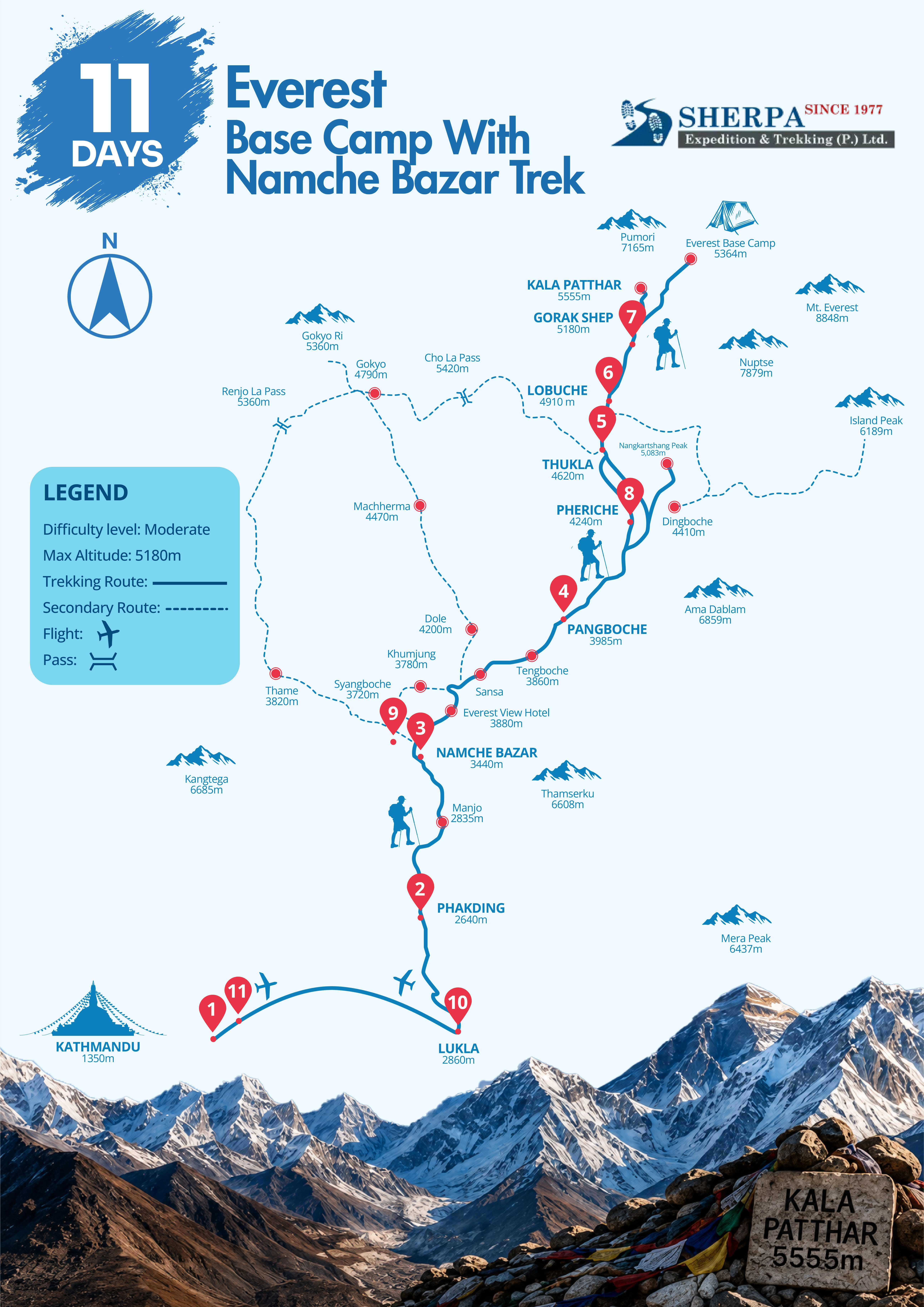
Packing and Gear List for 11 Days Everest Base Camp Trek
Below list would guide on how to pack your backpack, to keep yourself comfortable for the trek. Please do remember that neglecting any of the listed below items can affect your trek experience both positively or negatively; Conversely please do remember not to overload your backpack on the trek. Following is the gear list; which covers everything on this trek- Clothing, footwear, sleeping gear, trekking equipment, personal essentials.
General
- The 12 months season sleeping bag and down jacket (Sherpa Expedition and Trekking could rent it but it might be required to give back once the journey is finished).
- Duffle carrier (Sherpa Expedition and Trekking might provide duffle bag through trek but still you'll want to supply it right back immediately after trek).
- A slim covering rainproof wind jacket is crucial for morning, night, above three thousand meters.
- Daytime Packs
Head / Ears / Glasses (All Year Round)
- A pair of half hand protection
- A warm cover for the head
- Sunglasses
- A shawl
- 15 to 60 SPF ultraviolet ray sunscreen
- Headlights and bonus batteries
- A pair of mittens
- The same pair of half finger gloves when utilizing strolling poles
- It is additionally feasible to acquire warm cover gloves as well as lining
Upper System
- Long-sleeved shirts
- High temperature top
- Wool coat or top
- A few sports undergarments, ladies as well as girls
- Weatherproof and wind proofing protecting shirt
- Down jacket
Lower System
- Long thermal wear
- Lower body thermal underwear
- Pants, windproof and resistant
- Extra warm pants
- Loose trousers
Shoes
- Four to five pairs of pure wool lower body protection
- Pairs of sock liner
- Comfortable strolling shoes
- And also ice footwear
- Sandals
Initial Treatment Set as Well as Medicines
- Some bandaging for your feet and knees
- Blister creams
- Some repellent for mosquitoes and different creams from insects
- Ibuprofen etc from discomfort
- All types of bandage, butterfly shape stitches and also wrap as a result of any kind of harm
- Decontamination tablets (Sherpa Expedition and Trekking's company guide carries medication as well as medical care kit through journey though we still suggest you to bring yours too)
Miscellaneous– But Helpful to Carry on Your Trekking Trip
- 4 passport size photos along with the original passport
- Water bottle and water filter
- Flight details (make a copy of flight and left one in our office in Ktm In case you wants to reschedule)
- Personal toiletries (must include, toilet paper, plastic bag for your used, towel, Soap, hand wipes and everything you might think suitable)
Extras – Things to Carry Optionally
- Trekking pole
- Energy food bar (you will have the choice to buy in between)
- Power bank and musical device
- Camera (memory card, charger, Spare battery)
Why Choose EBC Trek 11 Days?
The 11 day itinerary allows us to strike the perfect balance between having fun in the high altitudes and ensuring our bodies are well taken care of. Ultra condensed treks where we're pushing ourselves way too hard are definitely off - which is why this timeframe makes more sense. We have included some built-in rest and adaptation days at important points during our ascent which gives our bodies enough time to generate all those red blood cells to help our climb! This means less chances of getting AMS and a far more enjoyable trip!
Also, unlike some other trekking options that force us into a very short window of time, we feel like there's plenty of flexibility here to enjoy ourselves and take it all in. We'll have time to really soak up every minute spent walking through lush valley riverside trails and alpine terrain and will be able to handle unexpected things such as flight delay situations in Lukla without worrying about messing up the plan. If you've ever been curious about what it would be like to go on a real trek but aren't sure if you'd enjoy it then try booking one of these 11 day treks out. They cater to anyone really – whether you're just starting out or you're an experienced hiker looking for some solid hiking with not too much challenge thrown your way. And most importantly they offer an amazing opportunity to truly relax while exploring some of the best parts of the Himalayas.
Who is Suitable for this Trek?
This Namche Bazaar Trek caters to all types of people including absolute beginner, solo adventurer, families, nature lover and those who are going for their very first hike in the Himalayas. If you are physically fit enough that you can walk for 4-8 hrs daily on the uneven and hilly terrains while carrying a light daypack then you have got everything you need. You don't even need any prior high altitude experiences. Just keep a relaxed mindset, hydrate yourself properly during your trek, spend some quality time out in nature and you would get this amazing journey of hiking in one of the most beautiful parts of the world which is in Nepal.
Namche Bazaar vs Everest Base Camp
An 11-day itinerary to get to the base camp passes through the places like Phakding – Namche Bazaar – Pangboche – Thukla – Gorak Shep allowing you to reach the Everest Base Camp at a height of 5,364m and the height of Kala Patthar which is 5,550 m. If you decide to use this popular trekking route of 11 days, it becomes possible to save some walking days on the way.
A base camp tour normally would last for 15 days. We visit more places in the Base Camp trek via Phakding – Namche Bazar – Lukla – Monjo – Tengboche – Dingboche – Lobuche, etc. A normal trek comprises Namche and Dingboche acclimatization days. But an 11-day hike doesn’t have enough time for those stops and includes only one acclimatization day in Namche Bazaar.
Comparison Between 11-Day and 15-Day Trek
Pros of 11-Day Trek
This will be best suited for those who don’t have much holiday, but they need to experience the beauty of Everest Base Camp (Kala Patthar).
Cons of 11-Day Trek
Need a lot of physical stamina.
Must travel fast because there’s no sufficient time to enjoy all places.
Pros of 15-Day Trek
Best option when someone wants a relaxing way to travel without worrying about altitude sickness problems.
Cons of 15-Day Trek
You should have more than 2 weeks of free holiday; else it would be tough to plan for this trip.
Flora and Wildlife around Namche Bazaar
The Sagarmatha National Park presents you some of the most abundant flora and fauna of the world. You will discover yourself walking through the well-known Namche Bazaar city and encounter with some wild flora and fauna namely; Himalayan Tahr that roams at Sagarmatha's rocky edge, even may find yourself at sight of Musk Deer that silently roam around woods. In fact, the sanctuary is dwelling some highly rarest of animals namely the shy by its habit Snow Leopards whose glance is merely afforded. Similarly, many other wild varieties i.e.; Red Panda and Blue Sheep.
There many interesting varieties of birds that roams and flutters within the park including the Nepal's national bird; Himalayan Monal; blood pheasant i.e. Danphe; the immense Himalayan Griffon. You'll observe as the changing forest varieties with altitude as you walk on the trekking routes of the forest with patches of Pine and Fir forests first up then gradually reaching to Bamboo patches inhabited by creatures like the Red Panda. Moreover, if you venture out the entire hillside in spring you'd get yourself acquainted with the vibrantly flowing colour of Rhododendron forest and eventually find the sighting of a black Himalayan Bear amidst their native grounds.
EBC Trek with Namche Bazaar Trek Difficulty
This trail has been assessed as moderate with many challenges. There’s quite an amount of uphill climbing involved during this trek. Climbing above the Jorsalle river crossing through a stretch of steep mountains over to Namche itself may take more time and stamina.
Also, you have to keep your balance due to the irregularities of stones when you are going down through the switchback while navigating rocky roads at a higher level.
Once you reach over 3,000 m the oxygen level can decrease substantially and this could cause you problems when breathing. This makes each step become more difficult because your body has to use more effort to do anything. If you don’t go slow enough, you might end up developing AMS from being too quick.
There isn’t much control over the mountain climate here. You could suddenly see a shift in temperature dropping dramatically once night falls, which means sudden wind gusts might pop up anytime causing rainfall followed by snowfall at such a high altitude. It would require constant adaptation too.
Distance and Duration
Total trekking distance of Lukla to Namche Bazaar trek is 18-20 km (11-12.5 mi) and can also take couple of days nearly 2 days. Normally it takes whole day for the Lukla to Phakding hike which will also last a 3-4 hours, then you have the next day to reach the Namche Bazaar. That consists with 10-12km steep and ups and town about 6,000ft in altitude which lasts 5-6 hours.
So altogether the walk time needed by trekkers who want to go all the way till the destination i.e., Namche Bazaar will be 8-10 walking hours only while coming back again same way to Lukla they need to walk same amount of hours.
Everest Base Camp Trek with Namche Bazaar Trek 11 Days Costs
Starts from just $1,150 USD Per Person with our 11-Day Namche Bazaar Trek package of Sherpa Expedition and Trekking.
Transportation Cost
The transportation cost includes a pickup / transfer from the Airport in Kathmandu by private Car/jeep as well as Ground transfer from the Kathmandu to Manthali (Airports) in Ramechhap if there’s a diversion due to busy season air-traffic. The overall transportation cost can be estimated to range between USD 30 and USD 80 according to taking private or Shared mode of transport.
Insurance and Visa Cost
- Nepal Tourist Visa: Free to pay at arrival at the Tribhuvan International Airport (KTM), Kathmandu and cost you U.S. $30 for 15 days, $50 for 30 days or $125 for 90 days visit.
- Travel Insurance: High altitude trek means need travel insurance that covering an emergency medical treatment and high altitude helicopter rescue from high altitude up to 6,000m (about $100-$180, depends on your age and your nationality).
Permit Cost
- While trekking to Namche Bazar as a foreign trekkers you need these two mandatory permits.
- Sagarmatha National Park entry permit - NPR 3,000 NPR (~U.S. $23) for each person.
- Khumbu Pasang Lhamu Rural Municipality permit - NPR 3,000 NPR(~U.S. $23) for each person.
- Total cost: U.S. $46 per foreign trekker (this is included in our package)
Guide and Porter Cost
- Licensed Trekking Guide: $30 – $40 USD/day including salary, food, accommodation and Insurance.
- Sherpa Porter :$20-25 USD/day( One porter carries luggage for two trekkers. maximum weight allowed by sherpa is 18-20kg)
Lukla Flights Cost
In general, the single most expense that many backpackers underestimate for their Everest Base Camp trekking holiday is the round trip (Kathmandu/Ramechhap - Lukla-return) flight to Lukla. This typically costs from $380 – $440 USD with standard foreign price (including internal airport fees and limited weight allowance (10Kg hold baggage and 5Kg hand luggage).
Accommodation Cost
Typical teahouse or trekking lodge accommodations during your EBC trek from Lukla through to Namche’s highest altitude will typically vary from $10-$25 for accommodation sharing the room. Premium, or higher altitude “luxury” tea houses in Namche have even been known to charge over $50-$150 for double accommodation with bathroom and heating.
Foods and Drink Cost
During your EBC trek, foods become more and more expensive as they all have to be transported to a higher altitude. Typically, your food may well range $25 – $40 per day (3 meals). Likewise, drinking water at $1-$3/liter is another cost to factor in.
Hidden Costs During the Trek
- Beyond your primary package, here’s a general breakdown of how much you should prepare for your on-trek (Nepali Rupees) miscellaneous cash needs:
- Charging: Most tea houses and lodges charge per electronic device for phone recharging; typically $2-$5 per device/recharge.
- Power and Internet: A 24hr Internet card from Teahouse “Air-links” or within a given teahouse costs approx $3-$5/day; some teahouses have satellite Wi-Fi as an option, which varies from the price of the “Air-links”.
- Hot Shower: A gas-heated shower will typically cost about $3-$6 at a lodge or tea house.
- Special Meals and Snacks: Most on-trail meals and drinks (including tea, coffee, etc.) are included in your package. You’ll need cash for snacks, treats, bakeries, and coffee in Namche Bazaar that range from $2-$8 per item.
- Tips: It’s customary for guides, porters, and drivers to be tipped in Nepalese trekking. Expect to pay a total amount of between $100-$150 for these various individual personnel per person for the entire length of the trek.
Best Time for EBC Trek
The journey to Namche Bazaar is feasible during most of the year but the weather and visibility will vary considerably. Below is a discussion of what to expect season-wise while trekking the route to Namche Bazaar:
September - November (Autumn)
This is regarded as the finest season for trekking due to clear, very dry, and very stable weather, extremely clear air from post-monsoon, and high-season mountain visibility due to these conditions. The days can be quite warm.
March - May (Spring)
With warming weather comes clear rhododendrons bloom during the season’s early months and an average clear day sky at dawn. It is a suitable season for trekking in ideal conditions, although a haze can occur in late afternoon throughout May.
June - August (Monsoon)
This is a rainy season, and treks are affected by very slippery trails, numerous leeches, frequent Lukla flight delays, and views obscured by cloud cover of the mountain. The landscape, however, becomes greener with heavier rain.
December - February (Winter)
This time of year is pleasant with frosty evenings but the days can be very warm and sunny with the odd clear day and light number of tourists around, just pack suitably for cold weather.
Preparation and Safety Measures for Everest Base Camp Trek
Officially, a "Namche Bazaar trek package", this 11 days route is not so modest and you travel beyond capital of Sherpa, to Everest Base Camp (5,364m), to Kala Patthar(5,550m). Strict measures for preparation are absolutely necessary in order to safely complete such a whirlwind trip up high.
Preparation and Health
The leg muscles and cardio are important but will take more of a back burner than long cardiovascular activities and leg strengthening training in 6 to 8 weeks before leaving.
You may begin to experience some benefits of training your muscles with actions such as:
- Hill climbing (steps)
- Swimming
- Cycling
- Jogging
This will help with the acclimation that your body receives with trekking daily about 5 to 7 hours over Everest terrain.
Altitude Training
Even without the ability to simulate extreme conditions or air pressure at sea level, with the help of endurance training you'll prepare your lungs to have the help they need.
Try:
- Inclined treadmills
- Stair training with a loaded day pack
- Controlled breath training exercises
- Simulated high-altitude workouts using high-altitude masks
- Short bursts of actual high-altitude hiking prior to the expedition
- These activities shall prepare to take altitude over 5,000m
Essential Equipment
The high quality equipment is crucial once you are above the trees to prevent a range of cold exposures and risks. Top items on the checklist are a high quality 4 season down jacket, a sleeping bag with an -15C rating, solid trekking boots with high ankle support and moisture wicking base layers which are also breathable. Trekking poles, U V Ray sun glasses and a windbreaker are also a priority.
Acclimatization
During our eleven-day visit, the most important aspect is an acclimatization day on day 3,440 m Namche Bazaar.. You should walk along at a relaxed pace; Do not over exert yourself during the trekking on this trip. Your guide will provide guidance about their own pacing strategy. You must stick to the “climb high, sleep low” principle while hiking for acclimatization.
First Aid Kit and Medication
Stock up on a personalized first-aid box that can address all types of issues at high altitudes. Acetazolamide (Diamox), blister prevention kits, rehydration salts, Ibuprofen, and broad spectrum antibiotics are some medicines you should have. Also, your sherpa expedition guide carries his own set-up consisting of a pulse oximeter which he uses every day to keep an eye on your blood-oxygen saturation as well as your heartbeat!
Diet and Hydration
Don't go hungry – you will get fatigue and suffering of Acute Mountain Sickness (AMS). Your menu would be fresh, vegetarian, made from high amount of carbohydrates. Choose teahouses, which allow you to be more active through their prepared meals.
Intake of sufficient amount of liquids such as pure 4-5 liters water every day and purify it with tablets or take an insulated water bottle to avoid it getting frozen. Absolutely avoid alcohol and tobacco. Because these will affect your body and cause dehydration.
Things To Know
Accommodation
- Teahouse System: Trekking in the region mainly uses classic Nepalese teahouses, which are family-owned homes located along the trail. A bed, a meal, and the welcome of Sherpas will be provided.
- Twin Sharing Rooms: There are rooms having twin beds or single wooden beds along with a bed, pillow, and blanket. Toilets and showers are usually located in the corridor. In a few teahouses, attached toilets are available.
- Basic Facilities: There is no heating in the teahouses at higher altitudes. Extra costs for hot water, using the internet, and charging electronic appliances will be charged per day by the lodge keepers.
- Luxury Facilities: Namche Bazaar has some relatively comfortable lodges such as "Hotel Everest view" and "Yeti Mountain Home", and these lodges have facilities of heating room and heating beds, with attached toilets as well which should be booked at prior notice.
Transportation
This transfer begins typically by a comfortable Private transfer from the airport. We drive through country sides of Kathmandu city up to airport, the place where Lukla journeys start. During the high tourist season, you would have to embark on a drive of around four to five hours to reach the airport of Ramechaap. The exciting flight to Lukla is approximately thirty minutes towards Tenzing-Hillary airport in Lukla.
Insurance and Visa
Nepal Tourist Visa
Easily obtainable upon landing at Kathmandu Airport.
- 30 USD / 15 days
- 50 USD / 30 days
- 125 USD / 90 days
Depending on the days of your stay in Nepal.
Travel Insurance
Mandatory for all trekkers.
Make sure it covers:
- Climbing up to 4000m on high altitude treks
- Medical expenses in high altitude
- Medical insurance for high altitude helicopter rescue evacuation
Permits
Sagarmatha National Park Entry Permit
Required for access to the park premises and conservation area.
- NPR 3,000 / person for foreign nationals.
- Available in Kathmandu or Monjo park entrance check point.
Khumbu Pasang Lhamu Rural Municipality Permit
- A regional entry tax for visiting the area
- It has replaced the TIMS card
- NPR 3,000 / person for foreign nationals
- To be purchased at Lukla arrival
Guide and Porter
- Government Licensed Guide: It is a mandatory requirement to hire a qualified trekking guide and ensure proper mountain safety and cultural experience during your trek. The guide checks your health in terms of oxygen levels at altitude and monitors the trek.
- Sherpa Porters: Leave the duffel bag (carrying a maximum of 18-20 kg shared between two trekkers) behind with your porters and enjoy trekking with just your light day pack and personal items.
Personal Expenses
A minimum amount of Nepalese cash rupees is needed for your personal expenses on the trek, including:
- Teahouse hot showers
- Recharging phones
- Wi-Fi passwords
- Drinking bottled water
- Treats from bakery shops
- Tips for guides and crew
ATMs in Namche Bazaar might not be reliable at times.
Gallery of 11 Days Everest Base Camp Trek With Namche Bazar


FAQS Related to 11 Days Everest Base Camp Trek With Namche Bazar
General Information
It is a perfect spot for a view from the Everest View Hotel (3,880 m) for a great view over Mount Everest and Lhotse as well as Ama Dablam. Another option is the Namche Cultural Museum viewpoint as well as the ridge above the village.
Yes, there are a few ATMs around Namche. Most all work for Visa and MasterCard, but network connections, cash availability, and power cuts are very common; thus, make sure to have some physical NRs cash with you when you leave Kathmandu for your trek.
A typical day in Namche is normally sunny and clear in the morning; however, there is a bit more rain in the afternoon as days cool down. Autumn and spring normally have 8 - 15 degrees Celsius and will drop below 0 at night. Winters will be extremely freezing, and the monsoon provides for lots of rain and fog.
In terms of day hikes around Namche, I recommend walking to some local villages like Khumjung or Khunde (where the Hillary school and Khunde Hospital are located), Thame, or even the local market and the Sherpa Culture museum.
Preparation and Fitness
Decent level of physical condition is needed. Although technically simple, this is uphill all day every day on rocky terrain at high elevation. So be prepared with good leg strength, endurance, and aerobic capacity.
In the 6-8 weeks prior work on steady state cardio. Running, cycling, rowing, and swimming training can develop your cardiovascular capacity. The 2 best activities for you to use outdoors are an incline tread mill walk and stair work with pack in.
To prepare yourself, I'd recommends walking in this normal way, also in your training weeks with your day pack (5-8 kg). This will exercise your lower back, core and your shoulders to keep up carrying necessary items in long distances at the mountain.
Include adequate clean food within your diet (healthy complex carbohydrates, protein and healthy fat) and hydrate accordingly over the coming weeks. This helps increase your capacity cardiovascular system to promote blood flow to the tissues oxygenating muscles.
Health and Safety
Yes AMS could begin around 2,500-3,000m with the symptoms of such in turn setting in at these altitudes (therefore being important in the case of Namche which is at 3,440m to move slowly and fluid the day as part of the climb and ensure designated rest days for the adjustment of the acclimatisation of the body with the atmosphere of altitude to ensure it would do so more smoothly).
Yes local shops exist at Namche which has basic health clinics/pharmacies which treat basic altitude related illness, minor injuries, common diseases etc. There is a well-resourced hospital on the mountain, a short trip to the nearby village of Khunde has expert doctors in mountain medicine.
Dress in layers- thermals that whisk away moisture, a down jacket to warm and a windproof outer shell. Keep hydrated with warm fluids like ginger tea wear a beanie and a neck gaiter on cold days to avoid 'Khumbu cough', sleep on very cold nights in thermal rated for -15C.
No, tap or river water cannot be drunk without a purification method as there is a risk of contracting gastrointestinal illness due to the bacteria contained within. Methods such as water purification tablets, UV purifiers, chlorine drops should be taken or boiled water can be purchased from teahouses.
Permits
Yes, please carry 2 to 4 passport size physical copies of the photographs of each group members for your Sagarmatha National Park Entry Permit and paper registration. Nowadays physical copy are decreasing because of electronic permit; however, carry physical photos for back up, on the spot usage.
Yes, you will have to take both the local Municipality Entry Permit (Khumbu Pasang Lhamu Rural Municipality Permit) and Sagarmatha National Park Entry Permit for entering Sagarmatha National Park and the Khumbu Region, whether your travel route is overland and trek.
Some of the hotels can be accepting US dollars as a currency, but it is very difficult to use any dollars in teahouses, stores and government offices in a local level. So you better exchange money from cash into local NPR currency while you are in the valley of Kathmandu.
Insurance and Visa
Yeah, pretty much every nationality can get a Visa on arrival to Nepal at Tribhuvan International Airport, Kathmandu. Just fill out one of the forms on the electric kiosks, pay cash and you'll have jumped over the immigration counter.
If planning a visit to Nepal, the tourist visas for Nepalese are available with the cost of USD 30 for 15 days, USD 50 for 30 days and USD 125 for 90 days on payment in convertible major currency at the airport.
Trekking in high altitude areas is hazardous and without cover any high-altitude helicopter rescues or medical evacuations will be eye-watering.
Your insurance must state clearly that it covers high-altitude trekking to 6,000 metres ( or 6,000m plus if going to EBC), medical emergency helicopter evacuation, mountaineering search and rescue, treatment, and journey cancellation and rescheduling.
Guides and Support
Hiring a licensed guide keeps you safe from the trail itself, provides context for the culture you will encounter, and can monitor the health of those trekking. Porters are helpful in that they lighten your load of gear. Nepalese law strongly recommends, if not requires, hired registered guides for foreign trekkers.
A single Sherpa porter can support approximately 18-20kg per trek, which works out to about 9-10kg per trekker duffel bag for two trekkers.
Tipping is customary within Nepalese trekking. Our general guideline rate is $10-15 usd /day for Guide and $8-12 usd/day for Porter (these rates will be paid directly to your guide/porterage company upon completion of the trek).
You can contact our licensed guide/trekking agencies who will assist you with all necessary documentation required for obtaining the permits such as Khumbu Pasang Lhamu municipality and sagarmatha national park permits.
Accommodation
Yes, WiFi is available in some tea house accommodation in Namche Bazaar, with prepaid "Everest Link" cards available for purchase at tea shops all the way up. However, this can get slower and more expensive further up.
Many of the tea house menus consist of local Nepali and western meals. Most prominent will be Dal Bhat (rice steamed in flat rice, served with lentil soup and curried vegetables), though also many variations on momos, noodles, fried rice, soups, porridges, and eggs are also common.
Yes, there are hot showers to be had in Namche Bazaar and in villages around there - usually charging USD 3-6 for 2 minutes, fed through on-demand gas geysers. Some also have solar water systems.
RELATED PACKAGES




Latest Traveller’s Reviews
Travel experiences of our clients who recently returned from their trips.
100%
Based On 258 Reviews
Uzzol Hossain
United States
September 17, 2024
Passionate and Dedicated Team
Grzegorz Łukasik
Australia
September 2, 2024
A Journey of a Lifetime
Mariana Dimitrova
Germany
August 13, 2024
Unforgettable Adventure

Write Your Review
Average Customer Ratings
How The Travellers Have Rated This Package
254
4
0
0
0


