LOBUCHE PEAK CLIMBING
USD 2,190 / Per Person
Lobuche Peak Climb Overview
This Lobuche Peak Climb is going to offer us a thrilling high-altitude trek with a climb through the Everest region of the majestic Himalaya mountains in the Solukhumbu region (Solukhumbu District) of Nepal Himalayas, which is one of the best trekking destinations for hikers from across the world. The journey will take us through the vast expanses of the Mahalangur Himal in the Everest Sagarmatha National Park, which is a UNESCO World Heritage Site, giving us great opportunities for classic Himalayan trekking at every alpine valley and glacier along the way.
Our adventure begins with an exciting flight to Lukla at Tenzing-Hillary Airport from where we will make our way across the fast flowing Dudh Koshi River to Phakding and then to Namche Bazaar, which is another famous Sherpa market. We will experience the rich Sherpa culture of the place along with the famous Local Hospitality (Sherpa hospitality), Buddhist Culture and Tibetan Buddhism as we visit local attractions on our way through the region. We will also be trekking along the popular Teahouse Trekking route in Nepal before crossing the beautiful Imja Khola river and reaching the famous Tengboche Monastery, a very holy monastery in Sherpa Community.
Moving deeper into the sensational Khumbu Region, our trek through the glorious Khumbu Valley passes Gorak Shep, with a summit push to the magnificent viewpoint Kala Patthar and a trek into Everest Base Camp, adjacent to the huge Khumbu Glacier. We then traverse a fierce, steep Moraine Trail through wild and difficult Rocky Terrain, cross a spectacular high Mountain Pass and arrive in a calm Glacier Basin where we will then prep our equipment for some extreme Alpine Climbing and wild wilderness Camping at Lobuche village.
For the final push to the summit, we leave Lobuche High Camp, taking the time to admire the peaks of the mountain, both Lobuche East and Lobuche West. Lobuche Peak Climbing requires making good use of your stamina and determination. But once you get to the top of Lobuche Peak, do not be surprised at the view of the mountain, for what they say is true. With a traverse up and over the Himalayan mountain range, along the ridges of Lobuche, we then gaze down with a fine view across the rooftop of the world, taking in the mighty Everest (8,848.86 m) massif – this includes Everest (8,848.86 m), Lhotse (8,516 m), Nuptse (7,861 m), Makalu (8,485 m), and its striking feature, the most iconic-looking peak, Ama Dablam.
Lobuche Peak Highlights
- You make it to the top at 6,119m and make wonderful, memorable, unforgettable experiences and enjoy fantastic Mountain Views from Lobuche East Summit.
- You have a breathtaking experience of Lukla's airport, one of the most extreme in the world.
- Crossing over various pretty swing bridges over the river originating from the Khumbu ice glaciers throughout your Lobuche via Everest Base Camp journey, you’ll be able to see the brilliant vistas of Everest, Lhotse, Nuptse, Makalu, Ama Dablam and other mountains.
- Everest Base Camp is also on your trek, and here we go to these amazing campsites that have been used by the Everest climbing teams.
- Kala Patthar provides an awesome view of the Mt. Everest which is known to be the best viewpoint in the Everest region, where you can witness a near-close-up view of the great peak during sunrise/sunset.
- Enjoy the view of the magnificent Khumbu glacier that is the largest glacier in Nepal, with its large size ice formations along with some rock-formed glacier paths.
- Walking amidst the traditional Sherpa village, passing through the peaceful Buddhist monastery, where you will get to feel the local culture as well as their hospitable nature towards outsiders.
- A trek to Sagarmatha National Park, which is a UNESCO World Heritage Site and home to diverse species of wildlife, beautiful forest and some of the world's highest mountains, including our famous Mount Everest.
- Take a visit to the ancient gompas such as the famous Tengboche Monastery – the largest monastery of the Everest region with spectacular Himalayan mountain views around.
Flora and Wildlife on the Lobuche Peak Route
With our trek ahead in the journey, you'd be at the core of a variety of habitation enriched with green surroundings of flora that's native of the great Himalayas. While trekking on our way in the lower elevations we hustle down the trails crossing through deciduous woody forest that's abundantly featured with deodar, pines, silver fir, junipers, and Rhododendrons. After crossing several high elevations, we will soon see the vegetation changing from luxuriant woods into susceptible plants of alpine shrubs, resistant grasses and weeds in the highlands.
Vibrant flowers carpet the side of our trails during spring and fall; they blossom vibrantly amidst the terrain. All these different species of flora support marvelous fauna. While walking through, we can come across some natives; native Himalayan tahr, musk deer as well as playful pikas will possibly crawl along the rock face slopes. Besides these, spectacular avian life also rules the sky, Danphe (Himalayan Monal) being most common species to be encountered, along with lammergeiers. Our high alpine venture could not be more perfect without enjoying the spectacular flora and fauna kingdom.
Lobuche Peak Climbing Route
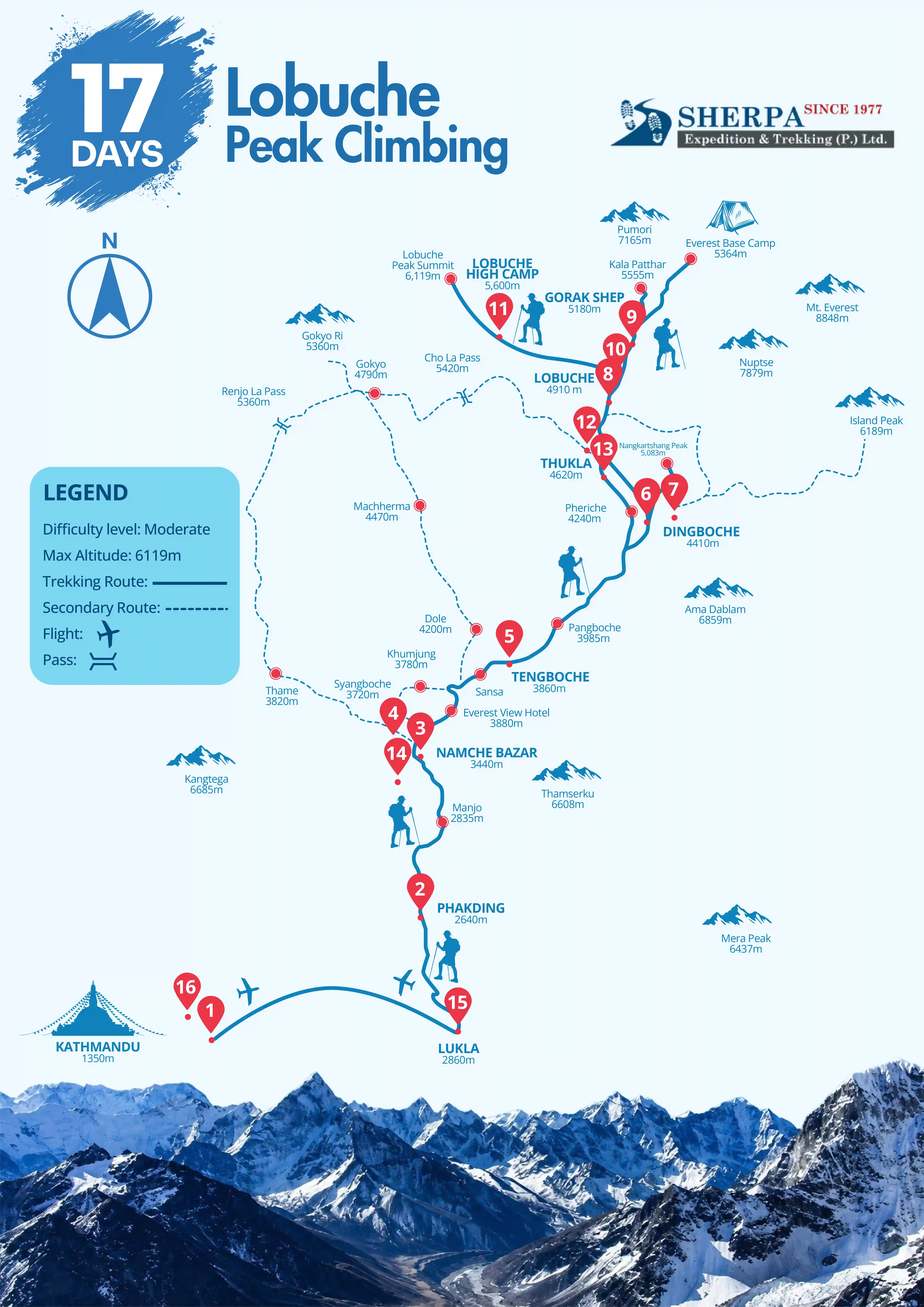
First we visit Lukla via flight, after we reach it then we travel by foot to Namche Bazaar via Phakding, then to the Tengboche Monastery. Followed with trekking beyond to Dingboche from there on the path leads to Lobuche. It will then bring us to Gorak Shep as well as take us on our exploration of Mount Everest Base Camp along with breathtaking vistas from Kala Patthar (a popular viewpoint of Mount Everest.)
After which, we return back down to Lobuche where we again climb to our high camp before our final journey towards the Lobuche East Summit. Then we come all the way back down to Lukla, we get on a flight and reach all the way back to our starting point which is Kathmandu.
Why Choose Lobuche Peak Climbing?
Amazing Mountain Views
Ascend higher than 6,000 meters and get an awesome panorama from the Lobuche top of Everest, Lhotse, Nuptse, Ama Dablam, Pumori, and other various ranges of the Himalayas.
An Excellent Peak for Climbing Training
While climbing Lobuche Peak you will learn how to use crampons, fixed rope, and ice axes, which are important things when doing a difficult mountain expedition in the Himalayas. So if you want to learn all the basics of mountaineering, then this will be the best spot for you.
Combined with the Everest Base Camp Trek
You’ll be heading for the ever-popular Everest Base Camp trek; thus, you’ll reach the Everest Base Camp site as well as take in the majestic view from Kala Patthar prior to heading to the summit of Lobuche Peak.
Rich Sherpa Culture and Local Traditions
Experience the rich heritage by walking through the traditional Sherpa villages. Visit the ancient Buddhist monastery and have interaction with friendly local people to know the unique culture and tradition of the Khumbu region.
Why Choose Lobuche Peak Climbing with Sherpa Expedition and Trekking
- 40+ years Himalayas knowledge, designed to perfection itineraries, small group sizes and a conscious travel approach translate into very smooth, organized, very responsible and ultimate trekking adventures from the moment of arrival till departure.
- Our experienced and licensed climbing guides and Sherpa team have many years of high altitude experience, offer practical on-trek climbing training, observe your safety closely and will guide you towards the successful expedition of Lobuche Peak.
- With Guaranteed departure, you can book your holiday to the Himalayas with assurance.
- Quality sleeping bags and down jackets, available for rent, will keep you warm during the extremely cold temperatures of the high mountains, without having to pack and lug your bulky gear around on your trip.
- We provide emergency services of 24 hours and health supervision, along with communication and coordination of rescues and helicopter evacuation through your travel insurance.
- The booking process is convenient and fast with clear trip information, secure booking confirmation, responsive communication, and assistance before and after your reservation.
- The local Sherpa group practices responsible trekking with respect for the culture of the people, preservation of nature, help to local communities, and good treatment of porters.
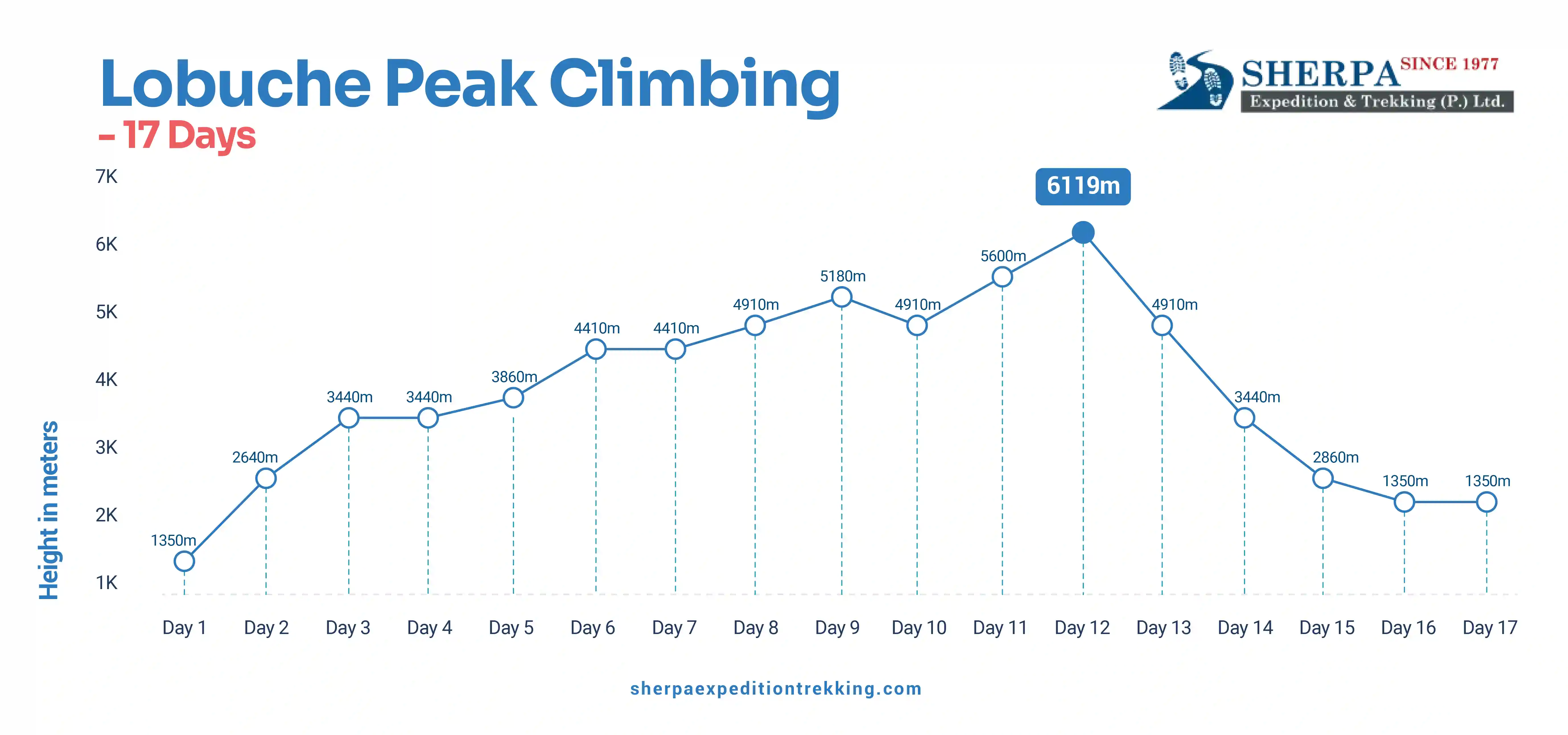
Elevation Profile
Lobuche East Peak Climbing Itinerary
We will start on our grand journey planned by Sherpa Expedition and trekking once we arrive at Tribhuvan International Airport in Kathmandu. There, a most welcoming member with a polite namaste from the gate receives us and smoothly personal transfer to our comfortable hotel in the core part of Thamel. After completing check-in at our hotel and getting ourselves refreshed, we’ll convene at the lobby for a comprehensive pre-trip orientation.
There, our main climbing guide will explain to us the climb itinerary, do a thorough gear check-up, review the protocols relating to altitude safety measures, and confirm we have the requisite trek permits arranged.
In the evening, you can go for a walk along the buzzing street where you can try mouthwatering delicacies like authentic Nepali delicacies, which is then followed up with answering your final questions, and we call it a night.
We wake up really early in the morning as our team will transfer us to the airport where we will take an aerial 30-minute scenic flight to Lukla's Tenzing-Hillary Airport. After landing, we'll meet our local porter team here and get sorted with all our gears before starting the official trek.
Once outside the town we turn right and head down on stone paved paths passing by chortens and prayer wheels towards the beautiful Dudh Koshi River Valley. We walk across our very first suspension bridges and traverse some small settlements such as Chheplung and Ghat. At the local municipal entry post, our guide gets our permits registered for the day ahead after which we have a nice and fresh lunch in one of the cozy little teahouses located along the banks of the river.
From here onwards we continue walking on the gentle and winding path keeping on the left side of the river bank till we arrive at this peaceful village called Phakding where we sit back and enjoy ourselves having a hot and hearty dinner followed by an overnight stay at a comfortably set up teahouse.
We start the day with breakfast back at our teahouse and then embark on the day's trek along the banks of the Dudh Koshi River. The trail takes us back and forth across various heart-pumping suspension bridges. We continue through Monjo where we have to verify our park permit at the Sagarmatha National Park check post.
After trekking further a short distance to Jorsalle for lunch, we brace ourselves for the climb, a mostly vertical ascent to a stunning viewpoint that unfolds with the convergence of the Dudh Koshi and Bhote Koshi rivers with yet another impressive suspension bridge, the Hillary Suspension Bridge.
Beyond this fearsome bridge, the trail takes a sharp right into a switchbacking climb through pine forests and rhododendron that offers up a tantalizing progressive views of our destination, Everest and then of course the array of lights of Namche Bazaar, which finally gives us pause as we find our teahouse for a much deserved evening meal and sleep.
Our morning begins with impressive mountain views from our lodge and an early breakfast prior to embarking on our day's important acclimatisation hike. Leaving the lodge we ascend the ever-present stone steps to the right, climbing up towards the Everest View Hotel. We follow an upward path above the town to gain our ever-increasing panoramic views of Mount Everest, Lhotse, Nuptse and Ama Dablam.
We take an ample amount of time at the Everest View Hotel terrace enjoying hot drinks while gazing at the incredible panoramic scenery.
For our loop we turn left to take us across towards the high altitude airfield and walk through traditional Sherpa villages including Khumjung and Khunde. We can also visit the monastery in Khumjung and the local Hillary School. In Khumjung we enjoy our delicious lunch prior to an easy and relaxed stroll back down into Namche Bazaar. After enjoying some time shopping in the town for souvenirs and baked goods, we have a fine dinner and another night of fine sleep at our teahouse.
Today’s journey begins with a delicious breakfast before heading back towards Tengboche Monastery on foot. As we walk, we’ll traverse a gorgeous stretch of forest consisting of birch trees, conifers and rhododendrons.
Then, after crossing a wooden bridge spanning the rushing waters of the Imja Khola River, we will begin walking gradually upwards towards Pangboche by turning left. We’ll walk past ancient stone walls and then stop off at a local teahouse in Somare for some relaxing lunch, enjoying up-close and personal views of the mighty mountain Ama Dablam.
Now the forested area will transition to a drier, shrubby landscape typical of alpine regions as we climb further up in altitude. Here we’ll come across another river confluence point - you'll need to pick the route going to the right here - which leads us up and into the wider wind swept valley known as Imja. After passing through stone walled fields, we’ll reach our final destination today of a high altitude Sherpa settlement called Dingboche and will be checking in at our lodge there and have time to relax and enjoy an evening meal and night’s sleep.
A clear morning is the best time to see the exquisite monastery in Tengboche. This is a perfect time to unleash the camera! We then continue our trek taking the upper trail taking advantage of the views to witness the view of this ancient monastery before passing through several Chortens and Mani walls and several small villages. While enjoying our lunch break we can take in the fantastic close-up views of Ama-Dablam. The afternoon takes us north to Pheriche, or alternatively, we can take the trail heading east beneath the towering north face of Ama Dablam. From this point, the trek is fairly easy-going before we enter the Imja Valley. The valley gradually opens up as we approach the confluence of the Lobuche River. We then descend into the river and begin the last and steepest climb of the day up to Dingboche On arrival in Dingboche, we see a spectacular array of fields enclosed by stone walls to protect the barley, buckwheat, and potatoes from the cold winds and grazing animals. Breakfast, lunch & dinner included.
Today’s goal will be to get your body ready for those crazy heights as you take on more active acclimatization. Start with a hearty breakfast then wrap up warm and hit the trails heading east from Dingboche.
Take the right hand trail which gently climbs through the spectacular Chhukung Valley. On this walk through an open glacial floor you’ll have the opportunity to enjoy incredible views of Island Peak, the massive south face of Lhotse and dramatic looking glaciers off of Nuptse.
Once you’ve reached the high point of Chhukung stop in the village to grab some hot drinks and maybe even treat yourself to some tasty lunch. Then make use of these glorious high-alpine mountain scenes to relax and really take it all in Following the 'climb high, sleep low' practice, time to turn around and hike down the most beautiful trail in this valley towards Dingboche. Rest this afternoon and drink more fluids then have another warm supper. Another overnight at this teahouse awaits you.
The day starts with a hot breakfast, after which we ascend to the ridge above Dingboche and then descend towards the large grazing fields of Dusa. The trail winds gradually up the high valley above the glacial stream bed with great views of peaks like Tawache and Cholatse on either side. We traverse a log bridge across a tributary stream from the Khumbu Glacier and reach the small settlement of Thukla, where we take a packed lunch in good time. The most challenging hike of the day begins next; a fairly abrupt rise along the terminal moraine of the Khumbu Glacier takes us to the crest where we encounter a memorial park for Everest climbers who have passed away. At the memorial grounds we take the trail bearing to the right and head onto a gravel moraine leading in direct line to Lobuche, the trek which should take only a couple of hours. We check into our mountain lodging and relax later.
We'll leave Lobuche early post-breakfast today as we head towards the lateral moraine of the massive Khumbu Glacier where we're going on an awesome trek.
Our journey will involve crossing over loose rocks, boulders, and then getting into steeper areas of glacial debris. As we reach lower levels, we'll find ourselves dropping down to the sandy area of Gorak Shep.
We check in at our teahouse, where you can drop your packs, grab some nourishing food for a short lunch break, and then set out on your way to Everest Base Camp.
For the first leg, you take a right turn from this point and trek on the glacial trail, crossing a trail of ice formations, rocky walls and to top it off witness the renowned Everest Base Camp at 5,364m right beneath the mighty, yet infamous Khumbu Icefall, a major danger zone for high-altitude expeditions on the world's highest peak. Have an awe-inspiring 2-3 hour stay in EBC as you take pictures with the world famous Everest Base Camp in the background. Once done, we retrace the steps and travel back towards the glacier again till we reach Gorak Shep, where we have a hot soup and dinner followed by staying at the overnight lodge.
We awaken in the pre-dawn dark, with sub-freezing temperatures. Fitted with our headlamps, we will begin our ascent to Kala Patthar. We will turn left on our way from Gorak Shep and will begin our steady uphill slog up steep, rocky, and grass covered ridges.
At sunrise we'll reach our destination, Kala Patthar summit at 5,545m for unbelievable, unobstructed views of Mount Everest, Nuptse and the other surrounding peaks of the Himalayas. After sufficient time taking in the scenery and snaps, we'll begin our descent back to Gorak Shep and have a proper warm breakfast. We pack up our duffel bags and begin to retrace our steps up the valley, down the path alongside the rocky trail along the moraine of the Khumbu glacier. Early in the afternoon, we arrive at Lobuche and get into our teahouse for a filling lunch, a much-deserved break, dinner, and to get a full night of sleep as tomorrow we will set off for High Camp.
We head off the main trekking trail after breakfast. Turn right here on this narrow rocky path and walk due towards Lobuche Peak. The first half an hour is scrambling on rocky alpine terrain, and then walking is an extremely tough hike due to walking through loose scree along with technical scrambling of granite boulder fields.
This will take about 3-4 hours and eventually lead us to our camp at 5,600 meters called the Lobuche High Camp. It’s located on a high rocky ledge next to a glacial lake. Once there, our experienced Sherpas set up your mountain tents and prepare a nice warm lunch.
In the afternoon, you’ll have a pre-climbing training session with your awesome guide who teaches all the important fixed-line techniques, how to fit your crampons properly, and much more. Then enjoy an early dinner inside our dining tent and rest as soon as possible in your sleeping bags since you’re going to need plenty of energy during today’s big summit push.
Our high-stakes day commences at about 1 am, with a tea, snack, securing headlamps, harnesses and crampons, and outside into the cold. We then turn onto the steep rocky gulley and up onto the glaciated snow covered ridge.
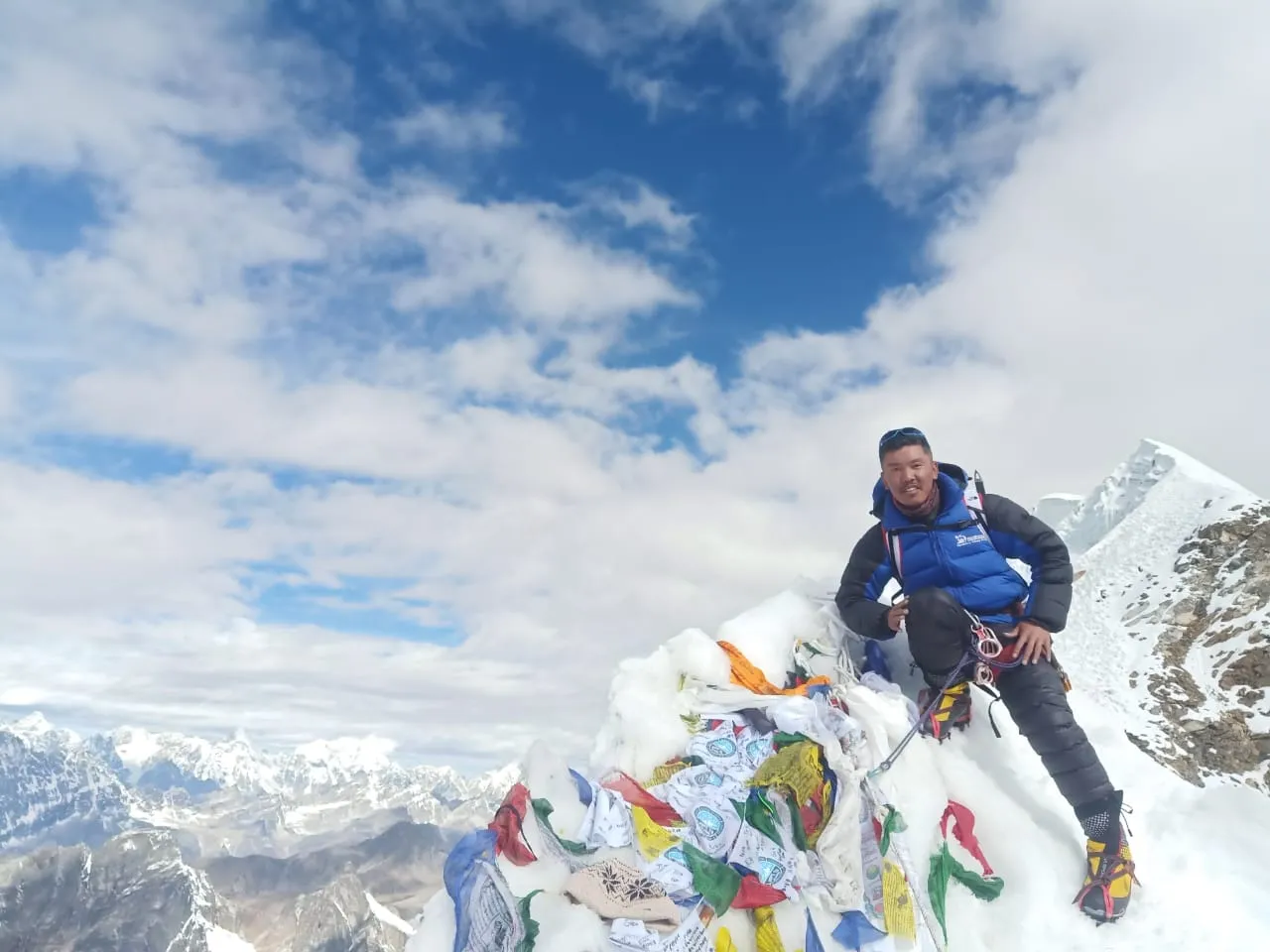
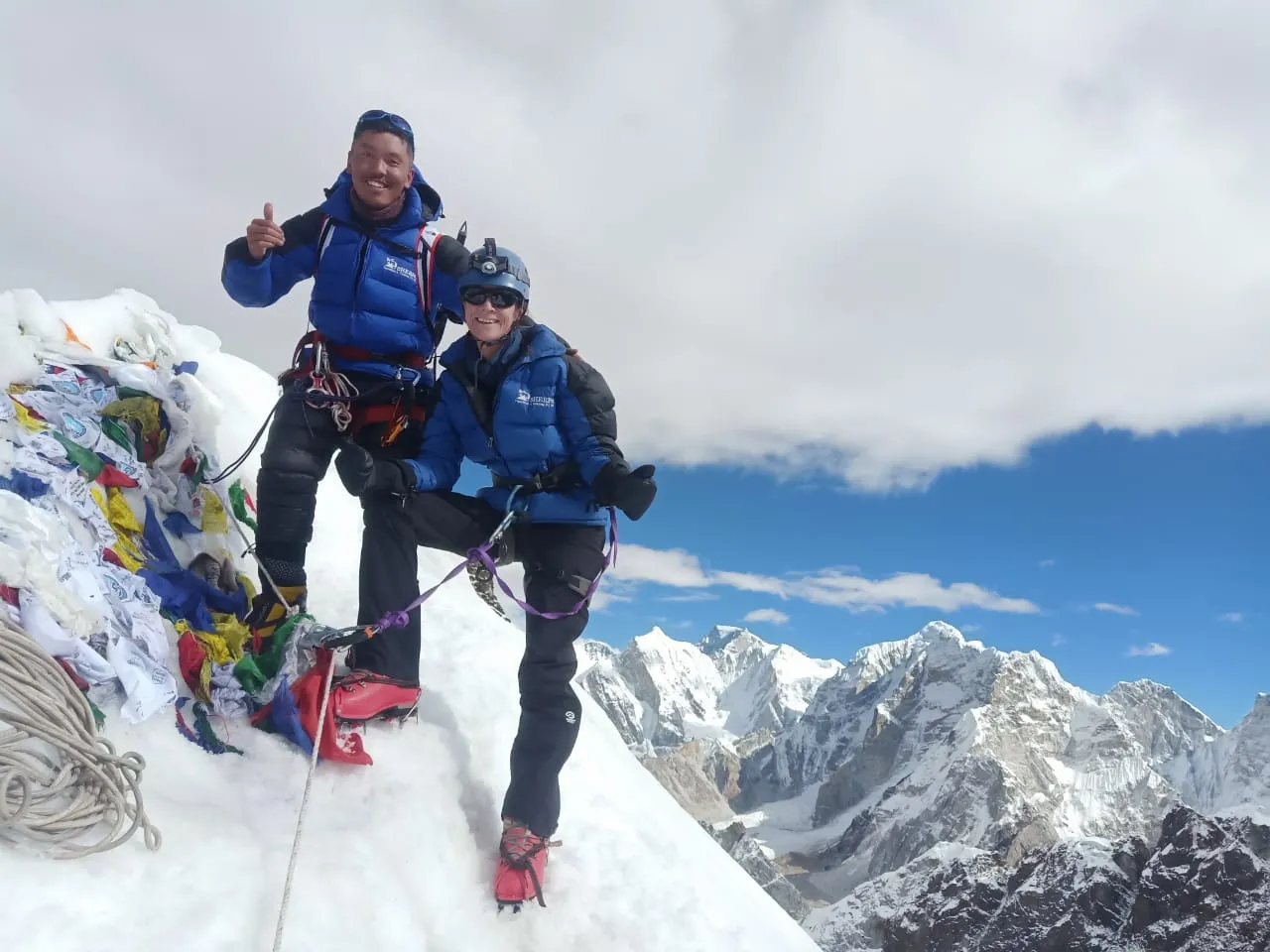
We use jumars over the fixed ropes put in by our Sherpa Team as they are climbing those steep 45 to 50 degree snow slopes. As soon as the sun comes up we do one last push on the narrow summit ridge which brings us to the very pinnacle of this beautiful mountain – Lobuche East (6,119m). From there we have some time to just stand there and take in all the panoramic views of Everest, Lhotse, Makalu, Cho Oyu and Ama Dablam.
Once you've had your fill of pictures, it's time to start the long process of descending these slopes again. Carefully we rappel back down through the snow-slopes until we get back to High Camp to grab a nice bowl of hot soup. It doesn't take too long getting packed up though, so we can make our way down along the lovely moraine trail passing Lobuche Village and continuing on down towards Thukla where we will have a warm dinner and spend the night.
As you may have noticed, most of these days will be affected by dynamic weather patterns that accompany high altitude mountaineering in the Himalayas.
Today is built right into your package itinerary for a contingency day - an extra day in case bad weather (high winds, heavy snowfall, poor visibility) prevents us from attempting our summit climb on Day 12.
If all goes well, and we are able to successfully summit on Day 12 without experiencing any weather-related issues, then we'll use today's day at Thukla to relax, stretch out, and take a nice easy trek back down the valley.
We will start with a delicious hot breakfast at our lodge after having climbed up all that way. From here, we get ready for a long trek downwards towards lower altitudes.
From Thukla, descend the ridge and head to the river trail which turns right as you go through Pheriche. Trekking across this windy valley floor, we come upon the main trail passing through Somare and then through Pangboche. On your way to the crossing point, you will get an opportunity to enjoy the view of this beautiful suspension bridge on top of the Imja Khola River. Then have a short walk through the rhododendron forest towards the Monastery (Tengboche Monastery). Lunch and relax yourself in the teahouse. Now continue to descend steeply from here till reaching the Phunki Thenga. Then crossing the river, we begin our last contoured winding trek along the mountain walls. Finally, after long journey, by the late afternoon hours of the day, you will reach the bustling streets of Namche Bazaar. You could take hot shower and spend a celebratory dinner in town followed by an overnight stay in one of many teahouses in Namche.
Enjoy your breakfast on this final day of walking. Leaving Namche Bazaar we go steeply downhill towards the switchback path through the pines; to the Hillary Suspension Bridge, we go back and forth across Dudh Koshi River with a walk through the pine forest.
Eventually, after going through Jorsalle, we get to our park permits checked at the Sagarmatha National Park exit gate located in Monjo, then continue on this wonderful journey to reach Phakding alongside the beautiful riverbank pathway and enjoy that delicious lunch once we reach there. After having our lunch, we resume walking again, taking the gentle uphill trail crossing many local farms, passing many prayer walls and small Sherpa villages such as Ghat and Chheplung. Taking a right turn, we enter the town of Lukla where we finally find our lodge and complete our trek. So in the evenings, we have a celebratory dinner party with all of you guides and Porters and enjoy our final night in this magical mountain area.
We wake up early in the morning and go towards Lukla’s Tenzing-Hillary Airport to catch our morning flight back to Kathmandu. Once our plane takes off, we’ll give ourselves one last glance at the towering peaks of the Everest region through the window seat.
Your aircraft lands at Tribhuvan International Airport, exactly where your Sherpa Expedition and Trekking Company meets, offering you an exclusive airport pick-up to your Hotel in Thamel. You may have the rest of the afternoon free to discover more than the most significant attractions with the town, explore monuments or chill over a cafe.
Today marks the end of our stunning 17 day excursion to the Himalayas. We eat one last satisfying breakfast at our Kathmandu hotel, then bag up our hiking and travelling gears and equipment. You will be picked up from the lobby of the hotel by a representative from Sherpa Expedition and Trekking (depending on your time of departure from International Airport and based on your check-out time from the hotel).
Enjoy a leisurely drive in a private vehicle for 3 hours to Tribhuvan International Airport, an hour ahead of time of your planned departure flight from Nepal, to help check in our trekking luggage and see us off.
LOBUCHE PEAK CLIMBING INCLUDES & EXCLUDES
Inclusion
- Airport Transfers - Picking up from your hotel via private car/jeep.
- Kathmandu Hotel Stay - Two nights, standard twin sharing, including breakfast at the hotel.
- Meals During Trek - Three times a day (B-L-D) on the days when we will be trekking and climbing.
- Fresh Fruit Daily - Fresh fruit on each evening of trek and camp after dinner.
- Mountain Accommodations - Local teahouse/lodge accommodation on the days of trekking, whereas during the camping periods of your climb we will be using tented camps.
- Government Fees and Permits - All the necessary documents for your trekking and climbing: Mount Everest National Park Permits Fee, Khumbu Pasang Lhamu Rural Municipality fee, Lobuche Peak Climbing permit.
- Transportation Costs - One round way Flights Kathmandu – Lukla – Kathmandu (Or if possible, Ramechhap - Lukla - Ramechhap), private vehicles at the airport.
- Local Expedition Crew - Local, competent, friendly, helpful climbing guide, government licensed (salary, food, drinks, accommodation, transport and insurance coverage). For large groups of 8 or more people will also provided assistant climbing guide.
- Portering Facilities – Local Sherpa porter (the salary of a local Sherpa porter will be allocated so that for 2 trekkers, 1 will assist carrying your baggage which will also include their food, drinks, accommodation and insurance)
- Medical Facilities – First aid kit well equipped. Using a pulse oximeter twice a day, check oxygen and pulse to avoid AMS.
- Gear Facilities - Provided free use of sleeping bags, down jackets, duffel bags, walking sticks.
- Certificate - Sherpa Expedition and Trekking T-shirt, Certificate of accomplishment.
- Support for emergency rescue flights, to be reimbursed by your travel insurer.
- Expenses of the whole expedition/treks.
- Government taxes
Exclusion
- Kathmandu Meals - Lunch and dinner during your time in Kathmandu.
- Nepal Entry Visa Fee - ‘On arrival entry visa’ on your arrival at the Tribhuvan International Airport, where you can avail of an ‘on arrival’ visa for three categories – $30 U.S. Dollar (15 days), $50 U.S. Dollar (30 days), $125 U.S. (90 days).
- Insurance – Personalized travel and medical insurance for your destination, which includes comprehensive cover in your home country for high altitude trekking, mountaineering and helicopter emergency rescue.
- International Flights - Round-trip international airfare, to and from your destination of abode.
- Personal Expenses - Shopping, laundry and your personal trekking gear beyond what is specified in inclusions.
- Beverages and Additional Snacks - Any and all alcoholic, non alcoholic beverages, instant soups, tea, coffee, hot chocolates, cocoas, bottled mineral/hot waters and other food treats purchased on the trek in the teahouses and anywhere along the trek.
- Desserts and Sweets - Cake, pie, chocolate bars, puddings, donuts and many other baked sweet goods.
- Teahouse Services - Charges for hot showers and electronic gadget charging facilities at the teahouse along the trail.
- Tipping - Tips for the guides, porters, driver/cook (expected as per Nepal trekking culture).
- Sightseeing Fees Kathmandu - Fees for the Kathmandu sightseeing tour (USD 30 per person approx.).
- Baggage charges - Fees for excess luggage over and above the normal cabin baggage limits, of about 10 kg of extra luggage.
We do not offer refunds on flights, hotel accommodation, mountain rooms, all the meals and transport for any reason if you turn back to Kathmandu early, either due to altitude sickness, health or for any personal reason. Any further additional expenses will be incurred by you for staying, eating and transport back to Kathmandu.
LOBUCHE PEAK CLIMBING Departures
Every departure listed below is 100% Guaranteed — once you book, your trip will run as scheduled regardless of group size.
Select a departure month
Fill out the form below and a Travel Expert will reach out to create your perfect tour.
Lobuche East Peak Route Map
Packing List and Essential Gear for Lobuche Peak Climbing
Here’s everything you require gear-wise for trekking and summiting Lobuche Peak: including climbing hardware, layered garments and hiking apparel, footwear, resting gear, and useful individual stuff.
Important Notes and Exclusives:
- All types of technical equipment, including a Base Camp tent, room accessories, climbing ropes, ice screws, snow bars, ice hammers, etc., will be provided by the group itself, i.e. Sherpa Expedition and Trekking.
- We provide you with a windproof duffel bag, which your porter will carry on his back for the entire duration of the trek, along with a complimentary amount of water. Once the trek ends, you can take this duffel bag too.
- High-altitude/4-season sleeping bags and down jackets will be available to rent complimentary at our office. Just inform us beforehand that you want to use these rental gear items. You just need to return them after finishing your trek.
- Luggage Storage – You can leave non-trekking stuff and additional bags at our office in Kathmandu free of cost, which will be available for collection on your return.
- First Aid and Health Monitoring – Our guides are equipped with comprehensive medical kits and pulse oximeters as well, but we recommend that travelers also keep their own small personal medical kit.
Technical Climbing Gear
- Mountaineering boots - Insulated, crampon compatible (rated B2/B3).
- Crampons - Steel 12 point climbing (semi-auto/auto).
- Ice Axe – General mountaineering ice axe with a wrist leash.
- Fully Adjustable Alpine Climbing Harness with Gear Loops – Greatly reduces strain on shoulders and knees from your weight by distributing your weight across multiple points of contact instead of only one.
- Lightweight Adjustable Safety Helmet – This helmet is made out of lightweight materials to provide protection without adding extra bulk around your head. It can easily be adjusted for a proper fit on all head sizes.
- Handled Right/Left Ascender (Jumar) – Allows you to climb up fixed ropes safely in either direction depending on what’s most convenient at any given moment.
- Descender (Figure 8 or ATC) – Controlled rappel during descent.
- Carabiners – Minimum of 2 locking (screw gate) and 2 non-locking.
- Tape Sling / Prusik Loop – 1.5 to 2 meter lengths for safety lanyards/anchoring.
Footwear and Handwear
- Sturdy Waterproof Broken-in Hiking Boots – For teahouse approach.
- Sandals or Crocs or Light Sneakers – To rest at lodges/camps.
- Merino Wool Trekking Socks – 4/5 pairs.
- Thick Mountaineering Thermal Socks – 1/2 pairs.
- Waterproof Gaiters – Keep snow and dust out of your boots.
Gloves
- 1 pair lightweight liner gloves.
- 1 pair warm, windproof fleece/leather climbing gloves.
- 1 pair heavy insulated, waterproof summit mittens/gloves.
Layered Clothing
- Base Layer - 2/3 moisture-wicking thermal tops/bottoms made from synthetic/merino wool fabric.
- Mid Layer – 1/2 fleecy jackets/lightweight insulated midlayers.
Outer Shell
- Wind and Waterproof Thin Layered Jacket and Pants - Must-have items for daily trekking since morning and evening temperatures drop significantly below 3,000m.
- Heavy Down Jacket (High-Loft Down Jacket Rated at -15°C to -20°C) - Will be provided upon request.
- Quick-Dry Stretchable Trekking Pants 2 pairs.
- Insulated/Softshell Climbing Pants 1 pair.
Headgear
- Warm beanie/fleece hat
- Neck gaiter/buff
- Wide-brim sun hat
Trekking Equipment and Sleep Gear
- Bring Your Own 30L to 40L Daypack – For carrying your everyday things like a jacket, water, camera and snacks. You can leave your duffel with our porters.
- Bring Your Own Rain Cover – Waterproof cover for your daypack.
- Bring Your Own Sleeping Bag – We have 4-season sleeping bags for all temperatures from -15°C to -20°C available on request.
- Trekking Poles – Adjustable walking poles to maintain knee stability when doing long descents.
- Glacier Glasses and Goggles – UV-400 rated glacier sunglasses with side shields + 1 pair of snow goggles to keep you protected on the windswept/snowy summit push.
Personal Essentials and Health
- Headlamp – A high-lumen headlamp is essential to remain visible to other hikers on your ascent in the dark. Don’t forget a set of extra batteries or your cord for recharging.
- Hydration – Two wide-mouthed 1L Nalgene bottles, insulated bottle jacket (hydration bladders are prone to freezing if used on summit day), water purification tablets or portable filters.
- Personal Essentials – Blister plaster, SPF lip balm, sunscreen, analgesia medicine, altitude medication (Diamox) and prescription medications.
- Toiletries – Microfibre toweling, biodegradable soap, wet wipes, hand sanitizer, toilet paper.
- Electronics – 10,000–20,000mAh power bank, charging cables, camera accessories – Make sure all batteries are kept warm in your jacket.
Gallery of LOBUCHE PEAK CLIMBING

Permits Required for Lobuche Peak Climbing
NMA Peak Climbing Permit
The NMA Peak Climbing permit is your official permit to go up Lobuche Peak. The costs, which depend on the season you select for your climb, are USD $250 in Spring (March - May), USD $125 in Autumn (September-November), and USD $70 for Off-Season (Winter and Summer).
Sagarmatha National Park Entry Permit
To reach Lobuche Peak on your adventure, you need hike along Sagarmatha National Park, so everyone trekking in the vicinity and all individuals planning on summit the peak needs a Sagarmatha National Park Entry Permit which usually comes to 3,000 Nepalese Rupees (which equates to about $20-$23 USD) plus service fee. You can get it at Monjo after entering from the Lukla, or you can pick one from the office of Nepal Tourism Board in Kathmandu.
Khumbu Pasang Lhamu Rural Municipality Entry Fee
The new TIMS Card, which will be used for the Everest region and as a Local Body fee for the development of high-altitude tourism, will be issued at a cost of NPR 2,000 to NPR 3,000 (approx. USD 20 - $23 per person). It can be issued by climbers after flying to Lukla on their flight. It can also be issued at entrance counters along the early trail.
Best Time for Lobuche Peak Climbing
Spring Season (March to May)
During spring, you can expect some of the best weather conditions to enjoy climbing in general - stable weather patterns and warm temps mean lots of great sunny days with those glorious blue skies we all love. Of course, as wildflowers such as rhododendron begin their blooming period in the lower valleys, these vistas are just extra-breathtaking thanks to their natural beauty. As long as there's moderate wind speed (and an ample snowpack), it won't be difficult to navigate your way up those pesky fixed lines and reach the top of that peak safely - plus, during this prime season, the odds will be pretty good too.
Autumn (Sep-Nov)
During this time of the year, there are clearer days with dry trails in the mountains, cool and fresh mountain air after the rains (monsoon). High altitude remains mostly stable, which is generally preferred by climbers for a successful peak destination. The sharp, crisp mountain air allows amazing views on very clear days, with peaks of Lhotse, Everest and Nuptse clearly at a glance. Nights can feel cool, although overall November remains quite pleasant.
Monsoon (June-August)
During the monsoon period, days consist of heavy rainfall, muddier, slushy trails, and heavy clouds that usually hang in the mountains, which obscure mountain viewing down below, thus causing numerous flight delays and cancellations to Lukla. Higher altitude areas suffer from heavy snowfalls with more avalanche risk and icy conditions.
These weather patterns make flying difficult, which means trekking/climbing is risky business during these months unless you have technical skills and are prepared for danger.
Winter (December to February)
Winters can bring harsh cold weather conditions, with high wind speeds and large amounts of snow on both High Camp and at the summit ridges. The majority of the teahouses above Namche Bazaar also shut down during winter months due to lack of visitors – therefore you will need to arrange your own self-sustained logistical requirements.
While winters offer beautiful clear blue sky days as well, technical climbing in such extreme cold can be quite challenging and should only be attempted by highly experienced and cold-hardened mountaineers.
Lobuche Peak Climbing Altitude and Acclimatization
Altitude Profile
Location | Altitude |
| Kathmandu | 1,300 m |
| Lukla | 2,840 m |
| Phakding | 2,610 m |
| Namche Bazaar | 3,440 m |
| Tengboche | 3,870 m |
| Dingboche | 4,360 m |
| Chhukung Valley | 4,730 m |
| Lobuche | 4,930 m |
| Gorak Shep | 5,170 m |
| Everest Base Camp | 5,364 m |
| Kala Patthar | 5,545 m |
| Lobuche High Camp | 5,600 m |
| Lobuche Peak Summit | 6,119 m |
Acclimatization Strategy
Our ascent to extreme altitudes follows a slow and steady path to ensure our bodies adjust smoothly to the decreased oxygen tension of high-altitude air. We utilize prescribed acclimatization days in Namche Bazaar and Dingboche based upon the well-established mountaineering principle "climb high, sleep low." These high-altitude day hikes will stimulate our bodies to begin increasing the production of red blood cells and oxygen-carrying capacity, while we will hike to a lower altitude again to rest.
Our trek to Everest Base Camp and Kala Patthar provides significant pre-acclimatization as well before we step onto our higher mountain itself.
By days spent both exercising and resting above 4,900 m, the vascular and respiratory systems get the time to adapt, and the chances of developing acute mountain sickness are drastically reduced. This leaves us physically ready and well prepared for our ultimate destination of 6,119 m on our way up the mountain.
Lobuche Peak Climbing Difficulty
The climb falls into the Alpine Grade PD+ (“Peu Difficile” – “Slightly Difficult”) category.
It's a non-technical trekking peak, but it still demands a high degree of physical stamina and basic skills required for mountain climbing, including exposure to technical terrain with steep rocky scrambling and glaciated slope along 35° to 45°, requiring the use of fixed rope, crampons, a harness, an ice axe and Ascenders/Jumars on exposed ridges.
Trekkers will be expected to walk long distances covering 5 to 7 hours during approach trek and even more while on summit day, ranging from 8 to 12 hours. And they have to start climbing about 1:00 AM under extreme cold and thin air.
Prior high altitude trekking experience and familiarity with basic rope work are highly recommended to ensure the safety of all participants. There is no requirement for previous advanced technical mountaineering history.
Altitude Sickness
- Climbing above 3000 meters can bring the human body to lower oxygen levels and changes in the pressure level of the air, which is why Acute Mountain Sickness (AMS) is a very important matter for the Lobuche Peak trek.
- Early Signs: The first indications of AMS are headaches, continued vomiting, a decrease in appetite, feeling dizzy, tired and trouble sleeping.
- Extreme Cases: In case of lack of early detection, AMS can cause the development of very dangerous illnesses at higher altitude which require immediate medical attention:
- HAPE (High Altitude Pulmonary Edema): Fluid builds up in the victim’s lung causing severe problems with coughing and difficulty breathing.
- HACE (High Altitude Cerebral Edema): Fluid buildup inside the brain can cause hallucinations, uncooperative behavior, difficulty walking, uncoordination, and a person's inability to function.
- Protection and Handling: A slow ascent that includes rest days at Namche Bazaar and Dingboche is definitely a good thing to avoid AMS. Also, drinking plenty of water, say 4-5 liters daily, measuring the levels of oxygen in your body with pulse oximeters, and going down without delay in case severe symptoms are showing would be the best ways to fight AMS.
Is Lobuche Peak Climbing Suitable for Beginners?
Fit beginners with strong willpower may indeed succeed in climbing Lobuche Peak. This peak is rated as an alpine PD+ climb and you will need some fundamental mountaineering knowledge, although no prior technical climbing experience is required. However, it's best to have the physical endurance, combined with a full range of climbing training at base camp. And don't worry too much as prior to the summit attempt, with the support of highly qualified Sherpa climbing guides, you will learn the correct ways to attach and use crampons, harnesses and ascenders on fixed ropes up to the peak.
Lobuche Peak Climbing via Everest Base Camp Trek
A combination climb of Lobuche Peak with an Everest Base Camp trek provides both the best of adventure and acclimatization. From visiting famous Sherpa villages and old monasteries, up to 5,364m (Everest Base Camp), further on to 5,545m (Kala Patthar), viewing sunrise over the highest mountain in the world: trekkers will gain enough acclimatization through the long altitude exposure before heading toward Lobuche High Camp and significantly increase their chances for success on the climb through the most classic route of the world.
Lobuche Peak Climbing vs Island Peak Climbing
Two of the most popular 6000m peaks at PD/PD+, Lobuche Peak (6,119m) is considered to be steeper than Island Peak (6,189m). Island Peak entails travelling across a long glacier and steep ice headwall, whereas climbing Lobuche mostly consists of moving across some rock scrambles along with long stretches of 45-degree snow and ice. Notwithstanding this, the Lobuche expedition basecamp commences at a higher altitude, making it less ascent from here to the summit as compared to Island Peak.
Summit Day Experience
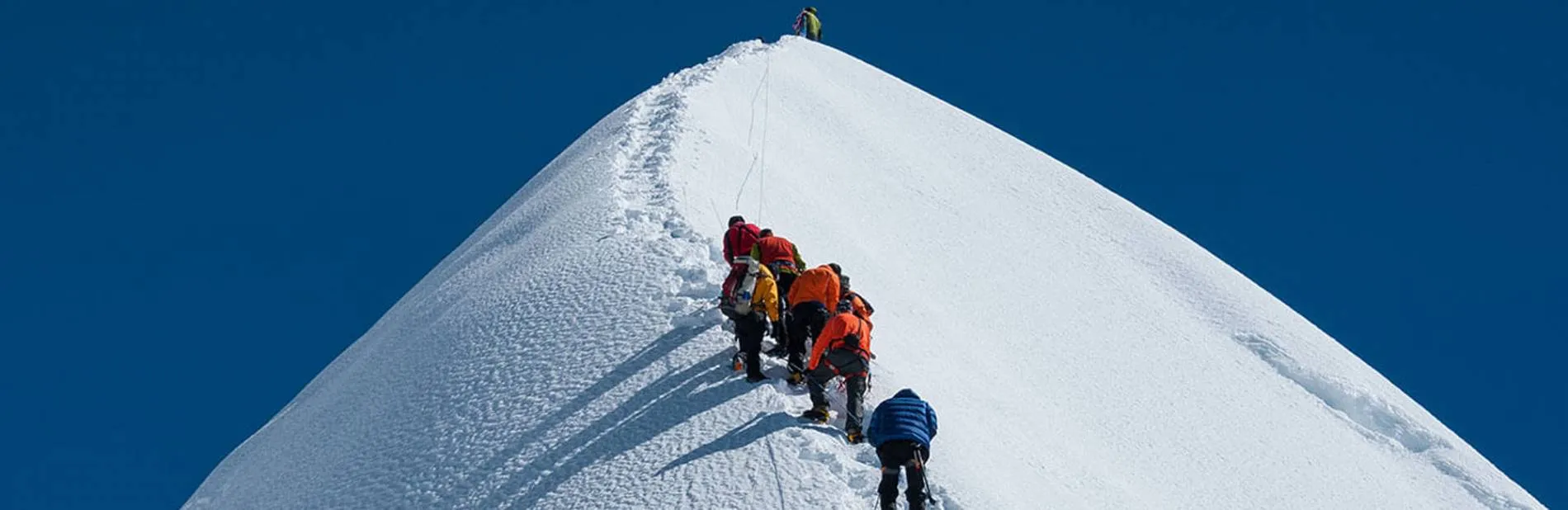
Summit push starts in a starry sky at around 1:00 AM. With your head down, you push along with sub-zero temps on icy rock, granite, and snow channels. You clip into fixed ropes using jumars and ice axes, navigating the steep 45-degree slopes through some beautiful snow. As sunrise comes upon you with a view of the Himalayas - nothing beats that moment. And when you finally make it to the narrow ridge at the top and witness all the 360-degree views of Mt. Everest, Mount Lhotse, Mount Nuptse etc the moment becomes more magical.
Preparation and Safety Measures for Lobuche Peak Climbing
A substantial level of cardiorespiratory endurance, leg strength and stamina is required to climb Lobuche Peak. Be trained at least 3-4 months in advance with a regimen consisting of running, cycling, swimming and stair climbing with a weighted pack. Core and strength training exercises will enhance stamina and the capability to undertake long 6-8 hour trekking days and arduous, vertical alpine climbing on summit day.
Diet and Hydration
A high carbohydrate, protein-based diet should be adopted to fuel the body for the required extended periods while consuming extra calories at altitude. Hydration at altitude will be crucial for prevention of altitude sickness. Plan on drinking at least 4-5 liters of sterile water throughout the day with the addition of electrolyte powder. It will be critical to limit your intake of alcohol, caffeine and smoking, due to their dehydrating effects, especially at altitude.
First Aid Kit and Medicines
Although our company guide will carry a comprehensive medical kit as well as a pulse oximeter, in addition you will want to carry a personal first-aid kit with you. Include Diamox (acetazolamide) to assist you in acclimatization, over-the-counter pain relievers, antibiotics, anti-diarrhea medication, antibiotic ointment, anti-blister kits and bandages. Include personal prescription medications you are currently taking, cough lozenges, lip balm, and broad spectrum SPF 50 sunscreen (for extreme high-altitude UV penetration).
Documents Required
You will be required to possess a passport with 6 months of validity and a Nepal entry visa. Be sure that you are insured to mountain climb as high as 6,200 meters or above. Also, have 4 passport-sized photographs on hand, copies of your passport, flight itineraries and permits. Sherpa Expedition and Trekking will secure the NMA Lobuche Peak Climbing Permit for you as well as your Sagarmatha National Park entry permits.
Things To Know Before Joining the Lobuche Peak Climb
Visa
Almost all nationals can get a Nepal Tourist Visa on arrival at Kathmandu International Airport (TIA) in Nepal or via an online application, prior to their travel. A 30-day Tourist Visa costs USD $50. A minimum of 6 months' validity before the expiry date of the passport is required for a Nepalese tourist visa, along with 1 blank page in the passport.
Insurance
You are required to possess complete travel insurance with cover for high altitude trek and technical climbing to 6,200m, emergency evacuation with helicopter, hospitalization and any unexpected event including cancellation and theft of baggage. Also make sure your insurance covers direct air rescue payment in the Khumbu area in Nepal.
Distance
Total distance covered of 130-140km round trip from Lukla is estimated for trekking and climbing the trail. You would walk for 10-12 kms every day, with 5-7 hours of trekking; however, this will expand to 8-12 hours on the climbing day towards the summit goal.
Duration
The total trekking time for only trek itself is 12 days to 13 days whereas the entire trek expedition from Kathmandu to Kathmandu is around 17 days. This 17 days expedition package will include rest days in Namche Bazaar, Dingboche (total two rest days), hiking, training at Base Camp and training at the Base Camp for summit push, for climbing on Lobuche and descending to Lukla.
Transportation
Our travel arrangements will cater to you with private airport transfers both ways in Kathmandu and international round-trip flights from Kathmandu (or Manthali/Ramechhap during peak season) to Lukla. The ground transportation to and from Kathmandu city or between stops in the city will be covered by our private or rented cars.
Lukla Flight and Weather Delays
Lukla Airport is at a great altitude, and mountain weather is subject to be fickle, resulting in regular flight delays and cancellations. We'd hence suggest pre-booking your return flights with a buffer of two days at the end of your trip given the variable weather of Lukla. In case the weather prevents the normal plane from landing at Lukla for several days, the helicopters can be available for your transfer.
Guide and Porter
One of the highlights of your trip will be the fact that you will have the company of Sherpa professional climbing guides who can be trusted as they speak English, are certified, and have the skill and the expertise of a mountain guide, plus have the Wilderness First Aid certificate. Our porters will take care of your heavy loads of duffel bags up to 15 kg per trekker so that you can continue your trekking without any burden but only with a lightweight daypack.
Weather Conditions
Spring (March - May) and Autumn (September - November) are ideal seasons. As a climber, you are going to enjoy stable weather, a sky without clouds for the most part and great views. From the valley floor up to around High Camp, temperatures are usually warm from 0°C to 23°C, whereas it will get freezing with serious wind chill at the mountain High Camp and summit of Lobuche Peak at between -9°C and -20°C.
Accommodation
Our Kathmandu stay will be at cozy 3-star hotels. On trek, most of the time your nights will be in teahouses/lodges which are simple but clean, and you are going to share your twin room bed. When you are actually climbing on Lobuche Peak, we will set up our expedition at High Camp, and there you will be in 4-season high-altitude tents operated by our qualified crews.
Food and Water
Teahouse meals are quite diverse and can give you a taste of the local and Western styles of food that will surely keep you energized for hiking; e.g., Dal Bhat, pasta, noodles, soups, fried, omelet, and boiled milk porridge are just a few examples of their menus. Drink only boiled or filtered water or one with water disinfectant if tap water is unavoidable. We'll also give you a free supply of clean drinking water for the entire trek.
Personal Expenses
You'll typically budget a few more dollars on the side, from $12 to $20 for meals and drinks you don't include in standard packages. Hot showers, free tea/coffee, room heating facilities, small gifts, souvenir purchases, soft drinks and beer, and of course tips to your mountain porters and Sherpa should be counted and added daily.
RELATED PACKAGES


FAQS Related to LOBUCHE PEAK CLIMBING
General Information
Lobuche Peak lies in the picturesque and treacherous Khumbu region in eastern Nepal near Mount Everest and the Khumbu Glacier which is said to be the most popular of the glaciers in the Himalaya range. It's located in the UNESCO World Heritage Site – Sagarmatha National Park.
Lobuche has two peaks – one is the east and another west and there are heights: 6,119 m (20,075 ft) on the East and 6,145 m (20,161 ft) on the West. While the majority of hikers choose the East side as it is safer and easier access for everyone. They primarily go this route to enjoy its popularity, simplicity, and a good level of security and safety.
Climbers rest in high altitude tents at Lobuche High Camp which rests about 5,600 m (18,372 ft) before heading off for the main attempt on the summit during the early hours of the night on snow and ice.
The idea behind going from Everest Base Camp to the top of Lobuche Mountain would be perfect. In fact, getting to know how to cope with very high altitudes by first visiting Everest Base Camp (5,364m) and Kala Patthar (5,545m), then getting to the mountain, you will have an idea of what a mountain peak climb looks like before getting ready for summits.
Permits & Documentation
These include: NMA Lobuche Peak climber permits, Sagarmatha National Park Entrance Permits, Khumbu Pasang Lhamu rural municipality local entrance permits.
It should be noted that climbing permits from Nepal mountaineering association (NMA) regarding the peaks cannot be personally obtained by the climbers. According to the laws, the trekking agents who are legally registered by the government are the only ones to whom the permits are issued. The mountain climbers can only get a permit if they are accompanied by a licensed local agency and a guide.
In the major climbing season of Spring, that is from March to May, one will pay USD 350 per person for the NMA Lobuche Peak climber permit fee. For other off-peak seasons like Autumn/Winter/Summer, the permit rates are less expensive.
A passport copy that is clean (the passport must be valid for at least 6 months), 2 to 4 passport-sized pictures, and health and safety insurance information that will safeguard you above 6,200m are the necessary documents.
Preparation and Fitness
Dedicated cardio stamina, solid leg power, and good general vitality are necessary. You need to be used to hiking for 5-7 hours a day across rough ground and be ready for a very tough physical challenge lasting 8-12 hours on the summit day.
The only alpine climbing technique you may use is a fixed rope. Yet, having been exposed to high-altitude walking is highly advised. In any case, novices who arrive in base camp before the climbing starts will participate in a climbing technique training course where they will become acquainted with the use of climbing ropes, crampons, and how to do Jumar climbs.
We suggest you start the exercise training programme at least 3-4 months before your expedition trip starts. The best workouts to prepare are aerobics: running, swimming, biking, stairs; combined with muscle training and strengthening your core muscles to stay upright while carrying your equipment on difficult terrain.
Yes, in fact training a few stair climbers or uphill walks with a weighted pack (5-10kg = 11-22lbs) will work the back, shoulder, and leg muscles needed for shouldering a day bag on the trails of Nepal.
Health and Safety
Altitude Mountain Sickness (AMS) is a form of medical condition which happens due to an extremely fast ascent, reduced atmospheric pressure and very low oxygen levels at high altitudes (more than 2,500m). The first signs of this can be headaches that are not going to be stopped, a feeling of nausea and vomiting, dizziness or vertigo, exhaustion, loss of appetite, and not being able to sleep.
Your chance of acquiring AMS is lower when you follow a slow, steady schedule of ascent, allow a few 'acclimatization' rest days if needed, drink sufficient water each day (2-3 liters at least), take in large carbohydrate meals to keep up energy levels, and avoid alcohol and smoking because they slow down the breathing process. As an option, you could also use medication such as Diamox to prevent altitude sickness.
HAPE, or High Altitude Pulmonary Edema, is the accumulation of fluids into lung tissues, while HACE is the development of edema in the parts of the brain. Both conditions are serious and fatal developments of altitude diseases which require immediate lowering of altitude and rescue with an ambulance or helicopter.
Diamox can help you gain acclimatisation faster and might help take away the pain from mild altitude sickness. Do not take this without prescription. You should visit your doctor for advice on the right use and amount to take.
Insurance and Visa
As you know, comprehensive travel insurance is strictly compulsory for our trek. Please provide us with proof of your policy prior to commencing trek.
Please note that insurance policies must be clearly specified to include "cover for High Altitude Trekking and Technical Mountaineering up to 6,200 meters (20,341 feet)". This will help our customers who are planning on going all the way up to the peak of Lobuche Peak which is at 6,119m.
Emergency Helicopter Evacuation Services may vary based on your policy. We recommend making sure your provider has specified that they do have "High Altitude Air Rescue" coverage included on your policy as well as direct emergency payment approval for air rescues in Nepal's Khumbu region.
You'll need to read carefully your comprehensive travel insurance policy for specifics about what's covered such as trip cancellations, flight delays, lost baggage, or unexpected medical interruptions but most provide coverage options that fit different needs if you buy them with an eye toward those specific scenarios.
Guides and Support
Yes, Nepal law requires a licensed, government-registered climbing Sherpa/guide for all mountaineering trips. No lone climbing without a certified guide is allowed on NMA trekking peaks.
Yes, health is checked on a daily basis by our professional guides with a pulse oximeter for the blood oxygen saturation and heart rate. The guides constantly look at symptoms of AMS and assess the right pace for ascent.
The luggage porter can carry up to 12 to 30 kg (to 6 to 15 maximum weight per client), usually divided between the duffel bag for two clients, which will leave you able to walk with only your day pack.
Yes, Sherpa Expedition and Trekking handles all arrangements including permit applications, local municipality requirements, national park checkpoints, as well as climbing documentation.
Accommodation
En route to Lobuche village, you lodge in local mountain teahouses (huts). Family-owned and operated, teahouses have common eating halls and facilities; usually, cooked meals are served, and rooms are allocated on sharing basis for climbers.
Rooms at the teahouse at lower elevations are usually twin shared, containing two single beds, mattresses and pillows. Usually, for a single room, you require additional charges during the high climbing seasons of Nepal; thus, one can ask for a private solo at lower elevations.
Yes, electricity is available for charging devices through solar power or a generator at teahouse communal dining rooms, charging some fee to individual travelers and device operators (USD 2 - $5).
For the high camps, including Lobuche High Camp (5600m), you will sleep in high-altitude special 4-season tents which are erected by your camp crew on snow/rock beds.
Latest Traveller’s Reviews
Travel experiences of our clients who recently returned from their trips.
100% of travellers recommend this trip
Based On 110 Reviews
Lobuche Peak Climbing
Great Team With Best Team
Lobuche peak

Write Your Review
Average Customer Ratings
How The Travellers Have Rated This Package
106
4
0
0
0