
Annapurna Circuit Trek 14 Days
USD 1,350 / Per Person
Overview
Annapurna Circuit trek is one of the most famous treks in the world. The major reason for its fame is the presence of the Annapurna massif and the Thorong La pass. Through the journey, you will find mountain landscapes, altitude variation, and authentic cultural encounters all in a single trekking experience.
Starting the journey from Kathmandu, you will move along to Pokhara, the Marsyangdi River, before crossing the beautiful Kali Gandaki region. All the trekkers will go through a variety of cultures from Gurung, Manangi, and other settlements.
Anyone who is looking for a complete Himalayan experience, the Annapurna circuit trek could be the answer for you. Sherpa trekking expeditions who have been doing the Annapurna circuit trek can help you have a successful trekking experience too.
Why the Annapurna Circuit Is the World's Best Long-Distance Trek
Annapurna circuit trek is known as the best long distance trek in the world. The major reason for that would be the wonderful geographical diversity, cultural richness and mountain scenic beauties. All of this is combined in a single journey across the Himalayas. During the Annapurna circuit trek you will get continuous altitude rise which increases the challenge in itself. Starting from the low valleys we will reach Thorong La Pass above 5000m. Annapurna massif, Gangapurn, Dhaulagiri are the key landmarks during the journey.
Trekkers will also find changes in the climate. From tropical region weather to the Arctic feeling at 5000m is hard to beat on any trek. There are only limited routes that provide such variety in a single trek.
Not to forget the cultural diversity present in this experience. From Hindu to Tibetian, Sherpa and Manangi people there is variety right around. Another key diversity is the Thakali culture and trading heritage you will experience.
With so much difference in all the aspects like culture, weather, food and the trail itself, it is easy to say that Annapurna circuit trek is the world's best long distance trek. The traditional anticlockwise direction provides a safer ascent profile. Gradual altitude gain through the Marsyangdi River valley allows more effective acclimatisation before crossing Thorong La Pass.
With route variations ranging between 160 and 230 kilometres, the Annapurna Circuit Trek covers significantly more terrain than many Himalayan treks. The trail includes forests, river valleys, high mountain passes, desert landscapes, and cultural settlements.
The route's legendary reputation is highlighted by endurance achievements such as the fastest known completion time of 68 hours and 22 minutes by Lefteris Paraskevas in 2017. From Chame and Upper Pisang to Ngawal, Manang Village, Taato Paani hot springs, and the sunrise viewpoint of Poon Hill, every stage offers a unique experience. The 14-day version balances pace with acclimatisation, making it the most popular duration.
Annapurna Circuit Trek 14 Days Day-by-day ITINERARY
On the first day of the trek you will arrive in Kathmandu. You will be welcomed and transferred to your hotel. As you will be transferred to your hotel, you will be briefed about the permits, equipment and the route ahead. The remaining part of the day will be spent exploring the streets of Thamel and be ready for Annapurna circuit trek.
This Annapurna Circuit Trek begins in the classical starting point of the circuit Syange, which is 7-8 hours drive from Kathmandu. The road begins in the capital city, then follows the rural landscape of central Nepal as terraced paddy fields, villages perched on the hills, roaring rivers, and far off peaks change as you progress. The hike is an interesting introduction to the remote region of Nepal and is also an introduction to the areas that support the trekking communities in the Annapurna region.
It passes through Lamjung District before it reaches Besisahar (760m) which is regarded to be the starting point of Annapurna Circuit Trek. This is the last place you can rely on ATMs, banks, pharmacies and larger supply stores, and is the best spot to get cash or any last bits of supplies for the trek into the mountains.
Following Besisahar, the road heads down deep valleys and through stunning Himalayan scenery through the river valleys of the Marsyangdi that will be with us for the next five days. The road gets rougher the further you drive towards Syange.
Syange is a small village located on the slopes of the mountain on the banks of the river, where you can see suspension bridges, waterfalls and traditional teahouses. Annapurna Circuit tonight – your first experience with teahouses! Accommodation is simple but comfortable and the meal is usually Dal Bhat, the famous staple of the Nepali people which has sustained generations of trekkers throughout the Himalayas.
On the third day, it's all about exploring forests and waterfalls, and getting first sightings of the mountain. Day 3 is all about seeing the forests and waterfalls, and first mountain views.
The hike will take about 5-6 hours today with a climb of about 1060 metres into the spectacular Marsyangdi River gorge leading deeper into the Annapurna region. This section of the lower Annapurna Circuit Trek is through a thick jungle of rhododendron, pine and bamboo trees.
Much of the day is spent listening to the roar of the Marsyangdi River and there are a number of waterfalls pouring down steep hillsides into the valley. This is an unforgettable start to the trekking in the Himalayas thanks to its abundant forest, impressive gorges and the roaring water.
You will pass the vital checkpoint of Jagat (1300m) on the way where ACAP permits are also regularly checked. It is one of the first circuit control points officially, and offers a brief break before proceeding up the hill.
The Dharapani (1,960m), at the junction of Marsyangdi river and Dudh Khola, is further ahead. Dharapani lies in a mountainous area with steep cliffs and impressive waterfalls, and was an important junction for many trade and trekking routes through the Himalayas.
As the elevation increases the subtropical forests gradually give way to hills covered with pines. Even langur monkeys can be spotted crawling through the canopy over. As the afternoon wanes, you reach Bagarchhap (2,160m) and begin to sense the culture that is the core of the upper Annapurna Circuit with stone roofed houses, prayer wheels, and architecture influenced by Tibet.
The walk between Bagarchhap and Chame looks like it should take 5/6 hours and has a gentle rise of approximately 510m. The hike today will be a significant leap into the alpine country of Nepal from this subtropical part.
The trail traverses beautiful pine and spruce forests and typical mountain villages such as Danaque, Timang and Thanchok. The villages have unique Tibetan architecture, prayer flags and traditions from centuries in the High Himalayas.
Higher up, the views of the mountain are more dramatic. The panoramic view of Lamjung Himal and also Annapurna II (7937m) is one of the highlights of the day that the snow clad slopes of these two peaks dominate the skyline as you approach Chame.
Chame is located at 2670m and home to the headquarter of Manang district and is also one of the most developed villages along the Annapurna Circuit. The trekkers will find better accommodation facilities than in the previous villages, a greater choice of accommodation, as well as bakery, trekking shops, and internet facilities.
Chame is also the last big village before Manang, and is an ideal place to purchase the final supplies needed for trekking. This is a good point to begin the Annapurna Circuit, many modern trekkers begin from Kathmandu or Besisahar, cutting off the trek to return to Kathmandu, but keeping the most stunning segment of the trek at high altitudes.
This hike on the day will take you up from 530 to 640 metres up to some of the most breathtaking views of the Annapurna Circuit Trek. On the right side of the path, there are rugged mountains and steep cliffs in the background, while snow-capped hills are visible in the distance.
The most popular landmark of the day is Paungda Danda or "Hot Wall. This massive curved rock face soars up the valley from the floor and is regarded as one of the most impressive rock formations on the whole circuit. It's so massive that it is an unforgettable backdrop as you ascend further into the mountains.
There are a number of exciting suspension bridge crossings of the Marsyangdi river during the day, so it is an eventful day with some adventure. These bridges are located high up and up on top of the river; and provide excellent panoramic views of the gorge and rugged landscape.
The steep gully opens out at Lower Pisang (3200m) to a large flat high altitude plateau. Here you can be rewarded with the first majestic views of Annapurna III (7555m) and Gangapurna (7455m), two of the tallest peaks in the area.
Other hikers choose to go further up to take a short walk to the small village of Upper Pisang (3310m), on the ridge with its beautiful view. Upper Pisang has better mountain views, less touristy and more of an authentic place than Lower Pisang. The village is also a home to the beautiful Buddhist monastery Pisang Gompa, which overlooks the valley below.
Upper Pisang is one of the most rewarding overnight enclosures on the Annapurna Circuit with its beauty of the Himalayas and the variety of culture.
This hike is one of the best hikes on the Annapurna Circuit Trek today. There are two highly recommended trails and the high trail via Ghyaru and the trail to Ngawal both of which offer a great deal of beauty, cultural experiences, acclimatisation and the lower valley trail. Ensured 7-9 hrs of trekking in some of the best landscape in Annapurna region.
First of all the day consists of a steep climb to an old village named Manangi, Ghyaru (3670m). Prayer flags are fluttering from chortens that can be seen from the majestic eyes of Annapurna II, Annapurna III, Annapurna IV (7,525m) and Gangapurna. The settlement has traditional and old stone houses and centuries old Buddhist traditions which imparts a timeless ambiance.
From here, it is up the high road to the peaceful village of Ngawal (3660m) which is only slightly quieter than other villages on the circuit. Enjoy a wonderful view around you, the mountains are covered with snow in the background.
The path is fairly flat as it descends to the biggest village on the Annapurna Circuit – Manang (3540m) by afternoon. The settlement contains bakeries, equipment shops, comfortable lodges, even a tiny cinema, which shows trekking documentaries and mountaineering films.
A beautiful 500 year old monastery which is perched on top of the valley, from which you can enjoy a short walk to the village of Braga. It is hierarchical and features 108 statues of Buddha made of clay and is still a significant religious centre in the region.
The Manang is home to Manangi people whose way of living is influenced by their Tibetan Buddhist tradition, their trading culture and unique way of life. The acclimatisation day on tomorrow will prove to be an important factor in getting ready for the above elevations ahead.
It is indeed a big day in the entire Annapurna Circuit Trek! Above an elevation of 3,000m, the human body needs to acclimatise to the lower oxygen levels which can take time. The level of oxygen present in air at Manang is low, due to the air pressure being approximately 65% of sea level. The race to the top also increases the risk of getting Acute Mountain Sickness (AMS).
Highly recommended to attend the HRA Clinic at Manang. The clinic is offering free altitude-awareness sessions daily which will include discussion of AMS, HACE (High Altitude Cerebral Edema) and HAPE (High Altitude Pulmonary Edema) and how to recognize and treat these.
Common AMS effects consist of headaches, nausea, dizziness, unusual fatigue and loss of appetite. The main principle to follow is: if it gets worse: go down! No mountain pass is worth a risk to one's health.
There are a number of very good acclimatisation walks available. After 7-9 hours of return trek it leads you to the beautiful Annapurna range which is the toughest of the lake, called the Ice lake (4620m). Those who wish for a less challenging trek can head to Gangapurna Lake (3700m) to enjoy a stunning turquoise coloured lake, encircled by a glacier. The next place is historic 100 Rupees Lama Cave (Praken Gompa, 3900m) which is said to be the place where meditation has been practiced for more than 200 years.
The rest of the day should be spent relaxing, drinking fluids and getting ready for the high altitude stages to come. Consume 3-4 litres of water, eat a carbohydrate meal and do an additional gear check. It's imperative that you have warm clothing, trekking poles with you, food, gloves and a headlamp for the pre-dawn trek that you must make to cross Thorong La.
This walk is an easy one today, taking around 4-5 hours of walking, as we slowly make our way above the tree line. Then, we enter Manang and things begin to change. Almost all of the forests have been removed and replaced with rock faces, glacial moraines, alpine meadows and alpine wind blown terrain.
The track gently climbs up towards the small settlement of Yak Kharka (4,050m) where the yak herders come in summer. Before heading to Thorong La Pass, it was in the middle of grazing land and the rugged mountains.
This is the trail to Thorong Phedi (4,450m) which means "foot of the hill". The scenes are reminiscent of the base camp of the mountain where people from all over the world are resting, refreshing and preparing themselves for the journey that lies ahead.
Some trekkers opt to go to Thorong High Camp (4925m) to cut short the trek of the following day. Basic sleeping gear, much colder at High Camp and a good sleeping bag are essential. During clear nights and with sunset, it's a great job to enjoy some great sightings of peaks of the Himalayas topped with snow and starry skies.
At these elevations, it is most important to get plenty of rest, fluids and food. Good health and plenty of water and early bedtime is of great importance as most trekkers start crossing Thorong La at 3:00am to 4:00am. If the symptoms of AMS are experienced it is advisable to come down to Manang, preferably High Camp.
This is an overnight climb and it is highly recommended to acclimatize before climbing today (3-4 hrs) over Thorong La Pass. The rising motion helps the body acclimatize as they climb, and conserve energy for the next day.
It is situated on the eastern side of the Jarang Khola and steepens once one gets into the river. The number of people breathing into the less dense and colder air, steep bluffs, bare slopes and high elevation landscapes is diminishing.
Thorong Phedi (foothill) is at the foot of the steep slopes which lead to Thorong La Pass. The majority of trekkers take the afternoon off after which they get organised, hydrated and mentally prepared for the highest point on the Annapurna Circuit Trek.
Should be monitored for wildlife on the hillsides around. Common rockslope inhabitants are the Blue Sheep and the elusive Snow Leopard; they are found in the higher altitudes of this region. Lammergeier or Bearded Vulture is one of the biggest birds in the Himalayas, frequently seen as soaring giant birds above the Himalayan hills. According to local legend there are mythical griffins in these exotic mountains!
It is important to have a good night's sleep and eat early meals. The day of crossing Thorong la pass will be the toughest day, but the most amazing of the march.
This is the most important day of the Annapurna Circuit Trek. The majority of trekkers leave around 3:00 to 4:00 AM and begin their climb at night. Often very cold, full cold weather clothing is essential – down jacket, gloves, thermal clothing and a balaclava.
The time taken from Thorong Phedi to reach Thorong La Pass (5416m) is normally 4-5 hours. There they are making progress... albeit slow. Breathing at only 47% of sea level oxygen at 5,416 m and each step will be much more challenging!
As you reach the summit, it's a moment you won't soon forget. Colorful prayer flags are flown over the pass and beyond and barren land of Mustang District is seen beyond and back-sighted Dhaulagiri (8167m) and Annapurna range. There is a stone cairn to mark the highest point of the trek and it is the ideal spot for celebrations and photo opportunities.
The weather can quickly get bad, so it's important to get it done in time. Winds, clouds and low visibility in the afternoon are common, snow and ice can occur on the trail during December to February.
Its descent, from a steep and loose terrain to Muktinath is approximately 1600m and a long steep journey. This is a 1.5-2 hour downhill, and may be a strain on tired knees – it's the trekker's poles that will save them.
On entering Muktinath at 3760m it's very satisfying and fun. It is one of the prominent destinations for pilgrimage in Nepal for the Hindu as well as the Buddhist communities to visit the holy Muktinath Temple. In the complex there are 108 holy water spouts and an eternal flame, which is fueled by natural underground gas. The site is sacred to Lord Vishnu for Hindus and for the tantric cult of Buddhism it is sacred.
Not many people will remember Thorong La Pass! The culmination of the preparation, acclimatisation and, safely, travelling down from the highest point of the Annapurna Circuit to the Muktinath valley is one of the greatest moments of elation and achievement.
The high altitude of Thorong La Pass is followed by a dramatic change in scenery on the drive of the day as you descend about 1480 metres through the legendary Kali Gandaki Valley. This trek goes through various culturally rich communities such as Marpha, Tukuche, Larjung and Ghasa and reaches Tatopani.
The most spectacular part of the day is to get through the Kali Gandaki Gorge between Dhaulagiri (8,167m) to the west and Annapurna I (8,091m) to the east. It is in a river valley that by some sources is the deepest in the world, in which there is a considerable vertical drop of the valley and its surrounding peaks.
Tukuche is an old trading town, which gives a glimpse of centuries of the old trading tradition and architecture in the Himalayas. The narrow alleys and the amazing views of Dhaulagiri on the way, stone built houses are an experience never to be forgotten.
This natural wind tunnel phenomenon is also observed in the Kali Gandaki Valley and there are strong winds in the afternoon hours that blow through the gorge. On the way to Ghasa (2010m) the terrain gradually shifts. The pine tree vegetation is replaced by subtropical vegetation, waterfalls can be seen again and the temperatures are quite high.
In the afternoon it reaches Tatopani (1190m) in Myagdi District. The village is named “Tatopani” meaning ‘hot water' in Nepali and home to the renowned natural hot springs. Soaking in the pools, surrounded by the mountain scenery is one of the most rewarding experiences of the Annapurna Circuit Trek and the ideal recovery after crossing Thorong La.
One of the most challenging and steepest walks of the second half of the Annapurna Circuit Trek. The path is fairly long at 6–7 hours with an ascent of some 1,684 metres and slowly ascends from the subtropical valley to the higher ridges of the Annapurna region.
From the hot springs the route climbs, passing through dense forests and the traditional mountain villages. The Gurung village of Shikha (1935m) is one of the most interesting places where the stone paths, terraced fields and culture, which are still largely rural, have changed little over the years.
As one goes up the hill, this wood becomes more and more beautiful and pretty. Oak trees, bamboo and rhododendron trees dominate the landscape making it one of the most famous landscapes for trekking in Nepal. March and April are the colour months of the forests when one will see red, pink and white rhododendrons growing on the hill sides.
In the late afternoon, reach the lively trekking village of Ghorepani (2874m) where there are sufficient teahouses and lodges. The views are good from the evening from the settlement to Dhaulagiri and Annapurna South (7219m).
One of the important places from which the old route of Annapurna Circuit begins and extends to the famous Poon Hill route, is Ghorepani. The sun is just touching the mountains and everyone is eagerly waiting for the sunrise tomorrow, from one of the most popular viewpoints in Nepal.
The last day of the trek starts early in the morning at Ghorepani village before dawn, and goes up to Poon Hill at 3210m for an hour. The majority of trekkers begin early (around 4:30 to 5:00 AM) and ascend to the summit of the mountain from where they can enjoy a panoramic view of the sunrise from one of the best vantage points in Nepal.
The sun is just beginning to rise over the Himalayas, creating an unusual mountain scene. The Dhaulagiri (8,167m), the Annapurna I (8,091m), Annapurna South, Nilgiri, Hiunchuli and the iconic Fish Tail Mountain (7,800m) Machapuchhare shine in shades of gold and orange. For many trekkers Poon Hill is the best of the best spots on the whole Annapurna range.
After enjoying the view, wait for the sunrise, take pictures and come back to Ghorepani for breakfast; then, head down. Travels through villages of Ulleri (2073m), Tikhedhunga (1540m), Birethanti and Nayapul (1070m).
One of the highlights of the day is moving down the famous stone staircase “Ulleri”. The seemingly endless steps can be on tired legs but also a great end to the nearly 2 weeks spent in the mountains.
The last checkpoint at Birethanti is where the ACAP and TIMS permits are normally checked prior to departure from the conservation area. The end of the trekking section of the Annapurna Circuit is called Nayapul.
The one way vehicle transfer service will drop you at Pokhara and then brings you to Kathmandu. It's been over 160 kilometres of trekking through different landscapes, cultures and ecosystems and some time to reflect the completion of one of the greatest mountain adventures in the world.
Following breakfast you will be picked up by bus for your international flight to Tribhuvan International Airport. The experiences of Thorong La Pass, Manang, Muktinath, Poon Hill and the spectacular view of the Annapurna region are still etched in your mind after you're back home.
Private airport transfer to and from the hotel and the arrival at the airport is recommended 3 hours prior to the flight. The Annapurna Circuit ends here, but the memories, friendships and experiences that you have gained from the Himalayas will stay with you for a lifetime.
Annapurna Circuit Trek 14 Days INCLUDES & EXCLUDES
Cost Included In Your Package
Annapurna Circuit trek cost included are given below:
- Airport pick-up and drop-off by private car or jeep.
- Three nights' accommodation in a standard twin-sharing 3-star hotel in Kathmandu with breakfast.
- One night's accommodation in a standard twin-sharing 3-star hotel in Pokhara with breakfast.
- Three meals daily during the trek, including breakfast, lunch, and dinner.
- Pokhara to Kathmandu Flight
- Fresh fruit served each evening after dinner.
- Public bus transportation to Besisahar.
- Shared local jeep or bus transportation from Besisahar to Syange and Jomsom to Pokhara.
- Teahouse accommodation throughout the trek.
- Kathmandu Valley sightseeing by private vehicle.
- Annapurna Conservation Area Project (ACAP) permit.
- Tourist Information Management System (TIMS) permit.
- Government-licensed English-speaking trekking guide.
- Guide salary, accommodation, meals, insurance, and transportation.
- Experienced Sherpa porter service with insurance and equipment.
- One porter shared between two trekkers.
- Comprehensive first-aid kit and medical supplies.
- Emergency helicopter rescue coordination service through travel insurance providers.
- Sleeping bag, down jacket, duffel bag, and trekking poles if required.
- Sherpa Expedition and Trekking T-shirt.
- Government taxes and official administrative charges.
- Trek completion certificate.
- Pulse oximeter monitoring twice daily to assist with AMS observation.
- Assistant guide for groups of eight or more participants.
Costs Exclude
Annapurna circuit trek cost Excluded are given below:
- Lunch and dinner in Kathmandu and Pokhara.
- Nepal entry visa fees.
- USD 30 for a 15-day visa.
- USD 50 for a 30-day visa.
- USD 125 for a 90-day visa.
- International airfare.
- Personal travel insurance.
- Personal medical insurance.
- Personal expenses.
- Alcoholic beverages.
- Soft drinks.
- Tea, coffee, hot chocolate, and specialty beverages.
- Bottled mineral water.
- Additional food purchased independently.
- Desserts, cakes, chocolate, pies, and puddings.
- Hot showers in teahouses.
- Battery charging fees in teahouses.
- Tips for guides, porters, and drivers.
- Additional accommodation and expenses resulting from early trek termination.
Note for Inclusions and Exclusions
If you return from the trek before its completion or in the middle due to various reasons like sickness, personal issues, health problems, the money you pay is not refundable. Along with that the cost of mountain room, flight and stay in Kathmandu is not refundable too. All the expenses incurred should be borne by the trekker himself/herself.
Tilicho Lake Side Trip (4,949 m): The World's Highest Alpine Lake
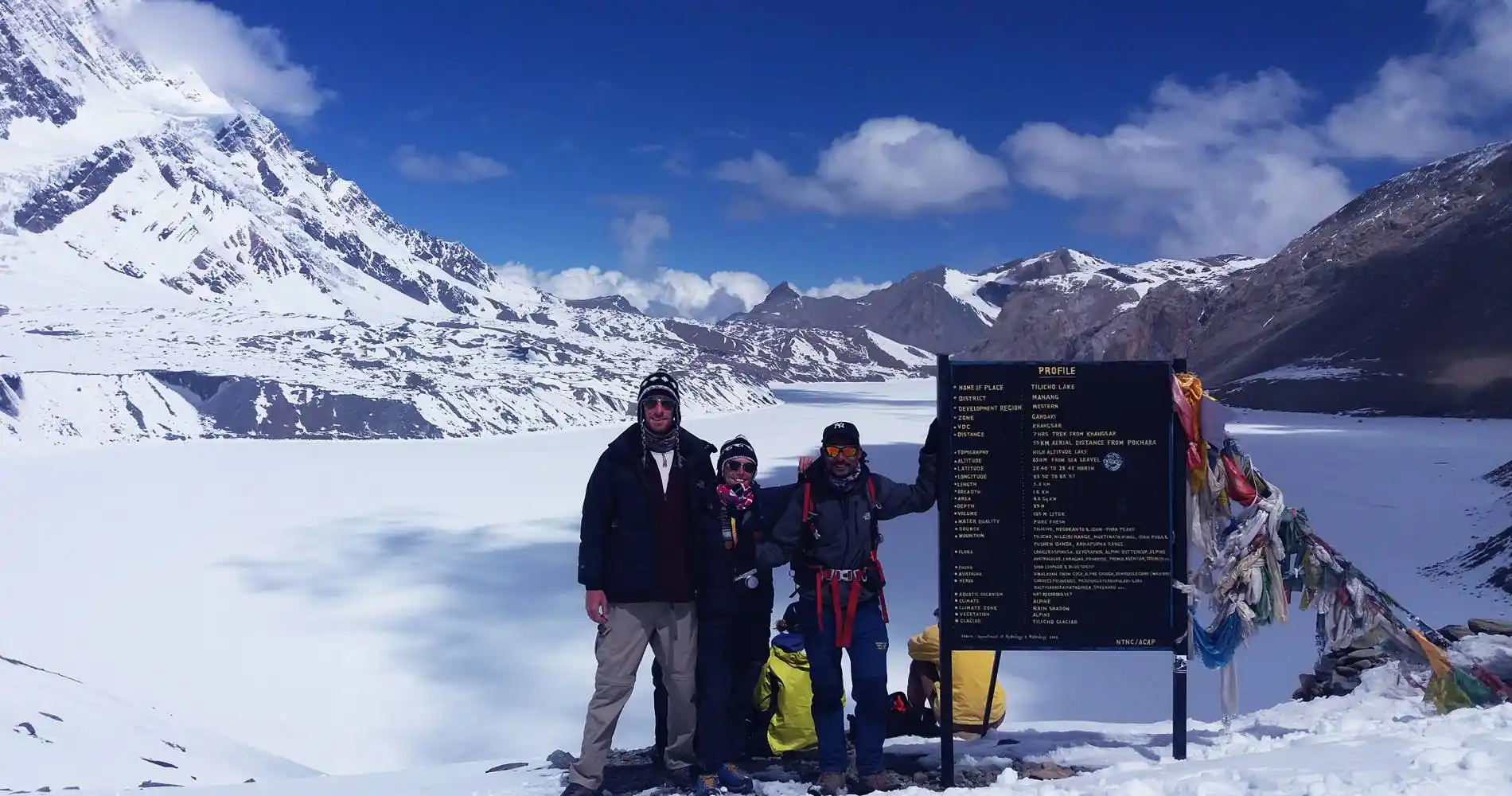
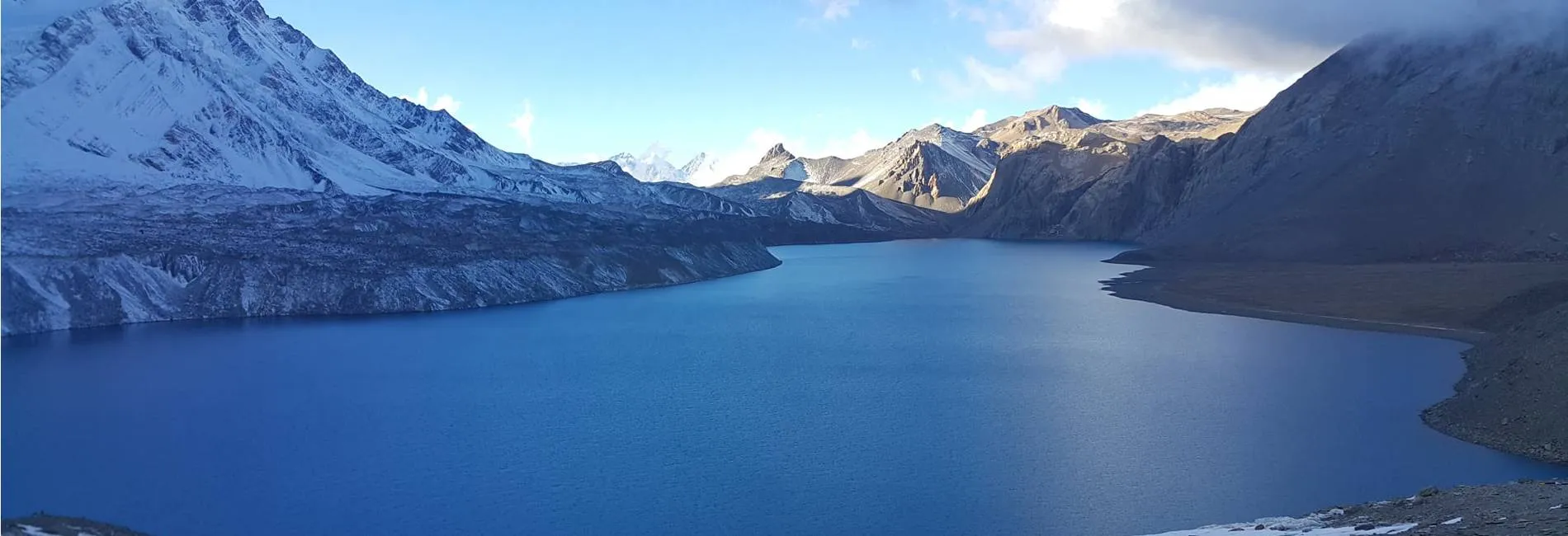
One of the well known landmarks in Annapurna circuit trek is Tilicho lake. It is situated at an altitude of 4949m. To unknown readers, Tilicho is one of the highest alpine lakes in the world which offers great high altitude trekking experience.
In order to get to Tilicho the side trip is taken from Manang and adds two days into the general itinerary. Starting from Manang you get to Khangsar village before moving to Shree Kharka, Tilicho Base Camp and lastly to Tilicho lake.
Standing beside the lake you will find great mountains and also the view of Tilicho peak. If the weather is clear and you remain lucky, the deep blue water of Tilicho creates a turquoise surface. It is an outstanding view when we talk about Annapurna region.
As beautiful as it may look, Tilicho lake visit demands physical strength and stamina. It is challenging with frequent changes in weather.
Annapurna Circuit Trek Difficulty: Fitness Level & Training
Annapurna circuit difficulty is harder to predict. If you have experience in trekking, it wont be too tough for you. However we can say the overall trekking experience is moderate to tough. Although technical skills won't be the key, you should have physical strength and stamina.
Moreover you should also be able to walk for multiple days. On an average the trekker should walk for 5 to 8 hours everyday. Not only that, there is 10 to 20 kms of regular trek which is tougher on your body. Right through the route you will be getting steep ascents, long descents, uneven terrain, suspension bridges, rocky trails and the high altitude conditions.
Out of everything, the most demanding day is crossing Thorong La Pass. With the reduced oxygen availability you will have to walk the trail for 8 hours on a single day. This could be very tough for the human body. Just imagine having 47% oxygen of sea level conditions, well that is what you have to face. Starting before the sunrise and ending the day after sun sets is tough demand.
The Annapurna circuit trek is accessible even for the beginners. But you will need to have adequate training before jumping in. In the case of fitness preparation, 3 months of exercise will be key. From cardiovascular training like hiking on a regular basis you should also focus on strength training.
The strength training should focus on quadriceps, calves, glutes and core stability. Lastly, be ready to carry at least 8 kms on your back during the hike practice. This will help you to simulate the trek conditions.
The Annapurna Circuit Trek remains accessible to beginners provided adequate preparation is undertaken. The gradual ascent through the Marsyangdi Valley and scheduled acclimatisation day in Manang support safe altitude adaptation.
Fitness preparation should begin three to six months before departure. Cardiovascular training should include hiking two to three times per week, gradually increasing to five or six-hour sessions. Strength training should focus on quadriceps, calves, glutes, and core stability, as descents place considerable stress on the lower body. Trekkers should also undertake training hikes carrying an 8–10 kg backpack to simulate trail conditions.
Compared with the Everest Base Camp Trek, the difficulty level is quite similar. However, the Annapurna Circuit Trek covers a major distance and offers more varied terrain.
Best Time to visit Annapurna Circuit Trek
The best time to visit the Annapurna circuit trek 160 miles Himalayan route circling the Annapurna massif is Autumn (September–November), Spring (March–May), Winter (December–February) and Monsoon (June–August). While Winter ( December - February ) and Monsoon ( June - August ) can be considered less ideal.
Types of best time to visit Annapurna Circuit trek outlined in detail are given below:
Autumn (September–November)
The best time to visit Annapurna circuit trek is during the months of autumn. It falls from September to November. The visibility remains clear with stable weather and excellent mountain views. As you go higher in altitude, the nights are more cold. It is during autumn that the teahouses and lodges run at full capacity.
Spring (March–May)
The second perfect time to visit Annapurna circuit trek is during the spring season. The snow seems to have cleared by this period and temperature is generally comfortable. Spring falls during March to May with rhododendron flowers blooming in full flow.
Winter (December–February)
Until and unless you are an experienced trekker performing Annapurna circuit trek during winter isn't advised. The accumulation of snow could result in tough trekking conditions. Not only that, the presence of equipment and flexibility is also pretty low.
Monsoon (June–August)
Monsoon in Nepal falls during the months of June to August. It is during this period that the Annapurna region gets massive rainfall. Even though Manang and Mustang lie besides the rain shadow zone, it is important to know that rainfall is pretty low there. The rainfall in Manang and Mustang is less than 300 mm all around the year. But if you aren't much experienced, trekking during monsoon isn't suggested.
Average Temperature in Manang (3,540 m) are given below:
Season | Day Temperature | Night Temperature |
Spring | 8°C to 15°C | -2°C to 3°C |
Summer/Monsoon | 10°C to 18°C | 2°C to 7°C |
Autumn | 7°C to 14°C | -5°C to 2°C |
Winter | -5°C to 5°C | -15°C to -8°C |
Annapurna Circuit Trek Permits & Costs
Any trekker looking to get into the Annapurna circuit trek must have the right permits with them. You can either get the permits at Nepal Tourism Board or also through your trekking agency.
Two of the major permits needed are given below:
- Annapurna Conservation Area Permit
- Trekkers Information Management System (TIMS) Card
For the ACAP permit you will need to pay 3000 rupees if you are a foreigner. Meanwhile the SAARC citizen will have to pay 1000 rupees. Any children below the age of 10 should not pay any fees. Meanwhile the TIMS card costs you 2000 although rules can change with time.
According to the current rules and regulations, solo trekking in the Annapurna region is not allowed. You will need to have a licensed guide to do the job. He should be registered under the current regulations.
Furthermore the documents generally required are passport photographs, valid passport, visa copies and travel insurance documents. If you also plan for Upper Mustang trek you should have a Restricted Area Permit with you. As you move further in the trek you realise places like Jagat, Manang, Muktinath, Tatopani and Birethanti have the permit checkpoints.
Altitude Sickness on the Annapurna Circuit Trek
Himalayan Rescue Association states that if you go past 2500m there is a major chance you might face Acute Mountain Sickness. AMS occurs when the body cant adapt efficiently to reduced oxygen levels at higher altitude.
There is a myth that age, fitness level and trekking experience tends to guarantee immunity, well that's false. The most common symptoms of altitude sickness is persistent headache, nausea, vomiting, dizziness, poor sleep, loss of appetite and unusual fatigue. Symptoms often appear several hours after gaining elevation and may be worse if we gain more altitude.
In order to be safe from all of these issues, Annapurna circuit trek has a dedicated acclimatization day at Manang. Our experienced team at Sherpa trekking expedition also help you to win over the issue of AMS. Slow climbing is the best way to beat altitude sickness.
Most of the medical authorities recommend you to sleep low even though you climb higher. After every 3000m you shouldn't get an ascent of more than 350m per day. There is also the presence of an HRA clinic in Manang which provides free altitude consultations. Before touching down on Thorong La Pass you need to get through these sessions.
In order to assist the climbers with acclimatization, Diamox or Acetazolamide is used. A typical dose of 250mg will be fine. After having the medicine though you could have increased urination, tingling sensation in hands and feet and change in taste. Consulting with a physician is a must before taking the medicine.
If you are going for an Annapurna Circuit trek, always have your travel insurance ready. It should cover for high altitude trekking and helicopter rescue coverage. You will have to pay around 3000$- 7000$ for emergency evacuation.
Ethnic Cultures during Annapurna Circuit Trek
The Gurung people are the oldest inhabitants of the Annapurna region. Starting from Syange and Chame, you can find the Gurung people all along. Gurung people are known to maintain both Hindu and Buddhist traditions and serve the Gurkha regiment. You will find great hospitality from the Gurung people during the trek.
Here are the some different cultural communities on the Annapurna region those are given below:
Magar People
Magar people are generally found at the lower to mid hill regions which surround the Annapurna area. Agriculture is the key source of livelihood for the locals. The community life of Magar people is dominated by distinctive cultural practices, traditional dress and seasonal festivals.Magar people are generally found at the lower to mid hill regions which surround the Annapurna area. Agriculture is the key source of livelihood for the locals. The community life of Magar people is dominated by distinctive cultural practices, traditional dress and seasonal festivals.
Manangi People
As the name suggests the Manangi people live mainly in the high altitude settlements of Manang and the surrounding villages. Manangi people are closely related with Tibet through trade, religion and migration. Tibetan Buddhism is the dominant faith. The key religious place for Manangi people is the Braga Gompa.
Thakali People
Between Tukuche, Marpha, Kagbeni and the Kali Gandaki corridor you will find the Thakali people. In the past they played a key role in trade between Tibet and India. As you get into the Annapurna circuit trek you will find some of the finest teahouses and lodges being run by the Thakali community. Besides, Thakali food is famous all around the world.
Religion & Monastic Traditions
Culture is the key part of people living in the Annapurna region. Having said that, you will see plenty of prayer flags called Lunga Ta which move from mountain passes and ridges. Mani walls are also present which are carved with sacred Buddhist inscriptions like many trails. As the chorten mark village entrances and important religious sites, traditional puja ceremonies are conducted in monasteries and throughout the region. The presence of Hindu and Buddhist culture shows great culture richness in the Annapurna circuit trek.
Annapurna Circuit Trek 14 Days PACKING LIST
The following information will give you some idea about what you need to bring for the trek. It is important you do not forget the essential items, as this will determine your comfort and safety on the trek. Equally important is that you do not burden yourself with unnecessary equipment on the trek.
General
- All season sleeping bag and down Jacket (we can provide if you need it, but has to be returned after the trek)
- Duffle bag ( Sherpa Expedition & Trekking provide duffle bag during the trek but has to be returned after the trek)
- A wind and waterproof thin layered jacket (a must-have for morning and evenings above 3,000m)
- Daypack
Upper Body- Head / Ears / Eyewear
- A pair of half gloves
- A warmer hat that covers the ears
- Sunglasses
- Neckwarmer
- Sunscreen (35 to 60 SPF)
- Headlamp and an extra set of batteries
Hands
- A pair of half gloves for walking poles(if you prefer)
- Warmer shell gloves and liner
Upper Body
- long sleeve t-shirts
- Thermal tops
- wool jacket or pullover
- Sports bras for women and girls
- Water and windproof shell jacket
Lower Body
- Thermal underwear (especially trousers)
- windproof and waterproof trousers
- warmer trousers
- Comfortable trekking pants
- Extra casual sport pants
Footwear
- A pair of good waterproof trekking boots
- Pair of sandals
- 4-5 pairs of woolen socks
- Sock liners
- Light shoes and sneakers
- First Aid Kits and Medicines
- Assorted adhesive bandages (fabric preferred)
- Blister treatment cream or similar
- Insect / anti-itch ointment
- Ibuprofen or other pain-relief medication
- Diamox (125mg to 250mg tablets for altitude sickness)
- Warps, splints, and wound coverings butterfly bandage
- Water purifying pills
(Note our company guide will carry the medicines and first aid kits during the trek. However, we recommend you bring your personal first-aid kit as well)
Miscellaneous - but must useful on the trek
- 4 passport size photos with original passport
- Water bottle & filter
- Flight details (please make a copy and leave one pic at our office in KTM because in case you want to change your flight date)
- Bathroom kit (conform, should be included toilet paper, plastic bags, hand wipes, towel, and soap, etc.)
Extra things
- Comfortable trekking poles
- Quality energy dry foods (up to you)
- Power bank and music players
- Camera (memory card, chargers, and extra batteries)
GOOD TO KNOW ABOUT Annapurna Circuit Trek 14 Days
Accommodation
You will be accommodated in 3-star hotels in Kathmandu. During the trek, we will be staying at lodges/ teahouses. You may find comfort and better quality teahouses - having attached bathroom at lower levels- until you reach higher elevations, where the accommodation is more basic with bare necessities.
Meals during the trek
In Kathmandu, your hotel includes breakfast, whereas all meals (breakfast, lunch, and dinner) will be provided during the trek. A staple food of the Manang & Mustang regions is potatoes, oats, buckwheat, Sherpa stew, and Tibetan bread. Sherpa’s’ started farming potatoes when the first seeds were introduced to the region in the early 90s. There is a limited choice of food at higher elevations and except many potato dishes. Potatoes are high in carbohydrates – an excellent source of energy needed at high altitudes.
Transportation
We use a private car for sightseeing and for the airport to hotel pick and drop off. We use public transportation or local buses during the trek.
Physical fitness
This can be a challenging trek where you often have to walk 6-7 hours a day. You need past experience of hiking or trekking but if you have done any kind of trekking activities then it is always a plus! We have met people from all walks of life, shapes, and sizes who have completed the trek. The only difficult part is when altitude sickness strikes and the effect that it can have on your body. Before leaving for Nepal it is good if you can prepare yourself physically by increasing your stamina and oxygen intake.
ROUTE MAP OF Annapurna Circuit Trek 14 Days
Gallery of Annapurna Circuit Trek 14 Days

Annapurna Circuit Trek 14 Days VIDEOS
Annapurna Circuit Trek 14 Days Departures
Every departure listed below is 100% Guaranteed — once you book, your trip will run as scheduled regardless of group size.
Select a departure month
Fill out the form below and a Travel Expert will reach out to create your perfect tour.
RELATED PACKAGES


FAQS Related to Annapurna Circuit Trek 14 Days
Others
Yes the Annapurna circuit trek can be done in 14 days. You will have to use the roads to Syange or Chame and carefully plan the trip. With easier access to roads you can get to the destination in less time. This 14 day approach balances duration, acclimatization and logistical efficiency.
The pre-monsoon (February, March, April and May) and post monsoon (late September, October, November and December) are considered the best for the Annapurna Circuit trek as the weather conditions become favorable during this time, providing you with good visibility and a suitable atmosphere for Annapurna Circuit Trekking.
In order to get to the end of Annapurna circuit trek, you should have 2 permits. They are:
- Annapurna Conservation Area Permit
- Trekkers Information Management System (TIMS)
- Restricted Area Permit (RPA) if you go Upper Mustang
Thorong La Pass is the highest point of this journey. It stands at 5416m which connects Manang and Mustang region. It is one of the most challenging and rewarding experiences for the trekkers.
With the help of proper preparation, beginners can also do the Annapurna circuit trek. It doesn't require any technical climbing skill. Consistent fitness, gradual acclimatization and following the guide is a must.
Comparatively both feel the same. Although EBC reaches slightly higher, Annapurna Circuit trek gives you overall coverage for the distance and has variety in landscapes. However you need good physical condition for both treks.
The best time to do the 14 day circuit trek is majorly during autumn and spring. The weather remains absolutely clear with brilliant mountain views, rhododendrons and the freshness of nature.
Any trekker who is experiencing altitude sickness should stop climbing any higher. Consult the guide and take medical assistance too. With proper rest and hydration basic symptoms can be kept in check. However if symptoms go bad you will need to consult the doctor or also evacuate.
No Tilicho lake is not included in the package. It is more about the optional extension. If you are actually interested in visiting the lake, we can add 2 more days into the itinerary. This condition however differs from agency to agency.
Sherpa expedition trekking package generally include:
- Airport transfers
- Accomodation
- Meals during the trek
- Permits
- Licensed Guides
- Porter services
- Transportation
- Basic equipment
- Emergency support etc.
Our itinerary has been specially tailored to prevent any kind of AMS (Acute Mountain Sickness) while moving up to higher altitudes. Normally, altitude sickness starts from 3,600 meters and above. You will be trekking at a relatively slow and gradual pace as part of the acclimatization process. Cut off caffeinated, alcoholic and smoking items. Drink at least 4 liters of water a day. Trek slow. Don't skip the acclimatization days. Better to continue with Diamox (if any symptoms show up). Drink Garlic Soup. In the higher elevation, there is less oxygen in the air and this is more so while crossing high passes. Our expert guides will advise you on how to avoid AMS and treat it when/ if required.
Make sure to have both medical and evacuation insurance before coming to Nepal for Annapurna Circuit Trekking. You should be careful in choosing a policy while traveling to a Himalayan country like Nepal as some insurance companies may make special exceptions for adventure travel. If you are confused about the insurance, please inform us and we will help you. It is usually better to arrange your insurance in your country before travel.
The trekking will be 5-7 hours a day depending upon the landscape and destination.
It takes 4 to 11 days to reach Thorong La depending upon the mode of transportation and packages of Sherpa Expedition and Trekking offers.
We at Sherpa Expedition and Trekking Team always have the safety, comfort, and satisfaction of our valued customers as our foremost priority at all times, and we assure you a wonderful and unforgettable time with us in our beautiful country. Sherpa team members of Sherpa Expedition and Trekking will be carrying all the necessary gear, equipment, and first aid kits and they have extensive first aid training. If a trekker falls sick on high altitude, the leader will decide whether to continue the trek. In case of emergency, Sherpa Expedition and Trekking have a rescue helicopter to bring you back from the higher elevation. Moreover, Sherpa Expedition and Trekking also provides oximeter to monitor the oxygen level at high altitude and offers regular health check-up facilities.
You can either trek on foot or by a flight. Sherpa Expedition and Trekking offer exciting and reasonable flight to Pokhara for 4 days and 10 days. Sherpa Expedition and Trekking can also customize your tour as per your necessity.
The flights are usually regular between September and May. But due to high altitude, bad weather and unforeseen technical issues, you may experience a delay or cancellation of the flight. On the occurrence of such events, Sherpa Expedition and Trekking tourist bus will be arranged.
Sherpa Expedition and Trekking will provide one porter for two trekkers to carry 20 kgs of luggage (maximum 10 kg for each trekker). Please be sure your porters are not overloaded because they do not carry only your equipment but also lift your spirit to reach new heights, and your love, affection, and generosity can be the reason for them to work hard to take you to your destination. However, the weight limit on flights to the Annapurna region, basically to Pokhara is a total of 20 kgs including hand bag and you need to pay an extra amount per kg for the excess baggage. Sherpa Expedition and Trekking pays up to 5 kgs of extra baggage making your total to 20 kgs with your hand bag.
Garlic soup is a must while trekking. Sherpa Expedition and Trekking recommend trekkers to drink green tea, lemon tea, hot lemon ginger tea and drink at least 2-4 liters of water a day. However, it is better to avoid alcohol and alcoholic beverages, caffeinated items, and hot-chocolates at high altitude.
Sherpa Expedition and Trekking won’t recommend non-veg items because the meat in such places may not hygienic and healthy. Sherpa Expedition and Trekking also encourage to avoid dairy and cheesy items and strongly suggest not to consume them during the trek. So, our packages are suitable for both vegan and vegetarians.
Your guide and porters are a big reason why you got a chance to feel something very few can have. Apart from guiding and carrying your necessities and being mindful of your safety, they want to see you happily succeeded more than anyone like family and help you successfully complete the trek safely. So, your tips reflect gratitude towards them. So, tipping is a recommended culture for porters and guide in Nepal as a gesture of thankfulness.
Sherpa Expedition and Trekking will introduce dozens of shops selling knock-off gear in Kathmandu. You can also barter those gears at the knock-off places but be sure you keep the receipt safely. Moreover, you can rent the needed gears if you do not want to buy them.
Yes, most guesthouses offer Wi-Fi, for a small charge. it cost USD$5 per day.
ATM services are available only in Pokhara & Jomsom. However, the services might not work or run out of cash. Therefore, we suggest you carry a small amount of money to buy snacks, etc during the trekking.
Most of the tea houses/ lodges have electricity whereby you will be able to charge your iPod or camera batteries. Please note that lodges/tea houses will charge you some extra money for the services. The fee may vary from 1 USD to 5 USD per hour.
Latest Traveller’s Reviews
Travel experiences of our clients who recently returned from their trips.
100%
Based On 159 Reviews
Kathleen Florence
Denmark
October 18, 2024
Outstanding Support and Guidance
Eljon Cayanan
Australia
October 4, 2024
An Unforgettable Journey
Dawid Nykiel
Hong Kong
September 25, 2024
Highly Recommend!

Write Your Review
Average Customer Ratings
How The Travellers Have Rated This Package
152
7
0
0
0


