
Annapurna Base Camp Trek
USD 990 / Per Person
ABC Trekking Overview
The Annapurna Base Camp trek is undoubtedly among the most popular ones out there and has earned its place as the best short Annapurna trek Nepal adventure. This amazing Annapurna Sanctuary trek leads you to the heart of the Annapurna Sanctuary situated below Mount Annapurna's colossal giant alongside its many other surrounding giants.
Embark on an unforgettable Annapurna hike journey where you will discover some of the most amazing hikes such as traversing through lush green rhododendron forest, terraced farmland and end at high altitude glacier morainic that gives panoramic views of the World’s 10th highest peak globally known as Annapurna I (8,091m).
This Annapurna trek in Nepal is the perfect trip choice allowing you to experience natural splendor, local culture as well as 360-degree views of Himalayan peaks. Our Annapurna tour will start from Pokhara which is called Lakeside gateway to Annapurna region. From here there are many options for you depending upon your itinerary and road condition. Trekkers generally start their journey from Pokhara and travel towards Nayapul, Jhinu Danda, Ghandruk, or Siwai etc according to your itinerary.
A very popular and modern Annapurna Sanctuary trek goes from Pokhara to Ghandruk to Chhomrong and then reaches Annapurna Base Camp. While trekking you will pass through several villages like Birethanti, Sinuwa, Deurali, Chuile etc. After reaching Annapurna Base Camp, most of the people end up their tour through Jhinu Danda / Siwai then they return back to Pokhara from there by bus/flight. There are also some treks that takes different route and comes down to Pokhara through Bamboo and Jhinu . Thus this gives you a little different scenery than going up the same path.
Located in Central Nepal in the Annapurna Range of the Annapurna region, which is one of the most visited Nepal Annapurna Base Camp trek destination for trekkers, Most trekkers fly into Kathmandu before connecting to Pokhara to start their ABC journey. It's culturally rich as you'll pass through several villages of the Gurung and Magar communities. So if you want to experience the best local cultural taste in addition to your adventure, then this particular Annapurna hiking tour is for you. Annapurna base camp trek will normally be about 10 days long trip from Pokhara and will be approximately 70km of total distance depending upon your trekking itinerary. Also, during the trek, we can get stunning views of the world famous mountains such as Annapurna south, Hiunchuli, Machhapuchhare etc. The highest point reached in this Annapurna trek would be approximately 4130m. Also, you may get the chance to visit the famous Machhapuchhare base camp before climbing up to the top of the Annapurna base camp.
Regarding trekking Nepal Annapurna sanctuary difficulty, the trek is rated moderate – this is to say it is possible to trek with average levels of fitness, but is physically taxing on most because the trek involves consecutive walking days at altitude. Usual challenges associated with Annapurna trail nepal are, for example, the long stone staircase section above Ulleri and also above Ghorepani, long hiking days, the variable mountain weather, the general effects of being at a higher altitude and the additional elevation on any Annapurna region Nepal treks, which include the Poon Hill (3,210 m) Sunrise view and passing via Tadapani. Trekking in annapurna base camp in nepal also involves significant altitude gain each day which most people undertaking an annapurna base camp trekking adventure for the first time underestimate which is why the fitness requirement for annapurna base camp in nepal means that you should be able to walk for between five and seven hours per day, mostly over very undulating terrain with basic cardiovascular ability; trekking experience is not a must but can only assist if you've prepared well.
Accommodation on this Annapurna Trail will primarily consist of tea houses and lodges which are another unique element that define your Annapurna Hiking experience. Typically these tea houses provide either private or shared room options including basic beds (with blanket) plus a communal dining space where you can indulge yourself in some authentic local Nepali fare alongside some basic international dishes. Hot shower availability may require an additional fee but generally there should always be electricity / Charging facilities accessible throughout most of this trail although sometimes these do tend to become limited towards upper altitudes.
Areas closer to the famous Annapurna Base Camp also contain some very basic amenities however due to its remote nature combined with high elevations this shouldn’t really come as a surprise especially if you’re planning to explore one of Nepal’s top Annapurna basecamp trekking routes.
Whether you want to join a guided Annapurna base camp trek tour package with expert guides (and sometimes even porters) that ensure safety, insights about the local culture, and assistance with everything from accommodations to emergencies, or plan your own independent/ solo Annapurna base camp trek adventure where you control your own schedule and save money.
We're here to answer all questions you have about choosing either a guided or independent Annapurna hiking experiences. But first, let's talk briefly about what each option offers and who might be best suited for which style of Annapurna trek.
For the first-timers, those traveling alone, or international tourists visiting Nepal - we recommend booking our ABC trek package tours as they include a guide along with some other essential staff members who will look after you throughout the journey. However, if you are quite experienced at trekking yourself then why don't try out going through an independent/solo Annapurna Base Camp trek? Just remember though that doing so would mean having complete responsibility over your trip plans including arranging hostels/guesthouses/hotels as well as obtaining necessary permissions before-hand.
No matter how you decide to spend time exploring the beauty of Nepal's natural landscapes, there's no denying that going through an Annapurna region trek is one of the most rewarding ways to experience its majestic Dhaulagiri and Annapurna Massif landscapes, rich culture, flora and fauna, of the mountainous region of this South Asian country. Some trekkers choose a longer hiking Annapurna Circuit route but if you are looking for an equally rewarding Himalayan experience with a shorter trek then this ABC trek would be your best bet.
Major Highlights of Annapurna Base Camp Trekking
- Witness the sensational sight of a sunrise from Poon Hill, arguably one of Nepal's finest viewing stations. You’ll see the Golden Light slowly unfold as it gradually reveals itself across the entire Annapurna range and cast it with hues of gold over the snow-covered mountains prior to sunrise visitors seeing it.
- Visit lakeside Pokhara, the picturesque entry point for the Annapurna range, where tranquil lake waves reflect mountains miles away, and visitors lounge, gear up and admire the impressive scenery before leaving for the Himalayas.
- Experience the lifetime memory of great culture of Gurung, Magar who invite you with sweet, welcoming and understanding nature, indigenous house built by stones, unique culture and mountain life culture as a native peoples during Annapurna base camp trekking.
- Take in the awesome sight of Mount Annapurna, world's 10th highest peak, a vast snow clad mass which is so colossal it occupies the entire skyline, offering trekkers a closer acquaintance with the authentic splendour of high altitude peaks and sublime Himalayan peaks.
- Visit for a view of mount Machhapuchhare (Fishtail Mountain), which features two headed summit. It is treated sacred among locals and is yet to be scaled.
- Take in sweeping views of the Annapurna range including Machhapuchhre, Hinchuli, Annapurna South, Annapurna I, Gangapurna, Annapurna III and Ghandarva, a vast 360-degree Himalayan amphitheatre that takes every trekker’s breath away.
- Find yourself relaxing by hot natural springs in Jhinu - these soothing hot springs are perfect to relieve your body from tiredness after hours of trekking and are popular too for having health benefits such as boosting the immune system and treating various skin problems.
- Trek in Annapurna Conservation Area of Nepal where Annapurna Massif, Machhapuchhare and Hiunchuli lies in the midst of thick oak, rhododendrons and bamboo forest of this protected conservation area.
- You can spot many types of colourful birds - Himalayan Monal, Wood Snipe, Red Headed Vultures are some of them while also, you will be able to see Musk deer and Monkeys in this Conservation Area. You can travel along Annapurna trails with Dense forested Areas, where you will find monkeys swinging around.
Sunrise View on Annapurna Massif
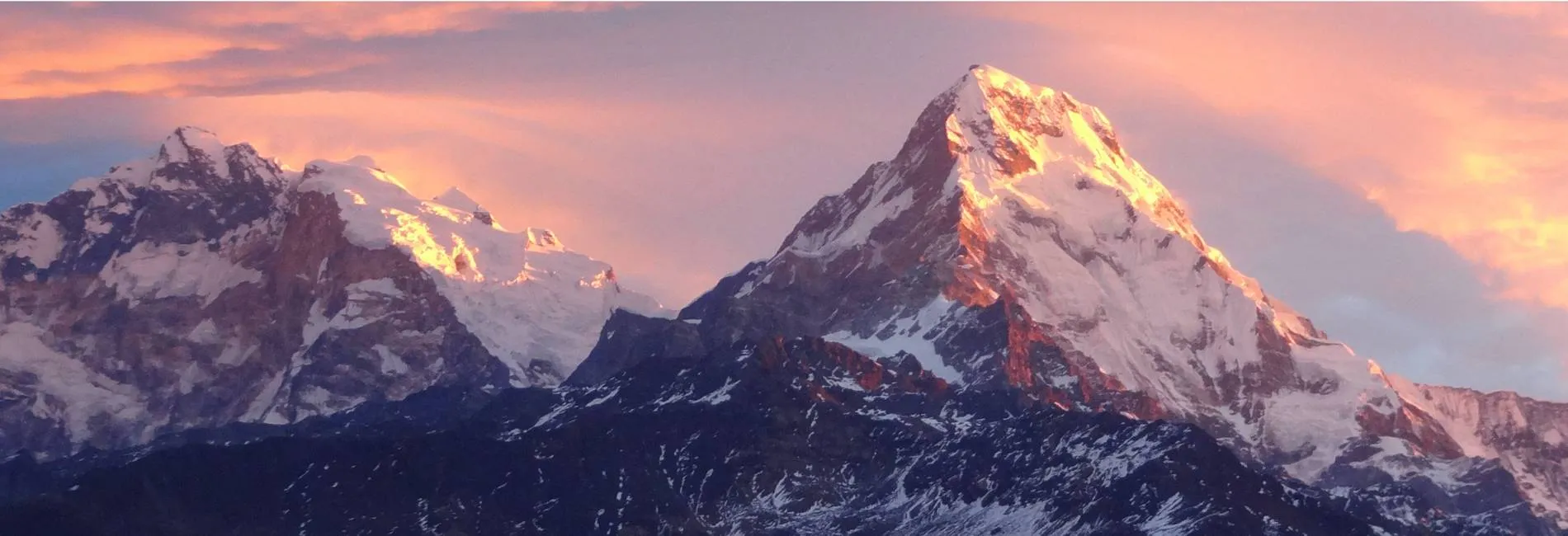
Almost every Annapurna trekker remembers this magical scene forever engraved in their mind’s eye. Annapurna I (8091m), the most prominent peak of the entire Annapurna Range with the most spectacular view, offers sunrise on the Annapurna Massif at Annapurna Base Camp Trek. The mountains that have been in dark shadows of blue color in the darkness just before sunrise will start to get painted by the first rays of the sun and will be transformed into gold, orange and pink colored giants with Annapurna South, Hiunchuli, and Machhapuchre (fishtail) and many more mountains.
Because the air in the morning is clear and still and it is possible to see far across and out to space the mornings in these mountain locations, Annapurna base camp (4,130m) is usually at its best photographically and for taking in wide views from high in the mountains and at base camp. And this vista takes the form of 360 degrees natural amphitheater, completely dominated by the great mountains of the Himalayas. The moment dawn breaks through the veil of darkness and lights up this beautiful scenery, there isn’t anything more magical than watching these magnificent formations come out of the shadows to reveal their true beauty to you.
Why to Choose Sherpa Expedition for ABC Trek
- Experienced Local Sherpa Team: With our licensed sherpa guides having years of Himalayan trekking experience, an in depth knowledge about trails, awareness of altitudes and first aid trained we ensure you get to enjoy a safe and culturally enriching journey on your Annapurna base camp trip.
- Fixed guaranteed departures: This guarantees no last minute cancellations because the group size is too small. Your trek will operate as soon as you confirm with our office. From the moment your trip is confirmed to your return, we assure you are looked after and travel with peace of mind.
- Free Sleeping Bag and Down Jacket Rental: Travel with more comfort on cold Himalayan nights and also travel with less baggage and lighter costs.
- 24/7 Emergency Support: We monitor every trek with our team and provide 24×7 Emergency Assistance. Our team will also co-ordinate rescue services, arrange medical support if needed etc. Our team will always be available to assist you through phone calls during your adventure.
- Easy and Secure Booking: Choose your date of departure, fill out our booking form and pay the deposit to book this holiday. You will then get an instant confirmation containing all trip details along with support. Our booking process is quick and hassle free.
- Trusted Himalayan Adventure Company: We’ve been guiding trekkers through beautiful Nepal since 1977 and have an amazing team that has extensive experience and knowledge. From our package prices to our personal approach, you can rest assured when choosing us as your trekking partner that you will get unforgettable trekking experiences in a safe environment.
Who Can do Annapurna Trail Nepal?
Suitable for all kinds of people including beginner, experienced hikers, families, single travelers, seniors and kids if they prepare themselves properly. Annapurna Trail Nepal doesn’t require any kind of technical climbing so everyone can do this hike as long as you have good fitness and acclimatize properly and plan your hiking itinerary accordingly. Seniors, family members, first time trekkers are also allowed to walk on Annapurna Trail Nepal with experienced trekking guide.
Annapurna Base Camp Height
Annapurna Base Camp trek takes you to original Annapurna Base Camp Height in Gandaki Province, of Nepal, which is 4,130 meters (13,550 feet). This Annapurna Base Camp elevation is the proof that you will be in high altitude environment for certain days and here oxygen level are very low than that at sea level. Because altitude of Annapurna Base Camp goes over the 4,000 meters threshold, every trekker from beginners to experienced require to follow proper acclimation schedule, stay hydrated and follow a gradual ascent.
The height Annapurna Base Camp reaches also adds up to make it among the most rewarding places for trekking in the Himalayas of Nepal. While taking advantage of the ABC camp altitude you will get to see the awesome view of Annapurna I, Machhapuchhre, Hiunchuli, and Annapurna South. Also, when visiting, an elevation Annapurna Base Camp, trekker can enjoy the scenic beauty formed as a result of the high Annapurna elevation, with all these peaks rising to over 7,000 and 8,000 meters.
Why Annapurna Trek is One of the Best Trek in Nepal
The Annapurna trek has a whole load packed into one of the finest trekking in Nepal is that you'll get to experience fantastic Himalayan scenery and beauty in a package trek like none other. With striking landscapes, Gurung and Magar villages, beautiful rhododendron forest and the Annapurna sanctuary, you get all the trekking experience in a package all suitable for both for beginners, and intermediate trekker. Professional service with teahouse facilities is available. On top of that rich culture and sunrise view is a wonderful highlight of the trek which proves that Annapurna trek is among the world’s most exciting and breathtaking adventure treks.
Elevation Profile
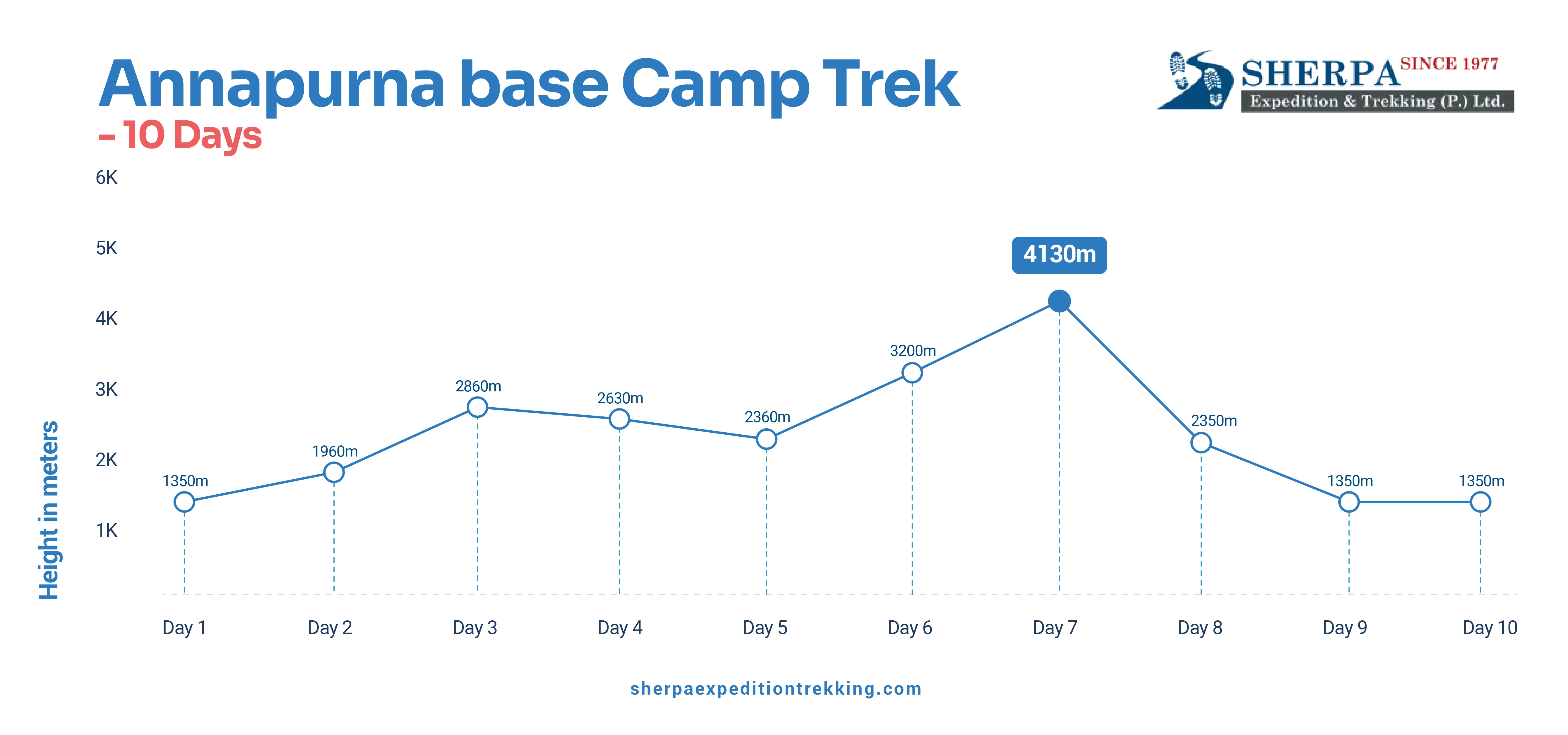
Short Annapurna Base Camp Trek Itinerary
On arrival at Tribhuvan International airport day your welcome by our representative of Sherpa Expedition and Trekking with the company placard and escort you across the city to your hotel situated in a convenient part of bustling Kathmandu city, via the charming street of Thamel.
After arriving at the hotel you can either rest after the journey, visit some cafes or shop and traditional market of Thamel, or visit around the nearby attractions. In the evening we will give a brief detail on our trek and you will have a chance to meet the trekking team members who will be with you throughout Annapurna base Camp trek. We also check your trekking gear, give a short brief on permits, weather, altitude and trail condition. And lastly enjoy dinner followed by return to hotel for overnight stay in Kathmandu.
On this day after breakfast in Kathmandu you will enjoy your early morning flight from Kathmandu to Pokhara. And after you land at Pokhara airport our team of Sherpa Expedition and Trekking staff will welcome you there and then we will head towards the starting point of hike (Nayapul) in the Annapurna region.
We pass through Hyangja and Naudanda, enjoying beautiful views of the green hill areas covered with terraced farms. Then, after checking our ACAP Permit at Birethanti, the path follows the course of the river called Bhurungdi Khola, crosses several suspension bridges, passes some little villages, and finally reaches Tikhedhunga, where we take a junction, continue further left and start ascending the famous Stone Staircase, having more than three thousand steps, until we reach Ulleri, which is one of the most traditional Magar Villages.
We can see our first view of Annapurna South and Hiunchuli. Dinner and overnight stay will be provided by our experienced trekking team in the comfortable teahouse located in Ulleri. This whole journey will last about 6-7 hours.
After breakfast, we will proceed uphill as guided by our experienced guide who has been trained properly for this kind of tour. We start our trek along well-maintained stone steps, going through peaceful forests consisting of oak and rhododendrons.
At banthanati we stop for some time to refresh ourselves and take breath of fresh mountain air.
Walking onwards from Nangethanti, the path starts to steadily go upwards through the majestic forest below canopy of trees, and with small clearings, spectacular view of Annapurna South, Hiunchuli and Machhapuchre in the sunny weather can be viewed. Today we will continue to go upwards with little gentle small ups and downs before taking the trail upwards again to Ghorepani. Your leader guides you at a pace where everyone get accustomed to altitude accordingly.
Have lunch at teahouse in Nangethanti before the ascent to traditionally Magar village of Ghorepani. At Ghorepani, you check-in into teahouse and rest with enjoying hot dinner in group with trekking team. Later get briefings for early morning visit to Poon Hill and stay overnight.
Today’s plan includes getting an early start & going with your guide for this walk of 45-60 min uphill all the way to see amazing view point of Poon Hill (3210 m). Here you can see magnificent view of the great mountains such as Dhaulagiri, Annapurna I, Annapurna south, Machhapuchhre, Hiunchuli, Nilgiri & many others under golden light when they will be seen with sunrise before dawns.
We can take some tea and photographs here as well. After that, our trekking guide would lead us down from the Ghorepani area where we have our breakfast. Then, we’ll trek towards the east and ascend slowly through the beautiful forest of rhododendrons and oaks until we get to Deurali Pass. Following this we shall trek downhill into Tadapani.
The forest bursts to life with colorful blooms of Rhododendrons in spring, which makes this section really a beautiful part of this trek. Our lunch will be provided by our local tea-house on the way and then finally we proceed towards Tadapani.
You’ll reach there in late afternoon and your Sherpa Team will make you feel comfortable with overnight accommodation and warm dinner.
Start with an early breakfast followed by trekking down towards Chuile along with dense rhododendron and Oaks forest. Descending steeply after some time we reach to the Kimrong Khola then cross over a suspension bridge. Then gradually start going up through Gurjung village amidst of terraced farmlands enjoying the magnificent view of Machhapuchhre, Annapurna south and Hiunchuli peaks here and there during our trekking. As we come across Chhomrong that serves as the key point to enter the Annapurna sanctuary for checking your ACAP permit then take lunch at a local Teahouse place.
Now onwards starts descending on the famed stone staircase till reaching the Chhomrong Khola then crossing the next suspension bridge and finally starting to go up towards Upper Sinuwa through peaceful Bamboo and Oaks forests. Even though we have some long descent and ascent routes today but all will be covered within the comfort limit maintained by our Guide throughout.
Finally end the day with a delicious warm dinner and staying overnight at a cozy teahouse located in Upper Sinuwa surrounded by tranquil mountain scenery.
After breakfast, your Sherpa expedition and trekking guide will lead you towards north direction from upper Sinuwa passing by dense forest consisting of bamboos, Oaks and rhododendrons.
From here the trek gradually descends down to Bamboos, then moves along the valley of Mod Khola till reaching to the village of Dovan. The trail then continues upwards gradually leading up to Himalaya. On this stretch there will be some nice little villages dotting the hillsides as well as some interesting geological formations like Hinku Cave.
The trek will finally end at Deurali after an initial climb that passes through beautiful places like a number of waterfalls and sometimes even sights of the majestic Machhapuchhre. As we are above 3000 meter now, your sherpa expedition trekking guide would be taking extra care about our acclimatization process.
In between all these we have lunch at some local tea house situated in either Dovan or Himalaya. Later as we reach Deurali we will be taking rest while listening to our trekking leader’s brief about tomorrow's plan to visit Annapurna base camp.
Start your journey after a good breakfast in Deurali then head towards Annapurna Sanctuary. We will go along the narrow entry point of Annapurna sanctuary and reach Machhapuchhre Base Camp (3,700m).
The forest ends and the view opens up showing a great glacier area which is surrounded by some amazing Himalayan peaks around us. After having a short break and lunch we will proceed to Annapurna Base Camp (4,130m) continuing with a gentle incline hill trail. In Annapurna Base Camp, as compared to others places, there is less steeper path but still require steady walking due to high altitudes. As soon as we arrive we can see beautiful sightseeing all around Annapurna i, South Annapurna, Hiunchuli, Machhapuchhre, Gangapurna, other peaks that surround the place all together.
So during this time your Sherpa expedition-experienced guide will take care of everything about you to make sure your safety while hiking here also keep a check on how much you have been getting adjusted. After having check-in at the mountain teahouse we will enjoy our dinner and sunset together. Then spend the night at Annapurna Base Camp.
After waking up very early morning for watching breathtaking sunrise of the Annapurna Sanctuary, have breakfast at Annapurna Base Camp.
Then our sherpa expedition and trekking will start your return journey back down towards Sinuwa via the same scenic trails which lead from Machhapuchhre Base Camp to Deurali-Himalaya-Dovan-Bamboo.
The dramatic alpine scene becomes more colorful as we descend toward lush bamboo and rhododendron forests. Since this day’s trek consists mostly of downhill, there are also some short stretches that require you to walk uphill, so our guide would always make sure that you’re going on a nice relaxed pace so that your knees can be protected. Then lunch will be provided at a cozy little teahouse located in either Deurali or Bamboo, after which you’ll begin the final climb up towards Sinuwa. Finally, in late afternoon, you reach at comfortable mountain teahouse and enjoy delicious fresh dinner by watching beautiful mountain views and sharing your trekking experience with your trekking team members.
On your last day of trekking, you have your breakfast in Sinuwa followed by trekking along with your experienced Sherpa Expedition and Trekking guide who will lead you from Chhomrong. The way down consists of descending down the long stone staircase till Chhomrong Khola crossing over the suspension bridge where we also climb briefly back into Chhomrong village again before going downhill towards Jhinu Danda.
With sufficient time we can visit the famous natural hot spring located beside the Modi Khola which helps us in relaxing all our tired muscle body parts. Once you reach the destination, have lunch then you will be transferred back to Pokhara with our private vehicles via Siwai, Birethanti and Nayapul and then fly to Kathmandu where we can view the spectacular scenery of Annapurna and Manaslu Ranges (subject to clear weather). You will be transferred to your hotels upon reaching Kathmandu City.
Today’s program ends your unforgettable Annapurna Base Camp Trek with Sherpa Expedition and Trekking.
Accordingly, our representative will meet you at your hotel and organize a comfortable private transportation towards Tribhuvan International Airport three hours before your departure.
On your way back home you can think about all the wonderful moments of these 10 days full of charm with amazing villages, green Rhododendrons forest and stunning view from Annapurna Base camp. Our team will help you carry your luggage and make easy airport drop off process without any problem so that you can complete our check-in and immigration procedure smoothly.
Annapurna Base Camp Trek Package and Inclusions
Cost Included in Your Package
- Airport Transfer: All international as well as domestic airport pick up and drop off service will be carried out through private car.
- Meals During the Trek: You get three wholesome meals - Breakfast, Lunch & Dinner everyday during the trek along with you while exploring the beauty of nature within the mountain.
- Accommodation (Kathmandu): Two nights’ standard accommodation at a 3-star Kathmandu hotel on a twin-share basis, including breakfast.
- Guide and Porter: Accompanied by a government registered and fluent English-speaking trekking guide having lots of experiences on the Himalayas.
- Strong and well-equipped Sherpa porters to carry our gears (1 porter for 2 trekkers).
- We'll cover all salaries, meals, Accommodation, Insurance & Safety Equipment etc for you.
- Flight tickets between Pokhara To Kathmandu.
- Local Transportation: Your ground local transport will be provided with car/jeep from Pokhara to Nayapul and then from Jhinudanda back to Pokhara.
- Guide and Porter Expenses: All expenses of guide & porters including food, lodging, insurance, and transportation charges are covered fully.
- Permits: Annapurna Conservation Area Permit and TIMS Card are also arranged, which is mandatory for this trek, so we include it in our package.
- SEAT Trekking Gear: Use of sleeping bag, down jacket, duffle bag, and walking poles (if required) will also be provided and should be returned on completion of the trek.
- Teahouse lodgings: We ensure you have comfortable tea house accommodations along your entire trek. During peak season (from mid March till end of May & from mid September to end of November) most teahouses on high altitude places (Deurali, Machhapuchhare Base Camp, Annapurna Base Camp, Bamboo etc.) do provide shared room with 4/5 bed. You need to prepare yourself for this because this is normal practice here.
- Assistant Guide: If your group consists of more than 8 trekkers then we will get one more assistant guide free of charge.
- Fresh fruits: Every day we serve seasonal fresh fruits during our whole trek.
- Trek Completion Certificate - At the conclusion of your trek, you will receive this certificate as recognition of your accomplishments.
- SEAT T-Shirt - As an added memento from your treks we also offer you our company’s T-shirts.
- Emergency Assistance
- We can provide assistance in setting up emergency rescue operations should you fall victim to some critical medical condition. This will be funded by your travel insurance.
- Oximeter Monitoring - We will be using a Pulse Oximeter twice daily to keep an eye on your oxygen saturation, pulse & heart rate. This provides us with a critical piece of information that enables us to monitor symptoms of Altitude Sickness (AMS).
Costs Excluded
Meal Cost in Kathmandu and Pokhara: Lunch & Dinner in Kathmandu and Pokhara is not included. We can give you suggestions on where you can have lunch and dinner.
Nepal Entry Visa Fee: Your Nepal entry visa can be applied for at the airport on arrival. The charges for your 15, 30, or 90 day tourist visa are USD 30, USD 50 and USD 125 respectively.
Travel and Medical Insurance: Please arrange your personal travel & medical insurance by yourself.
Flights: Flights (to/from Nepal) are not included.
Personal Expenses: Any kind of personal expense (shopping, souvenirs, etc.) will be charged extra.
Drinks: Alcoholic and Non-Alcoholic drinks ( soups, tea, Coffee, cocoa, hot chocolate, mineral Water etc ) and all the additional food and drinks will not be included. We do not cover food and drink you purchased at teahouses or at trail points too.
Desserts: The price will not cover desserts and sweets like (Chocolate cake, pie, pudding etc.)
Hot Shower and Battery Charging: Hot shower facility and battery charging service will be provided by tea houses with additional charges, which will not be covered under our package.
Tips: Gratuity for the guide, porter, and driver is not included in the package and is left to the traveler's choice.
Annapurna Base Camp Trek Departures
Every departure listed below is 100% Guaranteed — once you book, your trip will run as scheduled regardless of group size.
Select a departure month
Fill out the form below and a Travel Expert will reach out to create your perfect tour.
ABC Trek Packing List
Packing smart for the Annapurna Base Camp (ABC) trek is the only choice here as weather can alter with height across Annapurna region. Above 3,000m you'll notice that the cold will start setting in, while below this you might actually feel quite warm. It is always ideal to be prepared to dress in layers and also pack light, wicking clothing. You'll need good trekking gear, comfortable shoes and of course the little extras to make your trip successful.
We Sherpa Expedition and Trekking do have some extra gear, that you can borrow during your trekking trip, for example we can provide you with a duffle bag, 4-season sleeping bag and a down jacket on request. Please note, these are for you to use during your trek and you'll have to return them back after you finish.
General
- Valid passport and travel Insurance required.
- Visitors to the park must have a trekking permit, which is also managed by the company.
- All-season sleeping bag (Sherpa Expedition and Trekking will provide on request, return after the trek).
- Down jacket (Can be hired at Sherpa Expedition and Trekking, return after the trek)
- Duffle bag (This is a mandatory piece of equipment to carry gear around and is given by Sherpa Expedition and Trekking during the trek (But must be returned after trek).
- Shell jacket - windproof and waterproof.
- A light jacket with insulation or fleece jacket.
- Trekking poles
- Capable of being used more than once water bottles (2L capacity)
- Protect items in a dry bag or waterproof bag liner: Ensure clothing, sleeping bags, electronics and sensitive documents don’t get wet from the rain, snow and humidity so essential items remain safe on the Annapurna Trek.
Daypack (25–35L Comfortable Daypack)
- Cover to be used for backpack use.
- Water bottles to stay hydrated all along
- A camera and extra batteries. Extra batteries and camera.
- Incorporate a snack, or energy bar. Add a snack or energy bar.
- Sunscreen &lip balm with spf: Shielding the skin on your lips and body from extreme UV rays, biting cold wind, and dry mountain air. These are significantly stronger higher up on your Annapurna Trek.
- Personal documents
- Extra clothing layer
Upper Body – Head / Ears / Eyewear
- Heat cap - wool/fleece hat
- Sun hat or cap
- Neck gaiter or buff
- Balaclava (winter season)
- Sunglasses with UV protection (of category 3 or 4 no less or more).
- Light, battery and light jacket (but not a spotlight)
Hands
- Lightweight inner gloves
- Insulated outer gloves that are waterproof.
- Rather than referred to as a hand warmer, you can use a hand warmer if it gets very cold, especially during the winter.
Upper Body
- Moisture-wicking base layer
- 2–3 quick-dry trekking shirts
- Thermal top
- Fleece jacket
- Down jacket
- Waterproof and windproof exterior exterior shell. Exterior shell that is windproof and waterproof.
- Lightweight trekking vest (optional)
Lower Body
- Trekking pants (2 pairs)
- Thermal leggings
- Waterproof overtrousers
- Hiking shorts (optional)
- Comfortable underwear
- Gaiters (recommended when there is snow or monsoon weather)
Footwear
- Well-made boots that are waterproof. Waterproof good quality trekking boots.
- Sandals or camp shoes would come in handy.
- Light sneakers
- 4–5 pairs of wool trekking socks
- Sock liners
- Microspikes (in winter if necessary)
Personal Toiletries
- Toothbrush and toothpaste
- Biodegradable soap
- Quick-dry towel
- Wet wipes
- Toilet paper
- Hand sanitizer
- Nail clipper
- Moisturizer
- Lip balm with SPF
- Personal hygiene products
First Aid Kits and Medicines
- Adhesive Bandages – various types (preferably fabric-based)
- Frequent application of a treatment to warts (e.g. Compeed or other treatments).
- Any cream designed to relieve the effects of insect bites or anti-itch would work.
- An ibuprofen or other pain killer.
- Diamox (125–250 mg as recommended by a doctor for treating altitude sickness)
- Antiseptic cream
- Elastic bandage
- Butterfly wound closures
- Water purification tablets/drops
- Personal prescription medicines
- Note: On our treks we carry a complete first aid kit with us with our Sherpa Expedition and Trekking guide. We do strongly recommend personal medication as well as personal First-aid supplies however.
Electronics
- Mobile phone
- Camera
- Power bank (10,000–20,000 mAh)
- Charging cables
- Universal travel adapter
- Spare camera batteries
- Memory cards
Snacks and Hydration
- Energy bars
- Trail mix and nuts
- Electrolyte powder
- Take chocolate or protein snacks to fill in hunger.
- Coffee cups (do not use disposable ones)
Documents and Money
- Passport
- Travel insurance copy
- Flight tickets
- Emergency contact details
- Nepalese Rupees is used for personal expenses and tips.
Miscellaneous – Must Be Useful on the Trek
- Sunscreen (SPF 50+)
- Lip balm with SPF
- Trekking map (optional)
- Notebook and pen
- Binoculars (optional)
- Earplugs
- Small sewing kit
- Zip-lock bags
- Laundry bag
- Lightweight umbrella (optional)
- Camera cleaning cloth
Extra Things
- A light-weight book or Kindle.
- Playing cards
- Travel pillow
- Assistance with bringing snacks from home.
- Compression bags
- Secure a small lock onto the duffle bag.
- Reusable shopping bag
- Sojourns room in the trunk
- optional oxygen saturation monitor (pulse oximeter)
ABC Trek Route Map
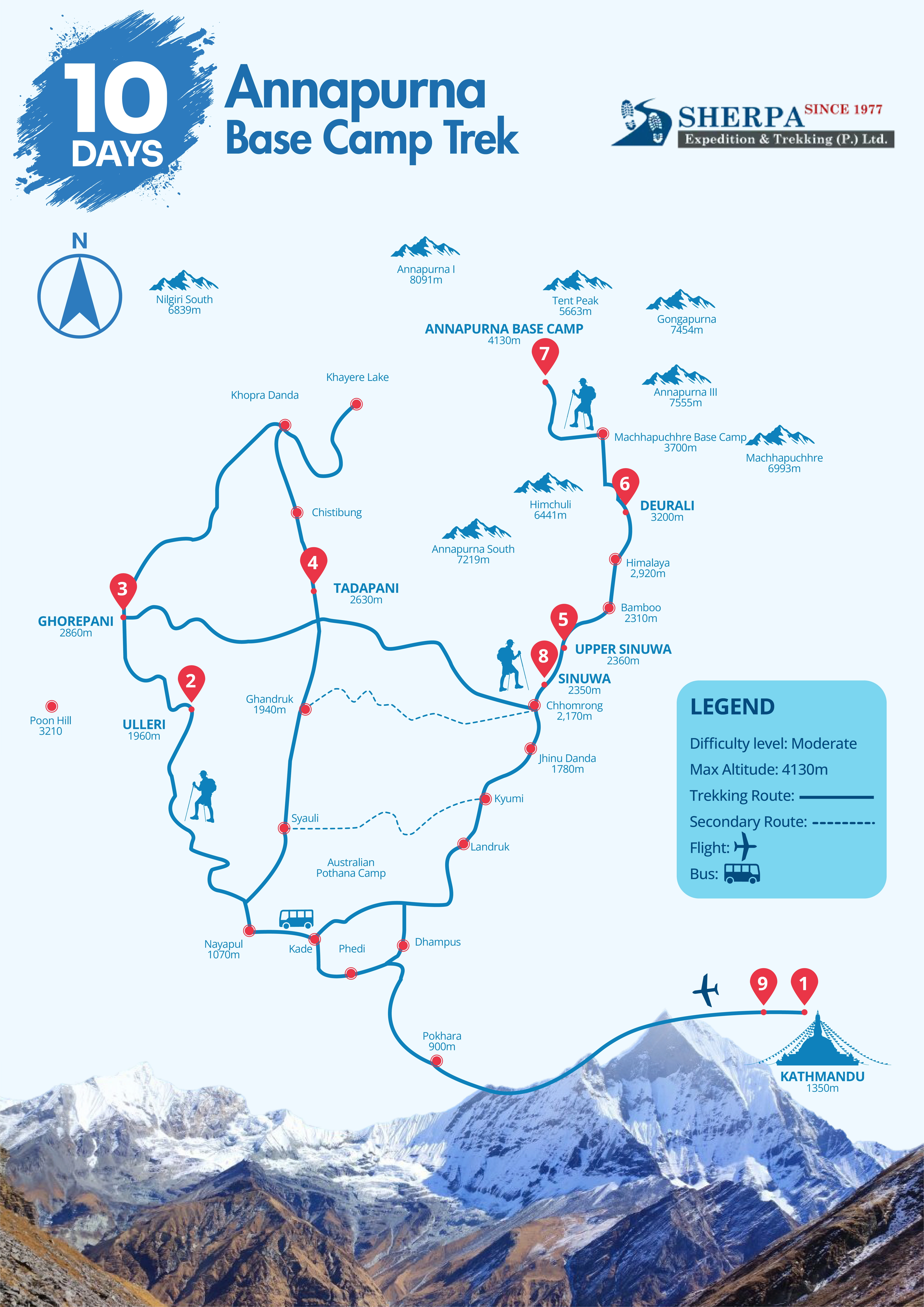
Annapurna Base Camp Trek Cost : All Hidden Cost
Annapurna Base Camp Trek Cost for Foreigners
If you are going to do this Annapurna Base Camp trek as a foreigner then you have to spend some USD amount on this trip which may vary according to your choice but normally for doing Annapurna base camp trek during a normal period (10 Days) including all services you have to pay around USD $700-$1,200.
Independent trekkers can find out their idea regarding how much amount of money they require to go on Annapurna base camp trek by this guide i.e USD$300-USD$600 excluding international flight & personal expense
Budget for ABC Trek in INR for Indians
If you're going on the treks through India then according to your requirement we can plan this entire package accordingly like accommodations, meal plan, permit charges, Transport cost & guides service etc. So, If you want to do this entire trekking tour then you have to invest at least 35,000-1,30,000 Rupees.
But, If you are a budget conscious traveler and want to spend your holidays on Annapurna Base Camp Trek independently i.e an independent trekker you might save your money up to 25,000 - 1,00,000 Rupees.
Annapurna Base Camp Trek Cost for Nepalese
For Nepali citizens, the Annapurna Base Camp Trek typically costs NPR 20,000–45,000, depending on transportation, accommodation, guide services, and trek duration. Since Nepali trekkers do not require foreign trekking permits, the overall cost is considerably lower than for international visitors.
Transportation Cost
The transportation costs generally vary between USD 40 – 500 based upon your choice of traveling. Tourist buses run between the capital (Kathmandu) & Pokhara are the cheapest option while you can take the domestic flight to enjoy more comfort at an extra price which will save your precious trekking time. Or even take a jeep for yourself.
Guided, Porter vs Independent Cost
Costs vary based on services selected during hiring:
- A licensed guide is typically hired at a rate of USD 30 - 40/day.
- You can hire porters to carry your load at a fee of USD 20 - 30/day.
Independent treks are cheaper than with a guide, who brings you more safely along the trail. Still, having one will make your journey worth every penny, as they provide safe travel, help navigate through areas, share their knowledge about locals, etc. For most trekkers, this added expense is well justified.
Food and Accommodation Cost
Accommodation in tea houses comes out to be about USD 5-15 for every night spent there. A meal would cost anywhere between USD 5-10 per dish. However, if you want to have your food at high altitudes then the prices increase. Most of the trekkers will be spending around USD 30-50 per day on food and lodging including other things which are not part of the trekking package itself.
Permits Cost
Annapurna Conservation Area Permit (ACAP) Cost: NPR 3,000 (approx. USD 22-25) for foreign nationals/SAARC national for
NPR 1,000 and free for Nepali citizens. Required to enter the Annapurna Conservation Area.
Trekkers’ Information Management System (TIMS): Is required for trekkers even if you use registered trekking agency along with a licensed guide in line with current Nepal trekking regulation. Previously Independent TIMS cards of green coloured ones used to be issued but now since solo trekking is not permitted and “blue" group TIMS cards are being issued.
Travel Insurance
Also, we would suggest getting a good comprehensive travel insurance covering all your needs during this trip. It costs about USD 50 to 150, according to your age / nationality / trip length / coverage.
It should include things like high altitude treks up to at least 4,500m, emergency medical treatment, trip cancellation & helicopter evacuation in Nepal, etc.
Emergency Evacuation Cost
The cost of the helicopter evacuation will depend upon various things. But in general, it can range between USD 3,000 - 6,000 depending on where you are located when they rescue you as well as other conditions such as the weather. Most trekkers don’t experience an emergency evacuation situation but its always better to check that your insurance covers “high altitude helicopter rescue” so that you won’t end up with huge unexpected bills.
Best Time to Trekking in Annapurna Base Camp
Whenever you are thinking of the best time to trek to Annapurna Base Camp, spring season and autumn should click your minds since, during these days the weather is amazing. Besides the full glamour of the mountains, these seasons render trekkers the finest condition on the trail, but each of them has got a magic of its own.
Spring (March to May)
Spring time is argued to be among the most favourite time for trekking at Annapurna Base Camp. In this period of the year, along with nice weather you can enjoy blooming rhododendron tree which creates beautiful view. Moreover during spring time there is high activity of wild life and nice days make your adventure more memorable.
Autumn (September to November)
Hence autumn season is one of the best times for trekking Annapurna Base Camp as this trek will organized during good weather right after the monsoon rains so that you can see all the views are beautiful and extraordinary. The trekking season falls at the end of September and continues through the month of october and into mid-november
Alternative Itinerary Lengths
- ABC Via Poon Hill
- South ABC Vs North ABC
ABC Via Poon Hill
The Poon Hill Trek adds the famous hike to the Poon Hill (3,210 m) in the trek itinerary which gives us an idea about how beautiful the Himalayas are. This addition extends your trek time by up to 9-14 days based on your speed. As you trek along with your guides to Ulleri and Ghorepani, you would be trekking downwards towards Tadapani and rejoin the usual hiking trail towards Chhomrong, MBC and ABC as your final destination. Besides this, the higher altitudes included in the treks this would provide trekkers an extra level of acclimatization and splendid views of mountains.
South ABC Vs North ABC
South route – This route covers the classic & established Annapurna sanctuary from Ghandruk to Chhomrong. It allows for more comfortable accommodation in the form of teahouses as well as provides chances for better acclimatization.
North route - This is a unique way of exploring the Annapurna range by going on an off-the-beaten-path camping adventure leading you towards another base camp approaching via the river Hum Khola. You do need mountain climbing skills but may have to take care of your own logistic needs since the area is too remote and not so developed as the south base camp. But you will be rewarded by the view of Annapurna's beautiful northern face.
Annapurna Base Camp Trek Map and Elevation
This Annapurna Base Camp Trek map gives you an idea about the route that you are going to follow during your Annapurna Base Camp Trek. It also depicts the different villages where you will be stopping throughout the course of this trek as well as all the points of elevation change which would help you plan for the best. And our map shows the trekkers about the starting point to endpoint of every section our Annapurna Base Camp Trekking tour. Our Annapurna base camp trekking tour 10 days begins from either Nayapul. Then we hike towards famous Ghandruk via Chhomrong and Sinuwa. Then we are heading towards Ghandruk through Chhomrong & Sinuwa. From here onwards we can go for Bamboo, Dovan, Himalaya, Deurali, Machapuchre Base Camp( 3,700m). Eventually we are going to end up at Annapurna Basecamp (4,130m). This map has all the details including daily distances covered, places for night halt etc. So using the above-mentioned details you can optimize your acclimatization..
Difficulty and Fitness Requirements for Annapurna Base Camp Trek
An important part of safely planning a Annapurna Base Camp Trek is also realizing the actual level of difficulty and and whether your body fitness level can take it or not.
Moderate Difficulty
So first I should tell you that this is one of the most popular moderate treks in Nepal which involves 5-7 hrs of walking every day. It has steep stone staircases as well with a gradual increase in altitude throughout the treks. But don’t worry there’s no technical skill needed here.
Daily Walking Duration
The amount of walking time can vary significantly from one trip to another but you should be prepared for approximately 5-7 hours per day.
On some days there are longer ascents or descents whereas summit days will require an early morning departure. With a comfortable walking pace & plenty of breaks this trip will suit most people who have good levels of general fitness.
Elevation Gain
The maximum altitude reached on this trek is 4130 meter/13550ft. At higher altitudes, there may be issues with your body adjusting to the lower concentrations of oxygen at these high elevations – i.e., “altitude sickness”. However, if you properly acclimate to the altitude, hydrate yourself and do not attempt to go up too fast, then chances are you’ll have an amazing experience.
Weather
The weather in Annapurna area changes very rapidly. Lower elevation areas tend to be warm but morning, evening and at high altitude places, temperatures go below freezing point. Spring & Autumn season of this region has more stable condition and Monsoon season has chances for rainfall. Also, during winters snowfall occurs at base camp area.
Fitness
Cardio Endurance
Good cardiovascular fitness will also help you out here as you’ll be walking for several hours everyday with the hike to higher elevation. Any activity that increases your stamina such as Hiking / Jogging / Cycling / Swimming / Stair Climbing should be done for 6-8 weeks prior to your trek. It’ll enhance your endurance & trekking experience.
Leg Strength and Stamina
Strong legs will be your friend if there’s anything from steep stone stairs to long descents on your itinerary. Some good workouts include squats, lunges, step-ups and hill walking.
By working up your stamina beforehand, you reduce the chances of getting muscle soreness while on the trek as well as helping you recover better after.
Hiking Experience
Do you have previous trekking experiences? Well, we suggest that if you’ve gone for treks before, then of course it would be great to take you through some challenging routes. But it’s completely optional. You know the Annapurna Base Camp Trail has some established trails and comfortable tea houses along its way. So beginners with decent physical fitness levels, proper preparations, and most importantly having an experienced guide will make sure they finish their trek safely.
Recovery Ability
Rapid recovery is necessary because you'll be doing nothing but walking all day every day. It is a necessary factor as you are literally walking the same trek day after day with hardly no break. Hydrating, a decent meal, deep sleep, steady stride will carry you through and make you look fresh the next day.
Annapurna Base Camp Trek Distance
Our Annapurna base camp trekking 10 days trek covers a total of 70 Kms Approx ( round trip). This starts at Nayapul going through Ulleri, Ghorepani, Tadapani, Upper Sinuwa, Deurali finally ending at Machhapuchhre base camp & Annapurna Camp (4130 m). Reverse of trek starting from Sinuwa to Jhinu danda then go to pokhara via motor, We will walk about 10-18 km/day according to your tour day/ Weather conditions of trekking Path
Safety and Altitude Considerations on Annapurna Sanctuary Trek
Traveling to high elevations requires careful preparation to prevent Acute Mountain Sickness (AMS), High-Altitude Pulmonary Edema (HAPE), and High-Altitude Cerebral Edema (HACE).
As the Annapurna Sanctuary trek climbs up to 4,130m the oxygen availability is lower thus increasing the possibility of trekkers to be affected if one climbs to high too fast. Here are the detailed explanation of Altitude sickness which are given below:
Mild Acute Mountain Sickness – Also called as AMS, this is the mildest one and commonly seen in people at higher altitudes.
High Altitude Pulmonary Edema – Known by HAPE, this disease arises due to the accumulation of fluids in the lungs. This could even threaten your life if not treated immediately.
High Altitude Cerebral Edema – The name suggests that this disease affects the cerebrum which results into its swelling. Thus immediate descend with medical treatments are required here otherwise you might face serious complications.
Symptoms of Altitude Sickness
This increase in height causes an increase in the altitude and decrease in the level of oxygen available for the human body which results in headaches, nausea, fatigue, dizziness, appetite loss, difficulty in sleeping, etc. These are usually felt when the people climb above an altitude of around 2500m. These should be known because if not treated may result into serious cases of altitude sickness.
Prevention and Management
Acclimatization Strategy
Try ascending gradually, allowing your body to adjust to being at higher altitudes. Also maintain your usual pace - don't try to reach an altitude too rapidly (especially above 3000m), and don't sleep at that height overnight. Follow the advice of your guide with regard to the optimal method of adjusting to the altitude.
Hydration
You need to consume about three to four liters of water daily. This will help your body adapt itself to this new environment as well as prevent you from getting dehydrated which may aggravate all symptoms related to altitude sickness.
Medication
Please always consult your doctor regarding the usage of this medicine to avoid Altitude Sickness.
Also make sure you bring all your prescription meds on board with you and report any symptom you feel during high altitude with your guide.
Diet
The body uses energy from food as the trekking can be lengthy, so eating carbohydrate snacks frequently during and in-between walks can be very beneficial, just as it is to reduce alcohol intake and smoking.
Pace Yourself
Go at a gentle pace, don’t overdo yourself, and have frequent stops. Maintaining a slow, unhurried pace helps conserve energy and breathing, allowing your body to adapt gradually as the oxygen levels drop.
Emergency Evacuation
Should any symptoms of HAPE or HACE appear or progress, descend at once and obtain medical help. Where it is required, your expedition leader will arrange an emergency helicopter extraction that will be paid for by your standard travel insurance, which is a policy designed to cover you with evacuation benefits at higher altitudes.
Gurung and Magar Culture on ABC Route
Gurung Culture (Tamu) and Magar Culture are the living heart of the Annapurna Trails. History of Annapurna region is many centuries old in villages such as, Ghandruk village and Chhomrong village. These village cultures maintain many different tradition that have not changed till now. For example, there are some exciting events to experience while visiting these places like Tamu Lhosar. You will also enjoy some interesting performances like Ghatu dance & Sorathi dance. It reflects their unique style of life and tradition here along with their Himalayan hospitality.
Accommodation on Annapurna Base Camp
Tea Houses and Lodges
All through this trek you will have the comfort of staying at tea houses as well as mountain lodges. They are usually run by families, providing basic yet clean accommodations, hearty food, cozy dining halls with fire places etc.
You can check out our article on what to wear during Annapurna base camp trek here. Facilities get simpler at high elevation areas, but these are perfect for overnight stays all throughout your trek.
Rooms
In most of these tea houses you’ll be able to get twin sharing room having two single beds and pillows, blankets, etc. In case you’re visiting places like Deurali, Machhapuchhre Base Camp, Annapurna Base Camp, where elevation is higher, there’s no choice but to share your room. Shared bathroom is a norm here, while some lower altitude village have attached bathroom facility too.
Food
Throughout this trek you will get many fresh home made food at each tea house that includes Dal Bhat (lentil and rice), vegetable / chicken soup, fried rice, noodles, pasta, momos, pancakes, eggs, porridge, potatoes, tea & coffee, and other simple Himalayan dish. Dal Bhat is the most popular food here in this trek as it provides nutritional value and you will get free refills of this.
Charging
Most tea houses offer mobile phone charging facilities which charge USD 2-4 for each device as well as cameras. Prices may go up if you're at high elevation since most of their electricity is derived through either solar or micro-hydro system.
Wi-Fi
There are Wi-Fi connections in most of the Tea Houses ranging from Chhomrong to Annapurna Base Camp. But there will be slower and unreliable internet connection as you reach to high altitude areas. You need to pay USD 2-5 for using internet in tea house, which depends on location and service providers.
Hot Shower
There’s no shortage of hot showers – they’re available at most tea houses (although they aren’t included in the price of your accommodation). You’ll probably need to shell out around USD 2-5 for one. While tea house accommodation usually offers gas-heated or even solar-heated showers, be aware that due to high usage (such as on treks) there are often times where hot water is not available depending on the season and area.
ABC Trekking VS Annapurna Circuit Trek
Annapurna circuit trek (a trek circuit around the Annapurna Massif) got confused with ABC Trek because ABC is an out and back trek that passes through the Annapurna Sanctuary. It’s a moderate length journey through verdant vegetation, villages and of course, great mountain views, without involving the difficult climb up any risky mountain pass. On this trek, we go through a variety of landscapes and have to navigate over the highest elevation pass in this area. You won’t find quite as much vegetation here as on the ABC Trek. Overall, the Annapurna Circuit Trek lasts for about 12-20 days and requires lots of your efforts and commitments.
Annapurna Base Camp Trek Vs Mt. Everest Base Camp Trekking
Feature | Annapurna Base Camp Trek | Mt. Everest Base Camp Trek |
| Maximum Elevation | 4,130 m | 5,364 m |
| Trek Duration | 7 to 12 days | 12 to 14 days |
| Cost | USD 500 to 1,200 | USD 1,200 to 2,000+ |
| Scenery | Rhododendron forests, waterfalls, villages, Annapurna Sanctuary | Glaciers, Khumbu Valley, moraines, Everest region |
| Crowds | Moderate | Heavy during peak seasons |
| Difficulty | Moderate | Moderate to Challenging |
| Accessibility | Drive and domestic flight via Pokhara | Flight to Lukla followed by trekking |
| Cultural Experience | Gurung and Magar communities | Sherpa culture, monasteries, Buddhist heritage |
| Mountain Views | Annapurna I, Machhapuchhre, Hiunchuli, Annapurna South, Gangapurna | Everest, Lhotse, Nuptse, Ama Dablam, Pumori |
Things to Know Before ABC Trek Nepal
Cancellation Terms
Your refund amount will depend upon the time before departure when you cancel your booking.
Time Before Departure | Cancellation Charge |
| More than 1 Year | 30% |
| 6 Months to 1 Year | 50% |
| 25 Days or More | 70% |
| 15 Days or More | 90% |
| Less Than 7 Days | No Refund |
Kids Guidelines
The Annapurna Base Camp Trek may be suitable for children if you have physically fit kids who will accompany you.
To make your child’s journey more interesting, consider slowing down your pace of walking while ensuring proper acclimatization, having an expert guide along with them, and also being ready to alter their itinerary accordingly as necessary.
Documentation
Make sure you carry all documents such as valid passport, Nepal Tourist Visa, travel insurance that covers high altitude trekking activities, and all required trekking permits such as Annapurna Conservation Area Permit (ACAP), if trekking with registered agency these things will be managed by them.
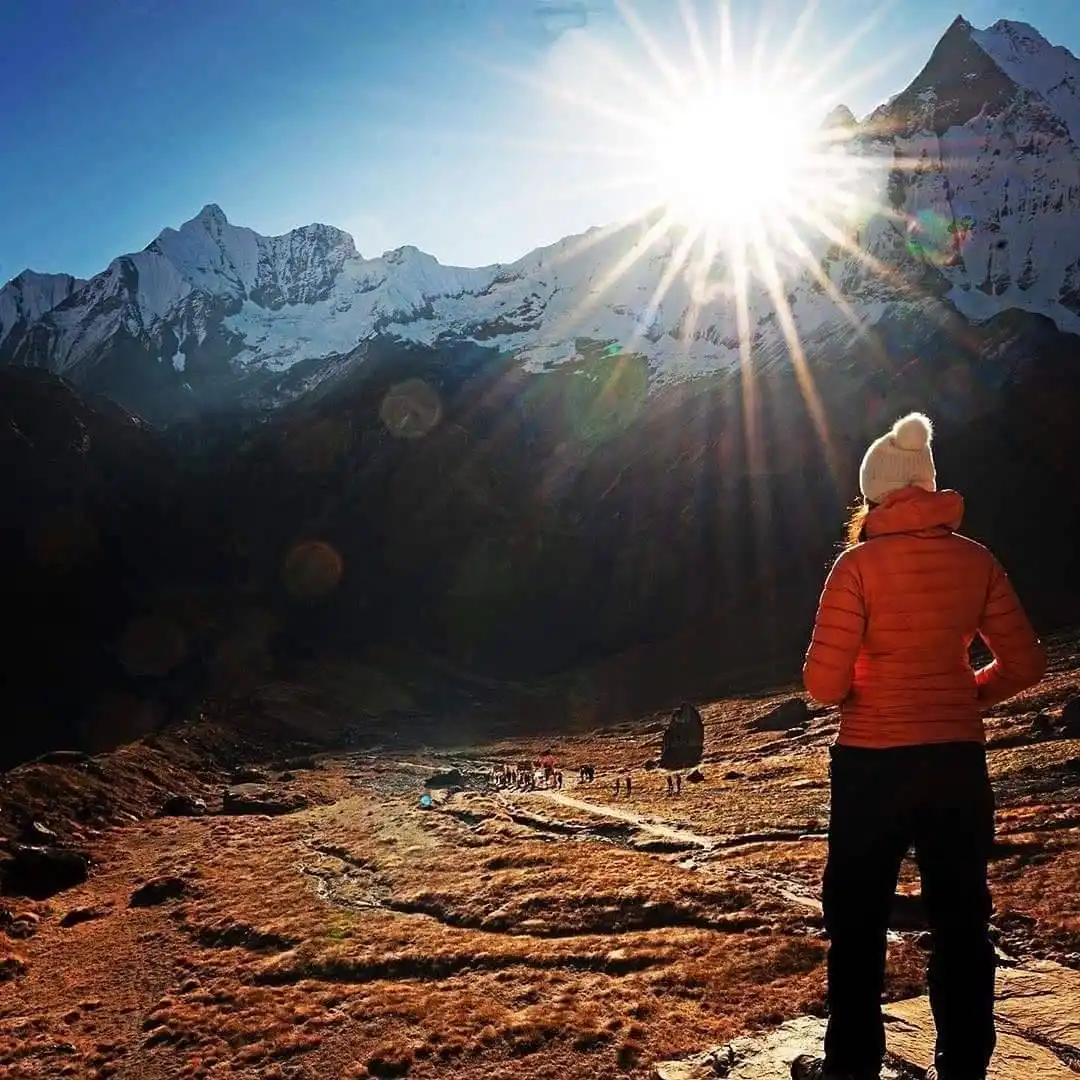
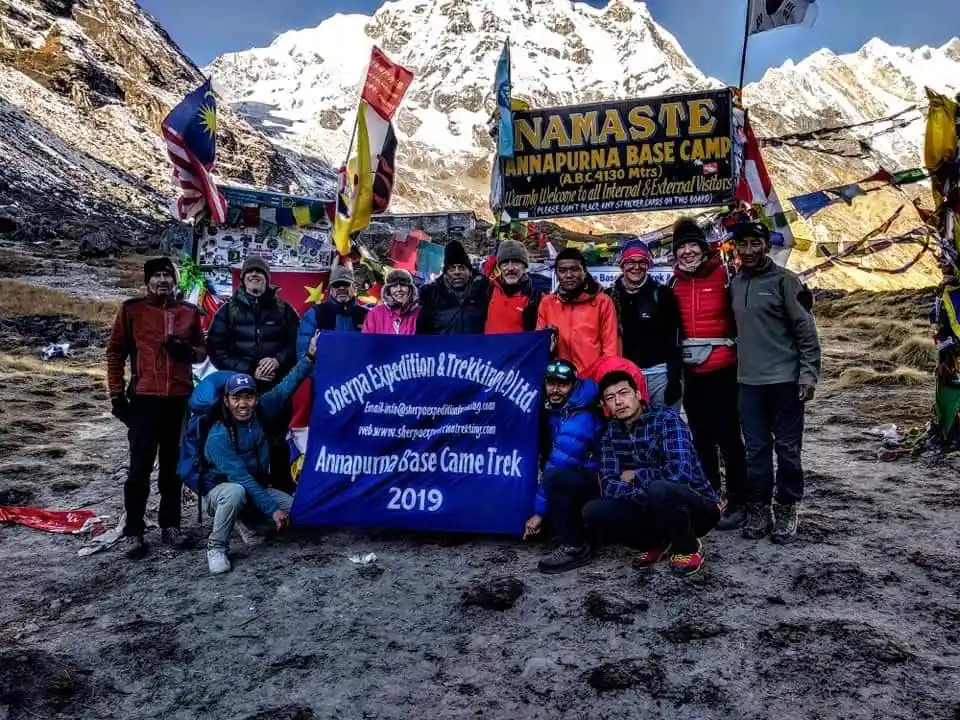
Gallery of Annapurna Base Camp Trek

FAQS Related to Annapurna Base Camp Trek
General Information
It is often easier to go via Ghandruk, as it has a more gradual path, passing by lovely villages. Nayapul is the most common departure point, though you can save some time off the route if you start by Kimche, which is a more abrupt approach.
The Modi khola runs through Annapurna Sanctuary to reach its base camp at the end. Mostly trekkers will have their way along this beautiful river flowing through this area with many small bridges.
Yes trekkers can visit glaciers and stony glacial moraines in vicinity of Annapurna Base Camp & Machhapuchhre Base Camp . These cold lands are quite a sensational sight for us who reach at such high sanctuary.
These icy sights of glacier is one of most breathtaking parts of summit of High Sanctuary. If you trek on this route then you will see the Machhapuchhre, Annapurna South, Hiunchuli and Gangapurna which shapes a huge wall round the base camp.
Preparation and Fitness
You don't need super athletic conditioning, you just need a decent level of fitness because you will be walking five to seven hours almost every day. Getting some regular exercise prior to trip will certainly help out, even if you're no olympiad.
Aim to work yourself up to walking for two to three hours at a time a few times per week. This way, you give your legs and lungs a chance to get in condition for the long walking days on your trek.
Practice walking these steps, as: 1. Increase your distance walking to 2–3 hours a few times a week. Your lungs and legs will thank you and they will start training you for a day on the trail.
Strengthen your legs with squats, lunges and stair climbing- just doing them a few times a week a few weeks prior to your trip will greatly improve the difference you notice during the walk.
Health and Safety
Your guide will put a small device called a pulse oximeter on your finger twice daily to monitor your oxygen and heart rate and to catch early symptoms before they become serious altitude illness.
Tell your guide if you are getting headaches, feeling lightheaded or sick. The best treatment for these problems is not to climb higher up anymore – go back down to the lower altitude if needed.
Although there are some village health posts available for superficial illnesses, it is important to have your medical insurance readily available on the trail for anything more serious. Guides carry first aid equipment and will organise an emergency helicopter evacuation for critical situations.
Due to the slippery nature of this trail which may also be obscured by heavy snows, waiting on it while accompanied by your guide is advised. Experienced guides know when to sit down or change course.
Permits
ACAP Permit – You may obtain an ACAP Permit either at Kathmandu or Pokhara in the official Nepal tourism board office. Most trekking companies will sort out all your permits before starting your trip to save time from running around with papers.
You'll need them. Both of these are verified at various points on your trekking journey and TIMS will be of blue colour.
There will be 2-3 main checkpoints where you will have to show your permits. These include ones near Birethanti (and others for those entering the Annapurna conservation area). At these checkpoints officials will verify that your ACAP and TIMS cards are valid.
Make sure you tell your guide straight away; this way, they can help you report it and get a replacement. Take pictures of your permits as a backup; then store these pictures onto your phone.
Insurance and Visa
We require this insurance for safety reasons as well, since trekkers reach high altitudes and emergencies might arise on the trip. Additionally, having travel insurance ensures that you are covered from a financial point of view if an emergency happens while you're on your adventure (like needing to be rescued by helicopter).
Ensure your insurance covers you for high altitude treks (up to at least 4,200 meters) including emergency helicopter evacuations, medical treatment & trip cancellation if needed.
Answer is YES.. In just few steps you'll be able to process this. Just fill up the form, pay appropriate fee and your visa will be stamped on arrival.
Nepal Tourist Visa cost – it is $30 USD for 15 days, $50 USD for 30 days & $125 USD for 90 days. . You have to pay this on arrival by cash or card.
Guides and Support
Of course he'll do that for you. Your trekking guide/company will also take care of getting both the ACAP Permit & TIMS Card arranged on your behalf saving yourself from having to sort this out.
Having local guide is best part of trekking. He would monitor your oxygen & hear rate every time using pulse oximeter twice a day while ascending at high altitude.
We ensure all our trekking guides are well-trained in first-aid and handle any emergencies for mountains-related problems with a team of professional treks guide. We always take care of rescue help to arrange immediately for our clients if something wrong happens to you while trekking.
Each trekker's one porter carries around total of 15-20 kgs luggage divide into two trekkers, which makes easier for you to carry less bag during your trekking adventure.
Accommodation
Tea Houses are small guest houses which typically provide very basic accommodation consisting of a room, bed, and common areas for dining. As you climb the quality tends to go down, particularly close to Annapurna Base Camp (ABC).
The majority will offer fairly basic, if clean, shared bathrooms – sometimes with squat toilets, although they may also be equipped with western-style toilets depending on location. Most will provide hot showers, though this tends to come at an additional charge.
There is plenty of opportunity to try local Nepali cuisine at tea houses – including Dal Bhat, Noodles and Soups – alongside some international options such as Pasta & Pancakes. You can enjoy breakfast, lunch & dinner wherever you choose to stop overnight.
While most tea houses will have blankets available for you, temperatures do drop considerably at night - particularly if you're staying high up. It's worth bringing (or renting) yourself a nice, warm sleeping bag to keep your body temperature stable at night.
RELATED PACKAGES


Latest Traveller’s Reviews
Travel experiences of our clients who recently returned from their trips.
100%
Based On 83 Reviews
Emily Zhao
Singapore
May 28, 2025
Professional Trek, Heartfelt Memories – Led by Tshering
Laura Petrovic
Canada
May 13, 2025
Absolutely Magical Trek with Guide Dendi
Mia Jensen
Denmark
April 7, 2025
Well-Planned Trek with Expert Guide Gyalzen

Write Your Review
Average Customer Ratings
How The Travellers Have Rated This Package
82
1
0
0
0


